


Prevalence and patterns of tobacco smoking among Chinese adult men and women: findings of the 2010 national smoking survey
- PMID: 27660401
- PMCID: PMC5284482
- DOI: 10.1136/jech-2016-207805
Prevalence and patterns of tobacco smoking among Chinese adult men and women: findings of the 2010 national smoking survey
Abstract
Background: China consumes about 40% of the world's cigarettes, predominantly by men, following a large increase in recent decades. We assess sex-specific prevalence and changing patterns of smoking in Chinese adults in the current decade.
Methods: A nationally representative survey of smoking was conducted in 2010 among 100 000 Chinese adults aged ≥18 years, using a multistage stratified cluster sampling method. Information on smoking frequency, type, amount, age started and quitting was collected. Sex-specific standardised prevalence and means were analysed and compared with estimates in the 1996 national survey.
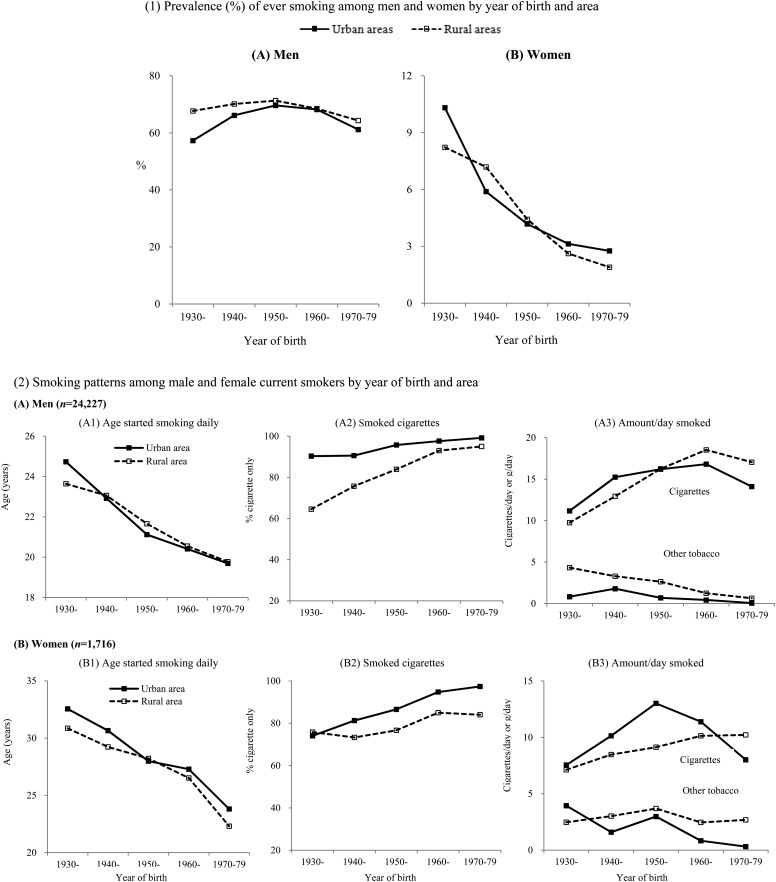
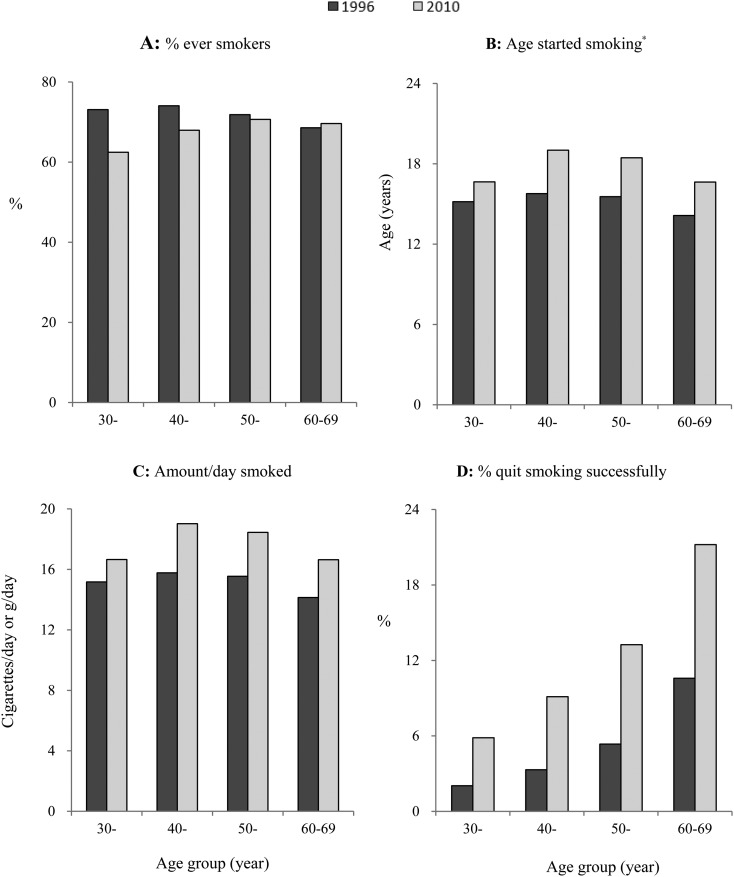
Results: In Chinese men aged ≥18, 62.4% were ever-smokers in 2010, including 54.0% current smokers and 8.4% ex-smokers. The smoking prevalence was higher in rural than in urban men (63.9% vs 58.4%). In younger men, the age to start smoking was earlier and exclusive cigarette use was much higher. Among current smokers, only 17.3% intended to quit. Compared with a similar survey in 1996 among adults aged 30-69, more smokers had quit in 2010 than in 1996 (11.0% vs 4.2%), but the number of cigarettes smoked per current smoker was higher (17.9 vs 15.2). In Chinese women, only 3.4% ever smoked and there has been a large intergenerational decrease in smoking uptake rates. In 2010, there were 318 million current smokers in China, consuming an estimated 1740 billion cigarettes.
Conclusions: The prevalence of smoking remained extremely high in men, but low and falling in Chinese women. Tobacco smoking remains an important public health issue in China, and stronger and more efficient tobacco control is urgently needed.
Keywords: EPIDEMICS; SMOKING; SURVEILLANCE; Tobacco.
Published by the BMJ Publishing Group Limited. For permission to use (where not already granted under a licence) please go to http://www.bmj.com/company/products-services/rights-and-licensing/.
Conflict of interest statement
Conflicts of Interest: None declared.
Figures
Comment in
-
Commentary on Liu et al, 'Prevalence and patterns of tobacco smoking among Chinese adult men and women: findings of 2010 national smoking survey'.J Epidemiol Community Health. 2017 Feb;71(2):107-108. doi: 10.1136/jech-2016-208177. Epub 2016 Oct 17. J Epidemiol Community Health. 2017. PMID: 27754858 No abstract available.
References
-
- U.S. Department of Health and Human Services. The health consequences of smoking-50 years of progress: a report of the surgeon general. Atlanta, GA: U.S. Department of Health and Human Services, Centers for Disease Control and Prevention, National Center for Chronic Disease Prevention and Health Promotion, Office on Smoking and Health, 2014.
-
- World Health Organization. Tobacco in China. http://www.wpro.who.int/china/mediacentre/factsheets/tobacco/en/ (accessed 26 May 2015).
-
- Yang G, Fan L, Tan J, et al. Smoking in China: findings of the 1996 National Prevalence Survey. JAMA 1999;282:1247–53. - PubMed
Publication types
MeSH terms
Grants and funding
LinkOut - more resources
Full Text Sources
Other Literature Sources
