


Next-generation EGFR/HER tyrosine kinase inhibitors for the treatment of patients with non-small-cell lung cancer harboring EGFR mutations: a review of the evidence
- PMID: 27660463
- PMCID: PMC5021053
- DOI: 10.2147/OTT.S94745
Next-generation EGFR/HER tyrosine kinase inhibitors for the treatment of patients with non-small-cell lung cancer harboring EGFR mutations: a review of the evidence
Abstract
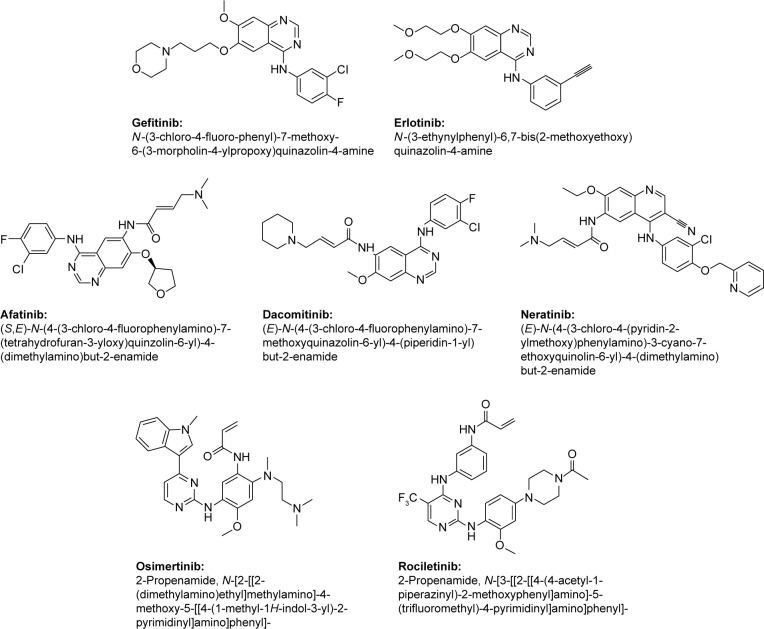
Tyrosine kinase inhibitors (TKIs) against human epidermal growth factor receptor (EGFR/HER) family have been introduced into the clinic to treat cancers, particularly non-small-cell lung cancer (NSCLC). There have been three generations of the EGFR/HER-TKIs. First-generation EGFR/HER-TKIs, binding competitively and reversibly to the ATP-binding site of the EGFR TK domain, show a significant breakthrough treatment in selected NSCLC patients with activating EGFR mutations (actEGFRm) EGFR (L858R) and EGFR (Del19), in terms of safety, efficacy, and quality of life. However, all those responders inevitably develop acquired resistance within 12 months, because of the EGFR (T790M) mutation, which prevents TKI binding to ATP-pocket of EGFR by steric hindrance. The second-generation EGFR/HER-TKIs were developed to prolong and maintain more potent response as well as overcome the resistance to the first-generation EGFR/HER-TKIs. They are different from the first-generation EGFR/HER-TKIs by covalently binding to the ATP-binding site, irreversibly blocking enzymatic activation, and targeting EGFR/HER family members, including EGFR, HER2, and HER4. Preclinically, these compounds inhibit the enzymatic activation for actEGFRm, EGFR (T790M), and wtEGFR. The second-generation EGFR/HER-TKIs improve overall survival in cancer patients with actEGFRm in a modest way. However, they are not clinically active in overcoming EGFR (T790M) resistance, mainly because of dose-limiting toxicity due to simultaneous inhibition against wtEGFR. The third-generation EGFR/HER-TKIs selectively and irreversibly target EGFR (T790M) and actEGFRm while sparing wtEGFR. They yield promising efficacy in NSCLC patients with actEGFRm as well as EGFR (T790M) resistant to the first- and second-generation EGFR-TKIs. They also appear to have a lower incidence of toxicity due to the reduced inhibitory effect on wtEGFR. Currently, the first-generation EGFR/HER-TKIs gefitinib and erlotinib and second-generation EGFR/HER-TKI afatinib have been approved for use as the first-line treatment of metastatic NSCLC with actEGFRm. This review will summarize and evaluate a broad range of evidence of recent development of EGFR/HER-TKIs, with a focus on the second- and third-generation EGFR/HER-TKIs, in the treatment of patients with NSCLC harboring EGFR mutations.
Keywords: EGFR mutations; EGFR/HER; NSCLC; acquired resistance; tyrosine kinase inhibitors.
Figures
References
-
- Siegel R, Ma J, Zou Z, Jemal A. Cancer statistics, 2014. CA Cancer J Clin. 2014;64(1):9–29. - PubMed
-
- American Cancer Society [webpage on the Internet] American Cancer Society. American Cancer Society: American Cancer Society; [Accessed April 29, 2016]. Cancer Facts and Figures 2016. Available from: http://www.cancer.gov/types/lung/hp/non-small-cell-lung-treatment-pdq#ci....
-
- Reck M, Popat S, Reinmuth N, De Ruysscher D, Kerr KM, Peters S. Metastatic non-small-cell lung cancer (NSCLC): ESMO clinical practice guidelines for diagnosis, treatment and follow-up. Ann Oncol. 2014;25(suppl 3):iii27–iii39. - PubMed
-
- Collins LG, Haines C, Perkel R, Enck RE. Lung cancer: diagnosis and management. Am Fam Physician. 2007;75(1):56–63. - PubMed
Publication types
LinkOut - more resources
Full Text Sources
Other Literature Sources
Research Materials
Miscellaneous
