


The effectiveness of dry-cupping in preventing post-operative nausea and vomiting by P6 acupoint stimulation: A randomized controlled trial
- PMID: 27661022
- PMCID: PMC5044892
- DOI: 10.1097/MD.0000000000004770
The effectiveness of dry-cupping in preventing post-operative nausea and vomiting by P6 acupoint stimulation: A randomized controlled trial
Abstract
Background: Postoperative nausea and vomiting (PONV) is a common complication after general anesthesia, and the prevalence ranges between 25% and 30%. The aim of this study was to determine the preventive effects of dry cupping on PONV by stimulating point P6 in the wrist.
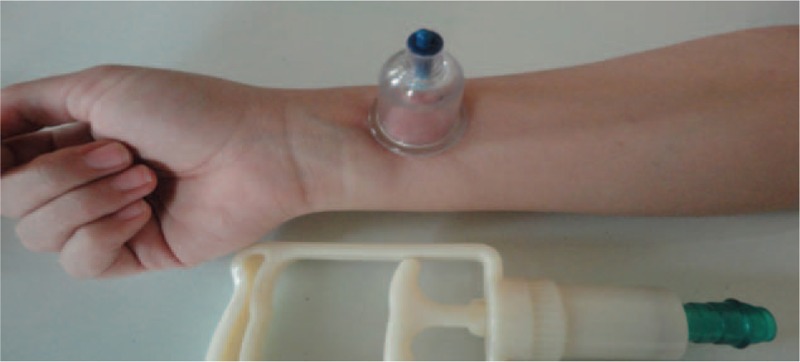
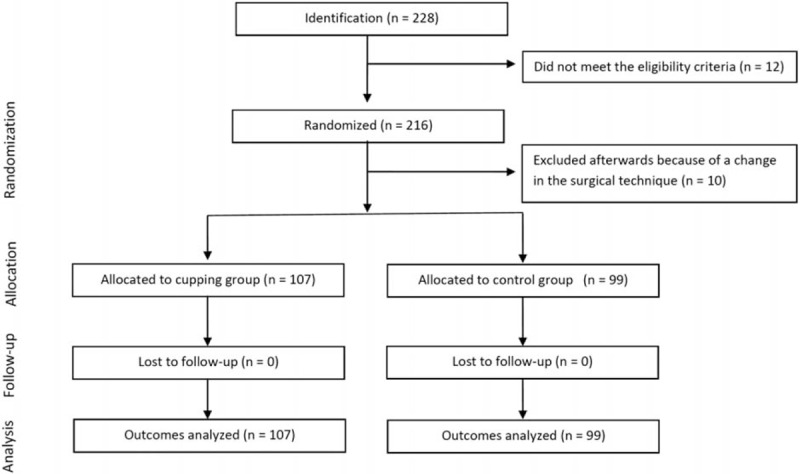
Methods: This was a randomized controlled trial conducted at the Imam Reza Hospital in Kermanshah, Iran. The final study sample included 206 patients (107 experimental and 99 controls). Inclusion criteria included the following: female sex; age>18 years; ASA Class I-II; type of surgery: laparoscopic cholecystectomy; type of anesthesia: general anesthesia. Exclusion criteria included: change in the type of surgery, that is, from laparoscopic cholecystectomy to laparotomy, and ASA-classification III or more. Interventions are as follows: pre surgery, before the induction of anesthesia, the experimental group received dry cupping on point P6 of the dominant hand's wrist with activation of intermittent negative pressure. The sham group received cupping without activation of negative pressure at the same point. Main outcome was that the visual analogue scale was used to measure the severity of PONV.
Results: The experimental group who received dry cupping had significantly lower levels of PONV severity after surgery (P < 0.001) than the control group. The differences in measure were maintained after controlling for age and ASA in regression models (P < 0.01).
Conclusion: Traditional dry cupping delivered in an operation room setting prevented PONV in laparoscopic cholecystectomy patients.
Conflict of interest statement
The authors have no conflicts of interest to report.
Figures
References
-
- Apfel CC, Roewer N, Korttila K. How to study postoperative nausea and vomiting. Acta Anaesthesiol Scand 2002; 46:921–928. - PubMed
-
- Apfel CC, Kranke P, Eberhart LH, et al. Comparison of predictive models for postoperative nausea and vomiting. Br J Anaesth 2002; 88:234–240. - PubMed
-
- Smith HS, Smith EJ, Smith BR. Postoperative nausea and vomiting. Ann Palliat Med 2012; 1:94–102. - PubMed
-
- Youssef N, Orlov D, Alie T, et al. What epidural opioid results in the best analgesia outcomes and fewest side effects after surgery?: a meta-analysis of randomized controlled trials. Anesth Analg 2014; 119:965–977. - PubMed
Publication types
MeSH terms
LinkOut - more resources
Full Text Sources
Other Literature Sources
Medical
Research Materials
