


Relationship between homocysteine and intraocular pressure in men and women: A population-based study
- PMID: 27661027
- PMCID: PMC5044897
- DOI: 10.1097/MD.0000000000004858
Relationship between homocysteine and intraocular pressure in men and women: A population-based study
Abstract
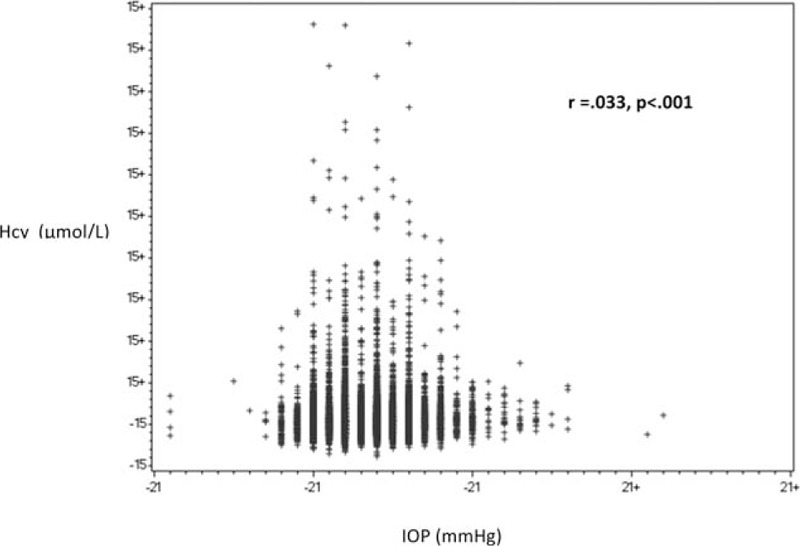
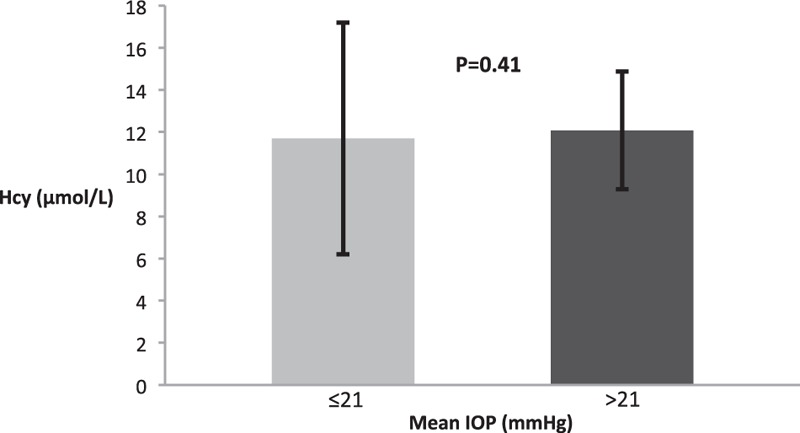
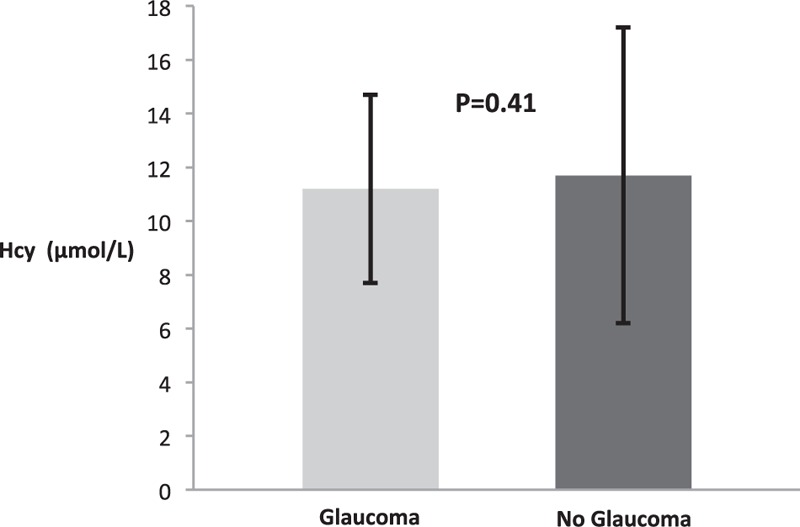
The relationship between homocysteine levels and glaucoma has been questioned in previous studies without conclusive results. In the current study, we assessed the relationship between homocysteine levels and intraocular pressure which is one of the main factors in the development of glaucoma in men and women.A retrospective cross-sectional analysis of a database from a screening center in Israel which assessed 11,850 subjects, within an age range 20 to 80 years. The relationship between homocysteine and intraocular pressure has been investigated by comparing intraocular pressure in subjects with elevated and normal homocysteine and by comparing homocysteine levels in subjects with elevated and normal intraocular pressure. In addition, we compared the levels of homocysteine in subjects with and without a confirmed diagnosis of glaucoma.The mean IOP (±SD) in subjects with normal homocysteine levels(≤15 μmol/L) was 13.2 ± 2.3 mm Hg and 13.4 ± 2.4 mm Hg in those with high homocysteine levels (>15 μmol/L) (P < 0.008, 95% confidence interval [CI] 0.3-0.09).Nonetheless, after multivariate adjustment for age, gender, vitamin B12, and folic acid statistical significance was no longer demonstrated (P = 0.37). Mean homocysteine levels (±SD) in subjects with normal intraocular pressure of ≤ 21 mm Hg was 11.7 ± 5.5 μmol/L and 12.09 ± 3.43 μmol/L in those with elevated intraocular pressure (P = 0.4, 95%CI 1.1-1.8). Mean homocysteine levels (±SD) in subjects with glaucoma were 11.2 ± 3.5 μmol/L compared to 11.7 ± 5.5 μmol/L in subjects without glaucoma and normal intraocular pressure ≤ 21 mm Hg (P = 0.4, 95% CI 1.2-2.1).The current study displays no clinical correlation between the homocysteine level and the intraocular pressure. Homocysteine may not be used as a predictive parameter to recognize those subjects prone to develop elevated intraocular pressure.
Conflict of interest statement
The authors have no funding and conflicts of interest to disclose.
Figures
References
-
- Colin CPF. Epidemiology of glaucoma: what's new? Can J Ophthalmol 2012; 47:223–226. - PubMed
-
- Yih-Chung TXL, Tien YW, Harry A, et al. Global prevalence of glaucoma and projections of glaucoma burden through 2040: a systematic review and meta-analysis. Ophthalmology 2014; 121:2081–2090. - PubMed
-
- Alfred SJM, Joanne K. Racial differences in the cause-specific prevalence of blindness in east Baltimore. NEJM 1991; 325:1412–1417. - PubMed
MeSH terms
Substances
LinkOut - more resources
Full Text Sources
Other Literature Sources
Medical
