


Long-term body composition changes in antiretroviral-treated HIV-infected individuals
- PMID: 27662545
- PMCID: PMC5101158
- DOI: 10.1097/QAD.0000000000001248
Long-term body composition changes in antiretroviral-treated HIV-infected individuals
Abstract
Objective: Body composition impacts physical function and mortality. We compared long-term body composition changes after antiretroviral therapy (ART) initiation in HIV-infected individuals to that in HIV-uninfected controls.
Design: Prospective observational study.
Methods: We performed dual-energy x-ray absorptiometry (DXA) approximately 7.5 years after initial DXA in available HIV-infected individuals who received DXAs during the randomized treatment trial AIDS Clinical Trials Group A5202. For controls, we used DXA results from HIV-uninfected participants in the Boston Area Community Health/Bone and Women's Interagency HIV Study cohorts. Repeated measures analyses compared adjusted body composition changes between HIV-infected and HIV-uninfected individuals. Multivariable analyses evaluated factors associated with body composition change in HIV-infected individuals.
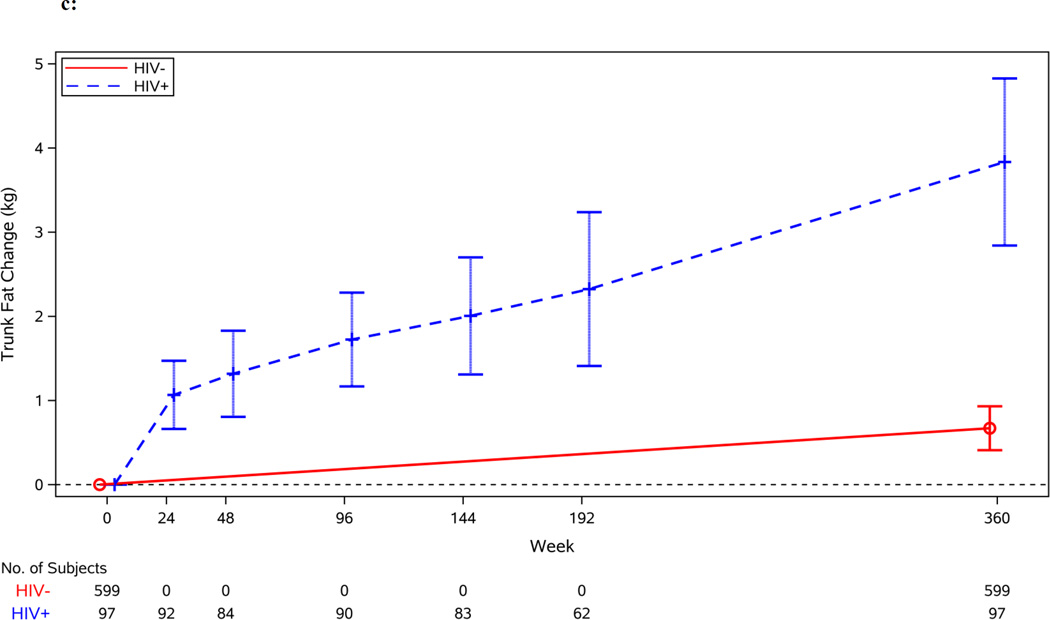
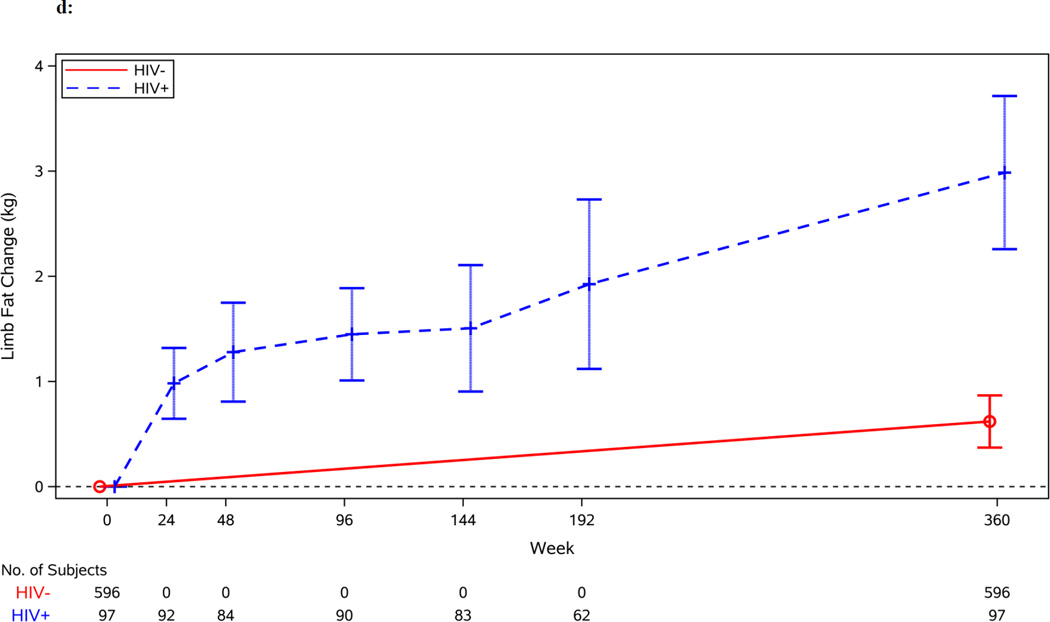
Results: We obtained DXA results in 97 HIV-infected and 614 HIV-uninfected participants. Compared with controls, HIV-infected individuals had greater adjusted lean mass and total, trunk, and limb fat gain during the first 96 weeks of ART. Subsequently, HIV-infected individuals lost lean mass compared with controls. Total, trunk, and limb fat gains after 96 weeks of ART slowed in HIV-infected individuals but remained greater than in controls. Lower CD4 T-cell count was associated with lean mass and fat gain during the initial 96 weeks of ART, but subsequently no HIV-related characteristic was associated with body composition change.
Conclusion: Consistent with a 'return to health effect', HIV-infected individuals, especially those with lower baseline CD4 T-cell counts, gained more lean mass and fat during the first 96 weeks of ART than HIV-uninfected individuals. Continued fat gain and lean mass loss after 96 weeks may predispose HIV-infected individuals to obesity-related diseases and physical function impairment.
Conflict of interest statement
POTENTIAL CONFLICT OF INTERESTS D.K and B.B. have no relevant disclosures.
Figures


References
-
- Kooij KW, Wit FW, Schouten J, van der Valk M, Godfried MH, Stolte IG, et al. HIV infection is independently associated with frailty in middle-aged HIV type 1-infected individuals compared with similar but uninfected controls. AIDS. 2016;30:241–250. - PubMed
-
- Desquilbet L, Jacobson LP, Fried LP, Phair JP, Jamieson BD, Holloway M, et al. HIV-1 infection is associated with an earlier occurrence of a phenotype related to frailty. J Gerontol A Biol Sci Med Sci. 2007;62:1279–1286. - PubMed
Publication types
MeSH terms
Substances
Grants and funding
- UM1 AI069494/AI/NIAID NIH HHS/United States
- UL1 TR001079/TR/NCATS NIH HHS/United States
- U01 AI035004/AI/NIAID NIH HHS/United States
- K23 AG050260/AG/NIA NIH HHS/United States
- K24 AI120834/AI/NIAID NIH HHS/United States
- UM1 AI068634/AI/NIAID NIH HHS/United States
- UM1 AI069481/AI/NIAID NIH HHS/United States
- U01 AI068636/AI/NIAID NIH HHS/United States
- K23 AI110532/AI/NIAID NIH HHS/United States
- R01 AG020727/AG/NIA NIH HHS/United States
- K23 AI108358/AI/NIAID NIH HHS/United States
- UM1 AI068636/AI/NIAID NIH HHS/United States
- U01 AI042590/AI/NIAID NIH HHS/United States
LinkOut - more resources
Full Text Sources
Other Literature Sources
Medical
Research Materials
