


Editorial
doi: 10.1016/j.jaci.2016.09.001.
Epub 2016 Sep 21.
Linking impaired skin barrier function to esophageal allergic inflammation via IL-33
Affiliations
- PMID: 27664378
- PMCID: PMC5335915
- DOI: 10.1016/j.jaci.2016.09.001
Item in Clipboard
Editorial
Linking impaired skin barrier function to esophageal allergic inflammation via IL-33
J Allergy Clin Immunol.
2016 Nov.
No abstract available
Keywords: Cytokines; barrier function; basophils; eosinophils; food allergy; innate Immunity.
Conflict of interest statement
Disclosure of potential conflict of interest: M. E. Rothenberg receives grant support from the National Institutes of Health; consulting fees from Receptos Immune Pharmaceuticals, NKT Therapeutics, and PulmOne Therapeutics; patents with Miraca Life Science; royalties from Teva Pharmaceuticals; and stock options from PulmOne, NKT Therapeutics, and Immune Pharmaceuticals. The rest of the authors declare that they have no relevant conflicts of interest.
Figures
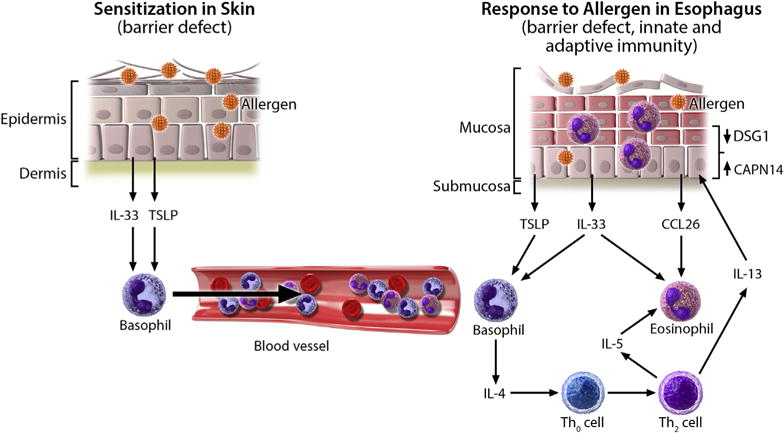
Proposed model for the development of allergic inflammation in patients with EoE.
Impaired skin barrier integrity, such as that caused by injury or
FLG mutations, allows for increased allergen penetration
through the epithelium, causing allergic sensitization and release of IL-33 and
TSLP from the epithelium. Secondary to activation by these cytokines, there is
increased trafficking of basophils through the bloodstream to the esophagus.
Later, direct exposure of allergens to the esophageal epithelium leads to the
release of TSLP and IL-33, which induce IL-4 production from basophils and
subsequent release of IL-5 and IL-13 from TH2 cells. IL-13 causes
esophageal epithelial barrier impairment and increased allergen exposure by
decreasing desmoglein 1 (DSG1) and increasing calpain 14
(CAPN14) expression. Additionally, IL-13 induces CCL26
production from the epithelium, which, in combination with IL-5, causes
eosinophil infiltration into the esophagus.
Comment on
-
Allergic skin sensitization promotes eosinophilic esophagitis through the IL-33-basophil axis in mice.J Allergy Clin Immunol. 2016 Nov;138(5):1367-1380.e5. doi: 10.1016/j.jaci.2016.02.034. Epub 2016 Apr 19. J Allergy Clin Immunol. 2016. PMID: 27233150
References
-
- Blanchard C, Mingler MK, Vicario M, Abonia JP, Wu YY, Lu TX, et al. IL-13 involvement in eosinophilic esophagitis: transcriptome analysis and reversibility with glucocorticoids. J Allergy Clin Immunol. 2007;120:1292–300. - PubMed
Publication types
MeSH terms
Substances
Grants and funding
LinkOut - more resources
Full Text Sources
Other Literature Sources
