. 2016 Sep 26:6:33711.
doi: 10.1038/srep33711.

Coffee and cancer risk: A meta-analysis of prospective observational studies

Affiliations

Coffee and cancer risk: A meta-analysis of prospective observational studies

Anqiang Wang et al. Sci Rep. .

Abstract

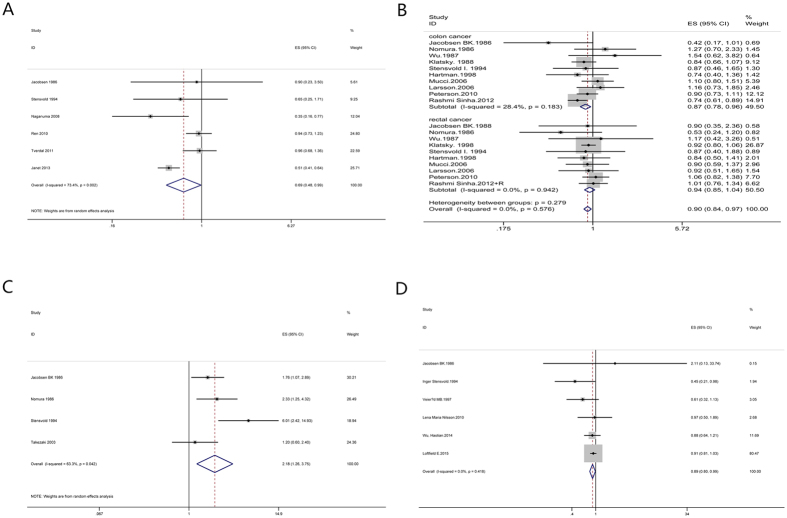
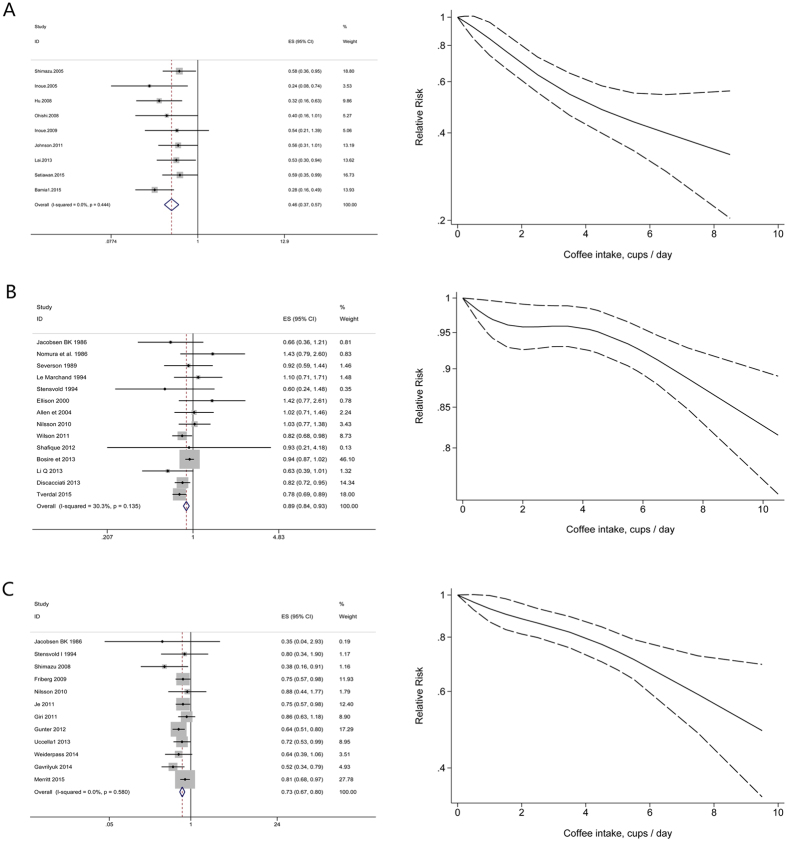
Meta-analyses on coffee and cancer incidence mainly restricted to limited cancers. We carried out a more comprehensive meta-analysis of cohort studies to explore association between coffee and most cancer types. We conducted comprehensive search and summarized relative risk (RR) and 95% confidence intervals for the highest versus lowest coffee intake and cancer using STATA12. We conducted dose-analysis if result suggested significant association. The publication bias was evaluated with begg's and egger's test. Finally, 105 individual prospective studies were included. Inverse associations were observed on oral, pharyngeal, colon, liver, prostate, endometrial cancer and melanoma, with RR 0.69 (95% CI = 0.48-0.99, I2 = 73.4%, P = 0.044), 0.87 (95% CI = 0.78-0.96, I2 = 28.4%, P = 0.007), 0.46 (95% CI = 0.37-0.57, I2 = 0%, P = 0), 0.89 (95% CI = 0.84-0.93, I2 = 30.3%, P = 0.003), 0.73 (95% CI = 0.67-0.80, I2 = 0%, P = 0) and 0.89 (95% CI = 0.80-0.99, I2 = 0%, P = 0.031) respectively. However, the relative risk for lung cancer is 2.18 (95% CI = 1.26-3.75, I2 = 63.3%, P = 0.005). The summary relative risk for increment of 2 cups of coffee were RR = 0.73, 95% CI = 0.67-0.79 for liver cancer, RR = 0.97, 95% CI = 0.96-0.98 for prostate cancer and RR = 0.88, 95% CI = 0.85-0.92 for endometrial cancer. Accordingly, coffee intake was associated with reduced risk of oral, pharynx, liver, colon, prostate, endometrial cancer and melanoma and increased lung cancer risk.


Figures
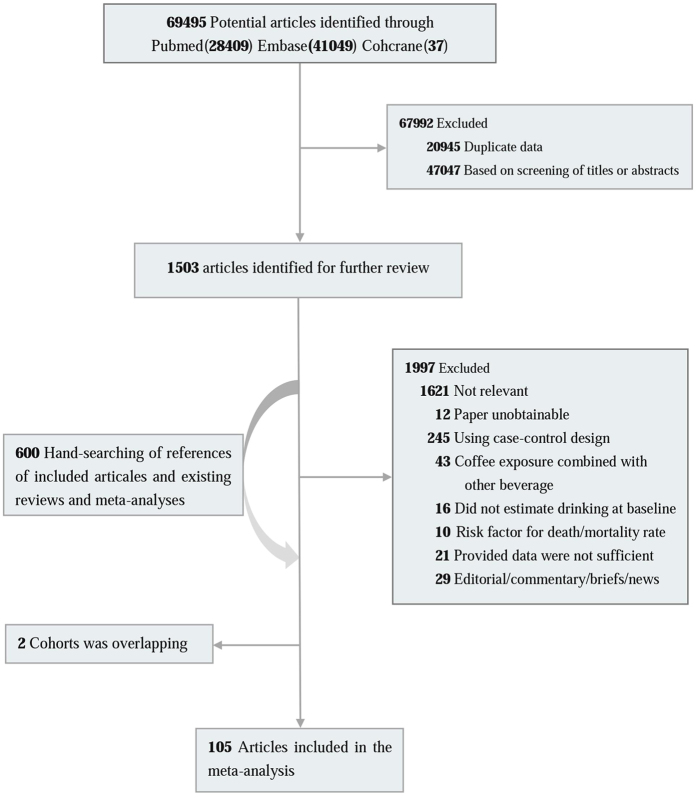
Figure 1
Figure 1. Flowchart of the searching and review of literatures.
Figure 2
Figure 2. Meta-analyses between coffee intake and risk of oral, pharynx cancer, colorectal cancer, lung cancer and melanoma.
Relative risks of oral, pharynx cancer (A), colorectal cancer (B), lung cancer (C) and melanoma (D) associated with coffee intake. Squares represent study-specific relative risk estimates (size of the square reflects the study-specific statistical weigh, that is, the inverse of the variance); horizontal lines represent 95% CIs; diamonds represent summary relative risk estimates with corresponding 95% CIs.
Figure 3
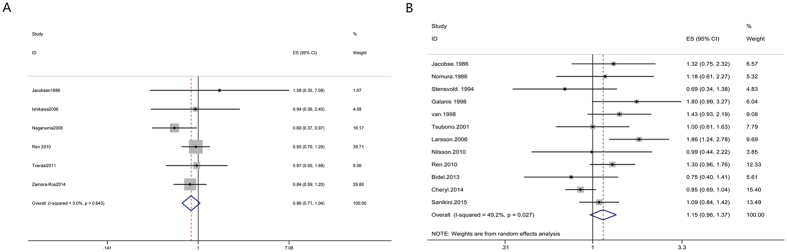
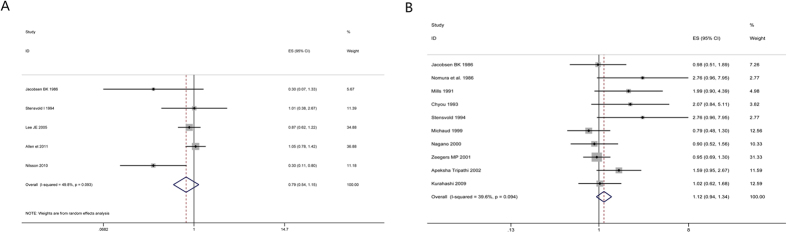
Figure 3. Meta-analyses between coffee intake and risk of esophageal cancer and stomach cancer.
Relative risks of esophageal cancer (A) and stomach cancer (B) associated with coffee intake. Squares represent study-specific relative risk estimates (size of the square reflects the study-specific statistical weigh, that is, the inverse of the variance); horizontal lines represent 95% CIs; diamonds represent summary relative risk estimates with corresponding 95% CIs.
Figure 4
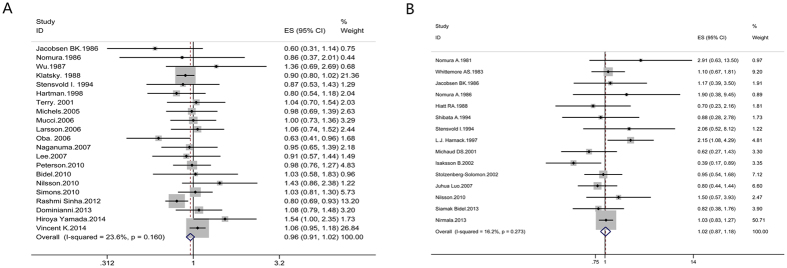
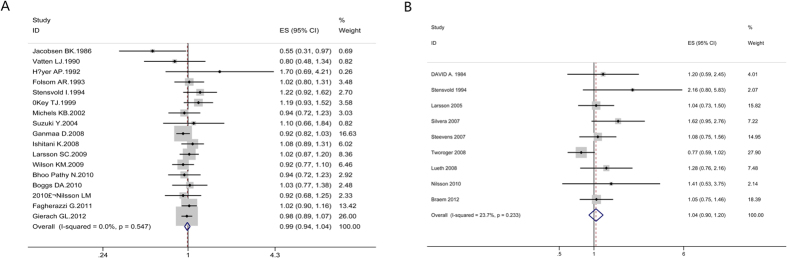
Figure 4. Meta-analyses between coffee intake and risk of colorectal cancer and pancreatic cancer.
Relative risks of colorectal cancer (A) and pancreatic cancer (B) associated with coffee intake. Squares represent study-specific relative risk estimates (size of the square reflects the study-specific statistical weigh, that is, the inverse of the variance); horizontal lines represent 95% CIs; diamonds represent summary relative risk estimates with corresponding 95% CIs.
Figure 5
Figure 5. Dose-response analyses between coffee intake and risk of liver cancer, prostate cancer and endometrial cancer.
Relative risks of liver cancer (A), prostate cancer (B) and endometrial cancer (C) associated with coffee intake. Squares represent study-specific relative risk estimates (size of the square reflects the study-specific statistical weigh, that is, the inverse of the variance); horizontal lines represent 95% CIs; diamonds represent summary relative risk estimates with corresponding 95% CIs.
Figure 6
Figure 6. Meta-analyses between coffee intake and risk of renal cancer and bladder cancer.
Relative risks of renal cancer (A) and bladder cancer (B) associated with coffee intake. Squares represent study-specific relative risk estimates (size of the square reflects the study-specific statistical weigh, that is, the inverse of the variance); horizontal lines represent 95% CIs; diamonds represent summary relative risk estimates with corresponding 95% CIs.
Figure 7
Figure 7. Meta-analyses between coffee intake and risk of breast cancer and ovarian cancer.
Relative risks of breast cancer (A) and ovarian cancer (B) associated with coffee intake. Squares represent study-specific relative risk estimates (size of the square reflects the study-specific statistical weigh, that is, the inverse of the variance); horizontal lines represent 95% CIs; diamonds represent summary relative risk estimates with corresponding 95% CIs.
Figure 8
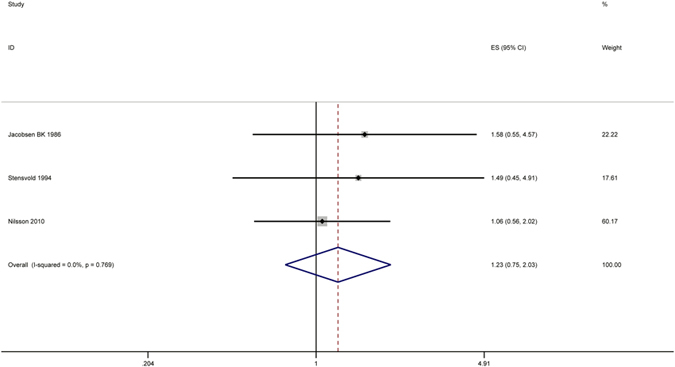
Figure 8. Meta-analyses between coffee intake and risk of lymphoma.
Relative risks of lymphoma associated with coffee intake. Squares represent study-specific relative risk estimates (size of the square reflects the study-specific statistical weigh, that is, the inverse of the variance); horizontal lines represent 95% CIs; diamonds represent summary relative risk estimates with corresponding 95% CIs.

References

    1. Torre L. A. et al.. Global cancer statistics, 2012. CA: a cancer journal for clinicians 65, 87–108, 10.3322/caac.21262 (2015). - DOI - PubMed
    1. Jemal A. et al.. Global cancer statistics. CA: a cancer journal for clinicians 61, 69–90, 10.3322/caac.20107 (2011). - DOI - PubMed
    1. Bae J. M., Lee E. J. & Guyatt G. Citrus fruit intake and pancreatic cancer risk: a quantitative systematic review. Pancreas 38, 168–174, 10.1097/MPA.0b013e318188c497 (2009). - DOI - PubMed
    1. Aune D. et al.. Dietary fibre, whole grains, and risk of colorectal cancer: systematic review and dose-response meta-analysis of prospective studies. BMJ (Clinical research ed.) 343, d6617, 10.1136/bmj.d6617 (2011). - DOI - PMC - PubMed
    1. Sang L. X., Chang B., Li X. H. & Jiang M. Consumption of coffee associated with reduced risk of liver cancer: a meta-analysis. BMC gastroenterology 13, 34, 10.1186/1471-230x-13-34 (2013). - DOI - PMC - PubMed

LinkOut - more resources