. 2016 Sep 24;17(10):1620.
doi: 10.3390/ijms17101620.

miR33a/miR33b* and miR122 as Possible Contributors to Hepatic Lipid Metabolism in Obese Women with Nonalcoholic Fatty Liver Disease

Affiliations

miR33a/miR33b* and miR122 as Possible Contributors to Hepatic Lipid Metabolism in Obese Women with Nonalcoholic Fatty Liver Disease

Teresa Auguet et al. Int J Mol Sci. .

Abstract

Specific miRNA expression profiles have been shown to be associated with nonalcoholic fatty liver disease (NAFLD). We examined the correlation between the circulating levels and hepatic expression of miR122 and miR33a/b*, the key lipid metabolism-related gene expression and the clinicopathological factors of obese women with NAFLD. We measured miR122 and miR33a/b* expression in liver samples from 62 morbidly obese (MO), 30 moderately obese (ModO), and eight normal-weight controls. MiR122 and miR33a/b* expression was analyzed by qRT-PCR. Additionally, miR122 and miR33b* circulating levels were analyzed in 122 women. Hepatic miR33b* expression was increased in MO compared to ModO and controls, whereas miR122 expression was decreased in the MO group compared to ModO. In obese cohorts, miR33b* expression was increased in nonalcoholic steatohepatitis (NASH). Regarding circulating levels, MO patients with NASH showed higher miR122 levels than MO with simple steatosis (SS). These circulating levels are good predictors of histological features associated with disease severity. MO is associated with altered hepatic miRNA expression. In obese women, higher miR33b* liver expression is associated with NASH. Moreover, multiple correlations between miRNAs and the expression of genes related to lipid metabolism were found, that would suggest a miRNA-host gene circuit. Finally, miR122 circulating levels could be included in a panel of different biomarkers to improve accuracy in the non-invasive diagnosis of NASH.

Keywords: miR122; miR33a/b*; nonalcoholic fatty liver disease; obesity.


Conflict of interest statement

The authors declare no conflict of interest.

Figures
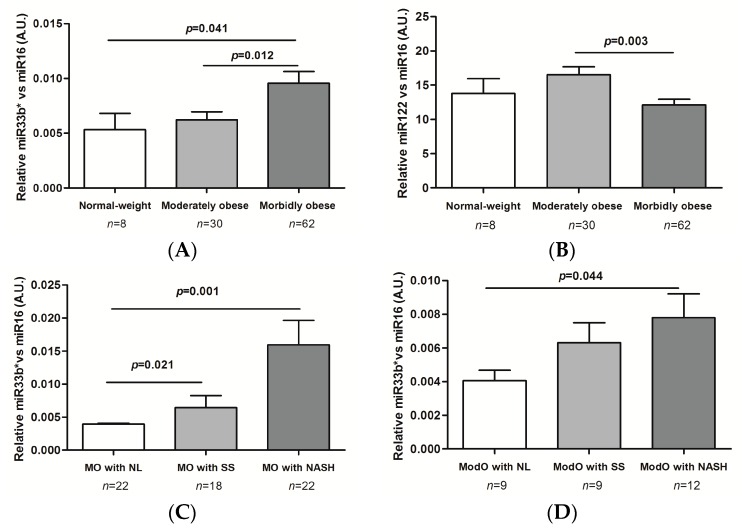
Figure 1
Figure 1
miRNA liver expression according to obesity degree and liver histology. (A) Differential expression of miR33b*; and (B) miR122 depending on the degree of obesity; (C) miR33b* liver expression in morbidly; and (D) moderately obese patients according to liver histology. Morbidly obese (MO) patients with normal liver (NL); MO patients with simple steatosis (SS); MO patients with nonalcoholic steatohepatitis (NASH); Moderately obese (ModO) patients with NL; ModO patients with SS; ModO patients with NASH; AU, arbitrary units. One-way ANOVA was used to compare the gene expression between groups. Results are shown as the mean ± SEM. p < 0.05 is considered statistically significant.
Figure 2
Figure 2
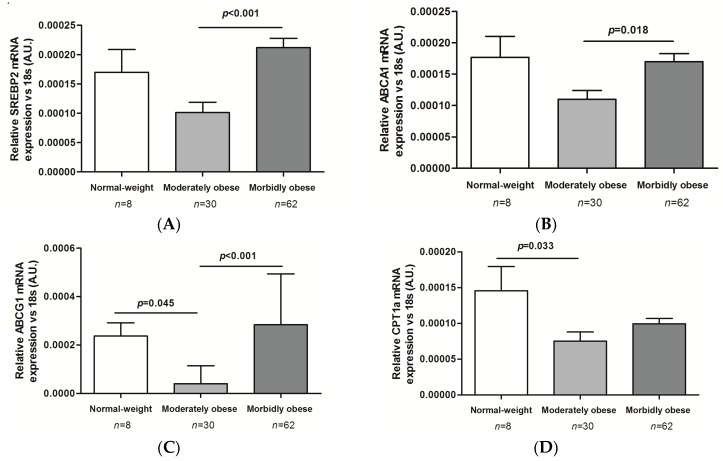
Liver expression of genes involved in lipoprotein secretion (AC) and lipid oxidation (D) depending on the degree of obesity. ABCA1, ATP binding cassette transporters A1; ABCG1, ATP binding cassette transporters G1; CPT1α, carnitine palmitoyltransferase 1 alpha; SREBP2, sterol-regulatory-element-binding protein. Differences between groups were calculated using one-way ANOVA. Results are shown as the mean ± SEM. p < 0.05 is considered statistically significant.
Figure 3
Figure 3
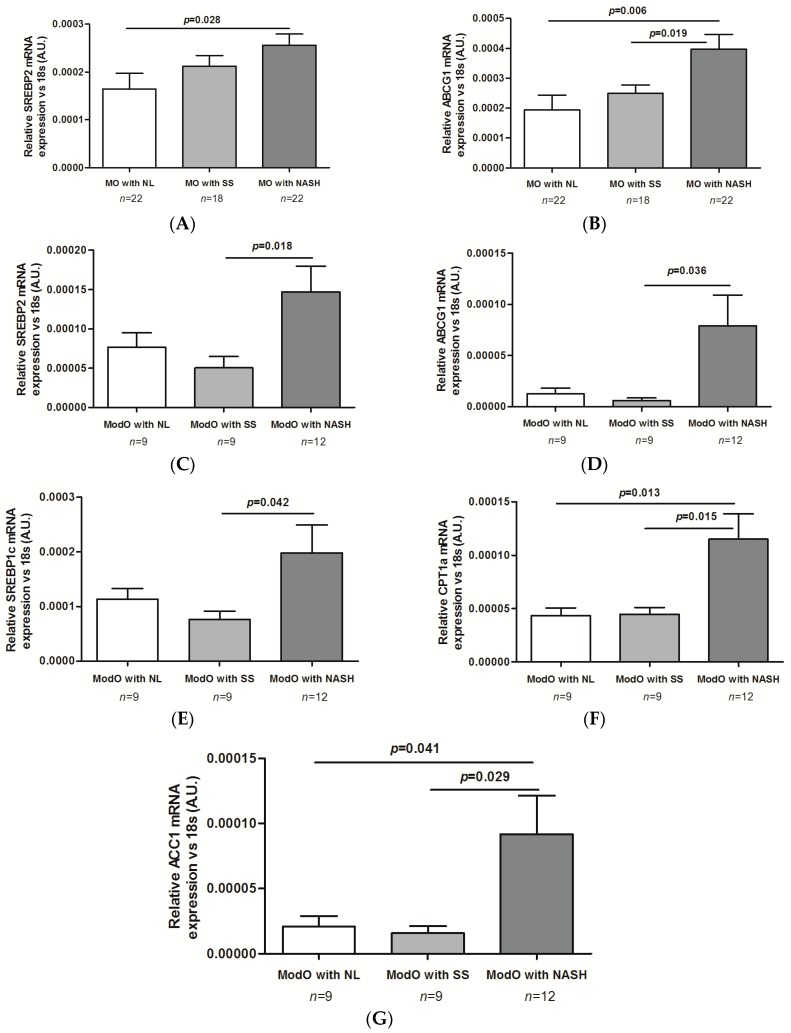
Liver expression of SREBP2 (A) and ABCG1 (B) in morbidly obese patients according to liver histology and liver expression of genes involved in lipoprotein secretion (CE); lipogenesis (F) and lipid oxidation (G) of moderately obese patients according to liver histology. Morbidly obese (MO) patients with normal liver (NL); MO patients with simple steatosis (SS); MO patients with nonalcoholic steatohepatitis (NASH); Moderately obese (ModO) patients with NL; ModO patients with SS; ModO patients with NASH; AU, arbitrary units. Differences between groups were calculated using one-way ANOVA. Results are shown as the mean ± SEM. p < 0.05 is considered statistically significant.
Figure 4
Figure 4
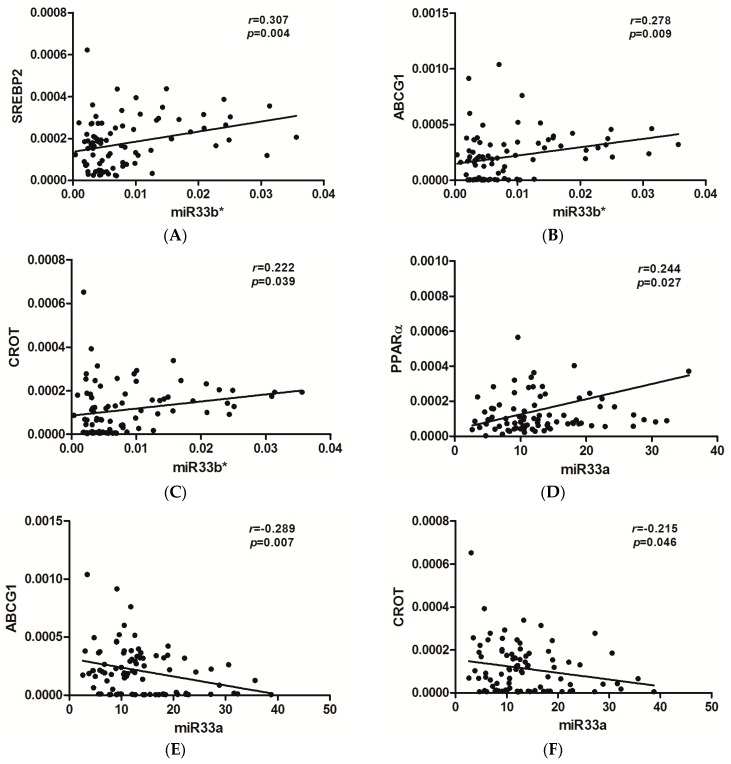
Correlation of the liver expression of miR33b* (AC) and miR33a (DF) with the liver expression of genes involved in lipid metabolism: lipogenesis, fatty acid oxidation and hepatic secretion of lipoproteins. SREBP2, sterol-regulatory-element-binding protein; ABCG1, ATP binding cassette transporters G1; CROT, carnitine O-octanoyltransferase; PPARα, peroxisome-proliferator-activated receptor α. The strength of association between variables was calculated using Spearman’s r correlation test. p < 0.05 is considered statistically significant.
Figure 5
Figure 5
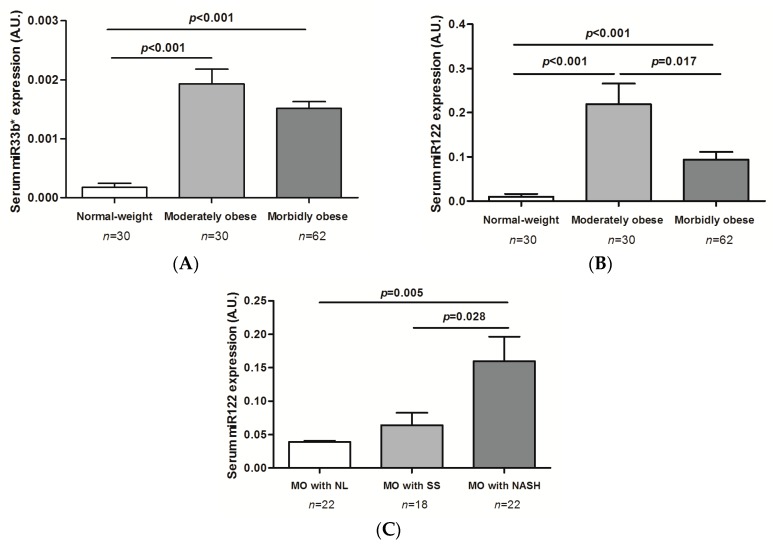
Circulating miR33b* (A) and miR122 (B) expression depending on the degree of obesity. (C) Differential circulating miR122 expression in morbidly obese patients according to liver pathology. MO with NL, morbidly obese patients with normal liver; MO with SS, morbidly obese patients with simple steatosis; MO with NASH, morbidly obese patients with steatohepatitis; AU, arbitrary units. Differences between groups were calculated using one-way ANOVA. Results are shown as the mean ± SEM. p < 0.05 is considered statistically significant.

References

    1. Yki-Järvinen H. Non-alcoholic fatty liver disease as a cause and a consequence of metabolic syndrome. Lancet Diabetes Endocrinol. 2014;3:1–10. doi: 10.1016/S2213-8587(14)70032-4. - DOI - PubMed
    1. Ballestri S., Zona S., Targher G., Romagnoli D., Baldelli E., Nascimbeni F., Roverato A., Guaraldi G., Lonardo A. Nonalcoholic fatty liver disease is associated with an almost two fold increased risk of incident type 2 diabetes and metabolic syndrome. Evidence from a systematic review and meta-analysis. J. Gastroenterol. Hepatol. 2016;31:936–944. doi: 10.1111/jgh.13264. - DOI - PubMed
    1. Lonardo A., Ballestri S., Marchesini G., Angulo P., Loria P. Nonalcoholic fatty liver disease: A precursor of the metabolic syndrome. Dig. Liver Dis. 2015;47:181–190. doi: 10.1016/j.dld.2014.09.020. - DOI - PubMed
    1. Bellentani S., Bedogni G., Miglioli L., Tiribelli C. The epidemiology of fatty liver. Eur. J. Gastroenterol. Hepatol. 2004;16:1087–1093. doi: 10.1097/00042737-200411000-00002. - DOI - PubMed
    1. Younossi Z.M., Koenig A.B., Abdelatif D., Fazel Y., Henry L., Wymer M. Global epidemiology of non-alcoholic fatty liver disease-meta-analytic assessment of prevalence, incidence and outcomes. Hepatology. 2016;64:73–84. doi: 10.1002/hep.28431. - DOI - PubMed

MeSH terms

Substances