


Acceptance-based versus standard behavioral treatment for obesity: Results from the mind your health randomized controlled trial
- PMID: 27670400
- PMCID: PMC5051349
- DOI: 10.1002/oby.21601
Acceptance-based versus standard behavioral treatment for obesity: Results from the mind your health randomized controlled trial
Abstract
Objective: To evaluate the efficacy, as well as potential moderators and mediators, of a revised acceptance-based behavioral treatment (ABT) for obesity, relative to standard behavioral treatment (SBT).
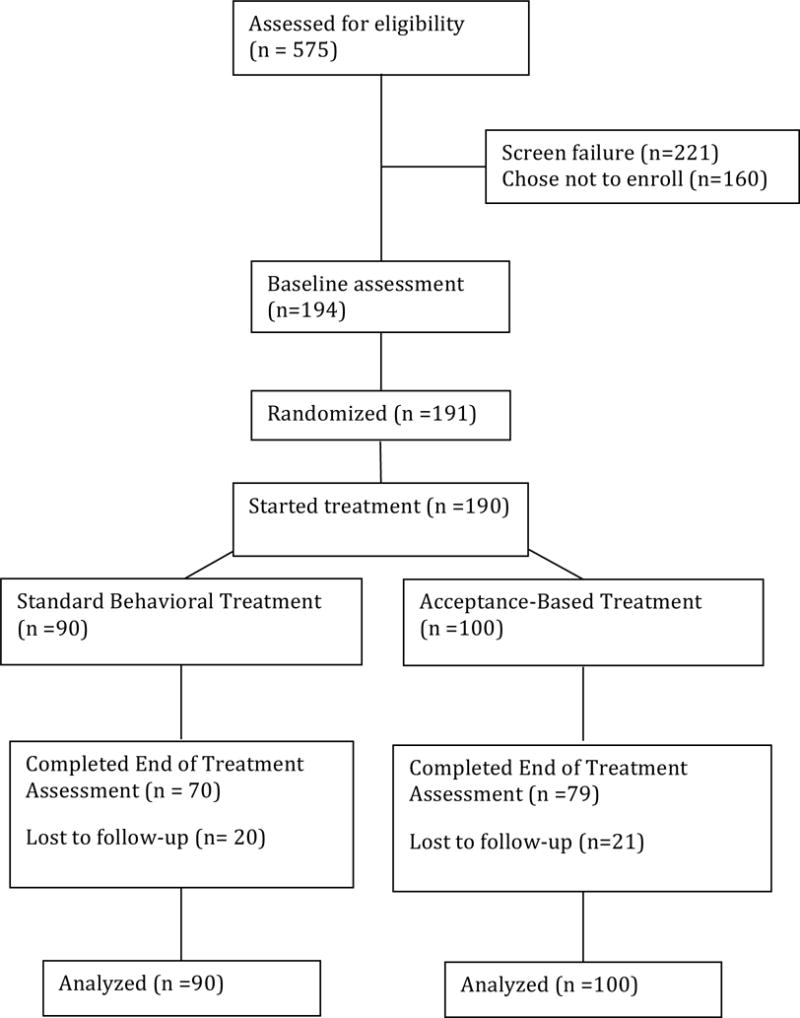
Methods: Participants with overweight and obesity (n = 190) were randomized to 25 sessions of ABT or SBT over 1 year. Primary outcome (weight), mediator, and moderator measurements were taken at baseline, 6 months, and/or 12 months, and weight was also measured every session.
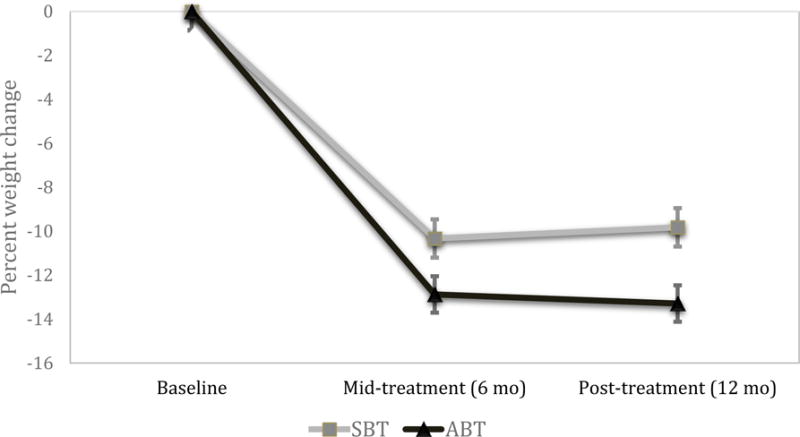
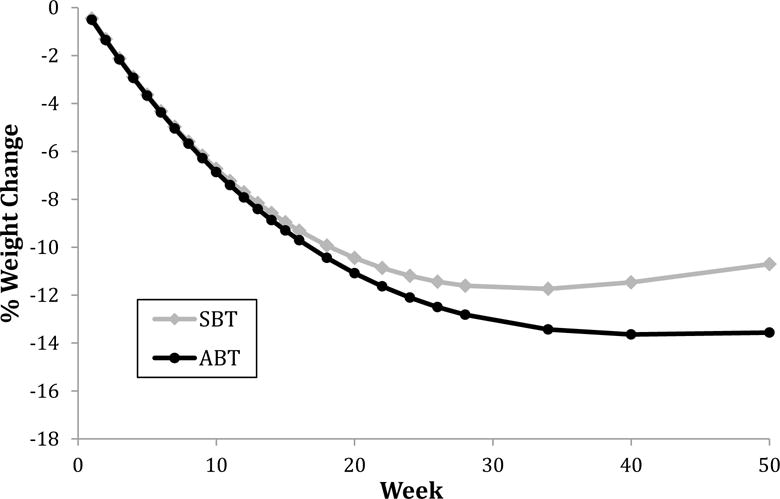
Results: Participants assigned to ABT attained a significantly greater 12-month weight loss (13.3% ± 0.83%) than did those assigned to SBT (9.8% ± 0.87%; P = 0.005). A condition by quadratic time effect on session-by-session weights (P = 0.01) indicated that SBT had a shallower trajectory of weight loss followed by an upward deflection. ABT participants were also more likely to maintain a 10% weight loss at 12 months (64.0% vs. 48.9%; P = 0.04). No evidence of moderation was found. Results supported the mediating role of autonomous motivation and psychological acceptance of food-related urges.
Conclusions: Behavioral weight loss outcomes can be improved by integrating self-regulation skills that are reflected in acceptance-based treatment, i.e., tolerating discomfort and reduction in pleasure, enacting commitment to valued behavior, and being mindfully aware during moments of decision-making.
© 2016 The Obesity Society.
Conflict of interest statement
Dr. Forman reports grants from the National Institute for Diabetes and Digestive and Kidney Diseases (award # R01 DK095069), during the conduct of the study. Dr. Crosby reports personal fees from Health Outcome Solutions, outside the submitted work. None of the remaining authors report a conflict of interest.
Figures
Comment in
-
Advancing the revolution in the behavioral treatment of obesity.Obesity (Silver Spring). 2016 Oct;24(10):2029-30. doi: 10.1002/oby.21641. Obesity (Silver Spring). 2016. PMID: 27670398 No abstract available.
References
-
- Klem ML, et al. A descriptive study of individuals successful at long-term maintenance of substantial weight loss. Am J Clin Nutr. 1997;66(2):239–246. - PubMed
-
- Brownell KD, Jeffery R. Improving long-term weight loss: Pushing the limits of treatment. Behavior Therapy. 1987;18(4):353–374.
-
- Wilson G. Behavioral treatment of obesity: Thirty years and counting. Advances in Behaviour Research & Therapy. 1994;16(1):31–75.
-
- Weinsier RL, et al. Do adaptive changes in metabolic rate favor weight regain in weight-reduced individuals? An examination of the set-point theory. American Journal of Clinical Nutrition. 2000;72(5):1088–1094. - PubMed
Publication types
MeSH terms
Grants and funding
LinkOut - more resources
Full Text Sources
Other Literature Sources
Medical
