


Simultaneous noninvasive recording of skin sympathetic nerve activity and electrocardiogram
- PMID: 27670627
- PMCID: PMC5182108
- DOI: 10.1016/j.hrthm.2016.09.019
Simultaneous noninvasive recording of skin sympathetic nerve activity and electrocardiogram
Abstract
Background: Sympathetic nerve activity is important to cardiac arrhythmogenesis.
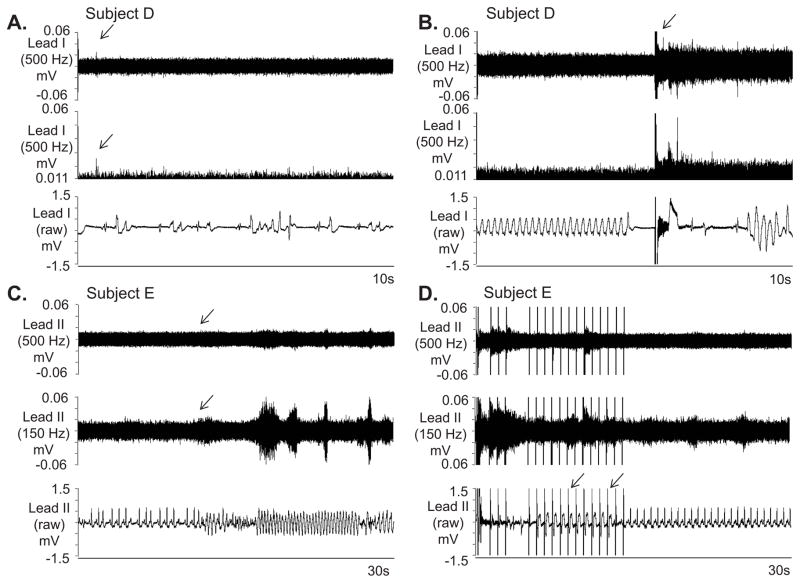
Objective: The purpose of this study was to develop a method for simultaneous noninvasive recording of skin sympathetic nerve activity (SKNA) and electrocardiogram (ECG) using conventional ECG electrodes. This method (neuECG) can be used to adequately estimate sympathetic tone.
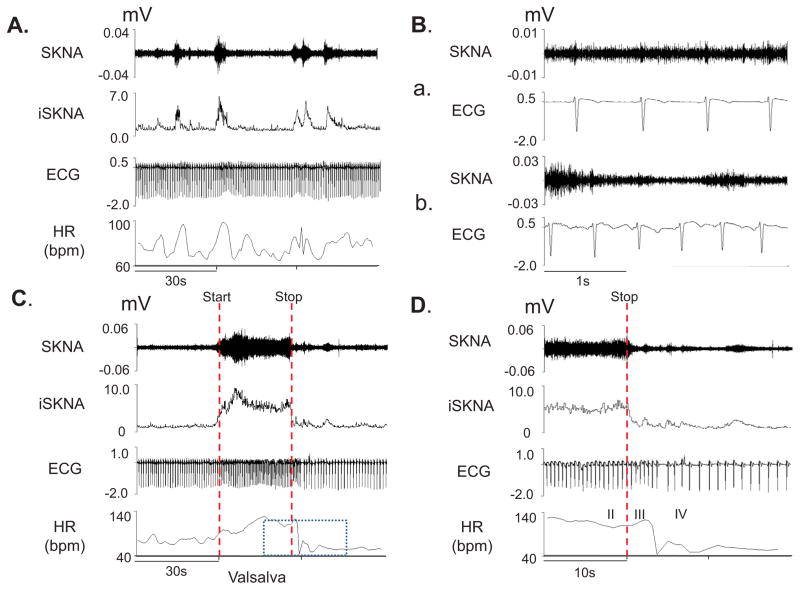
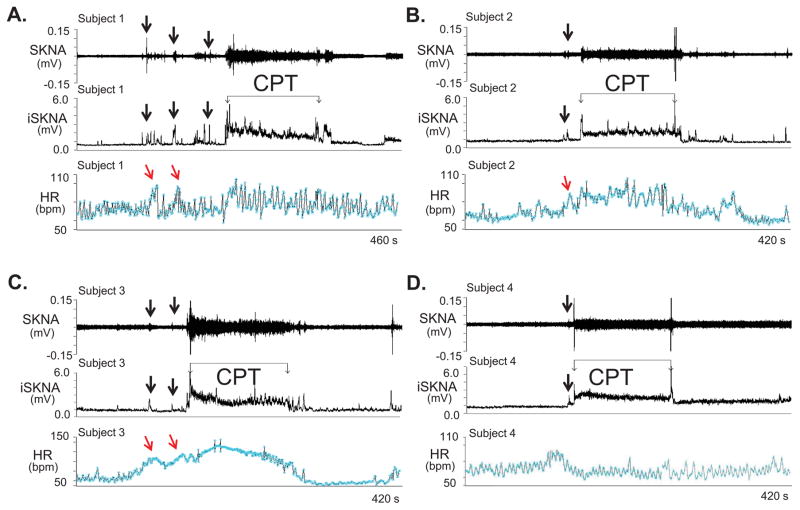
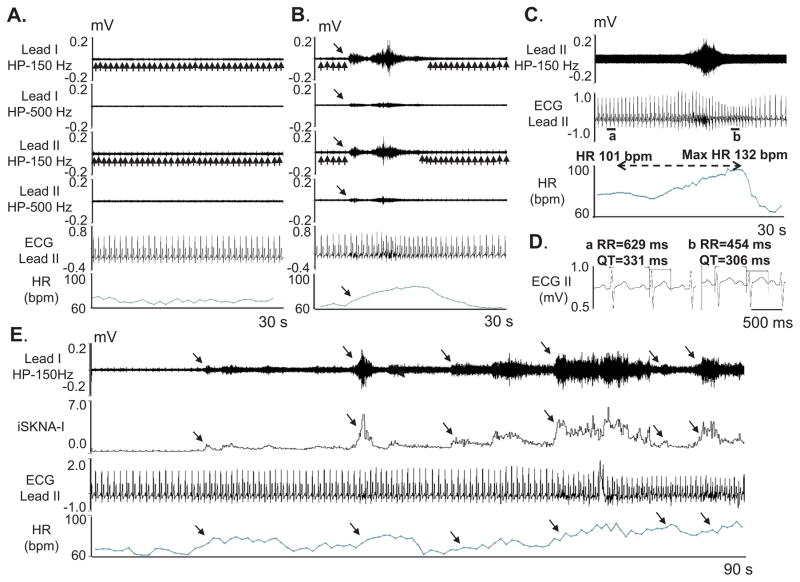
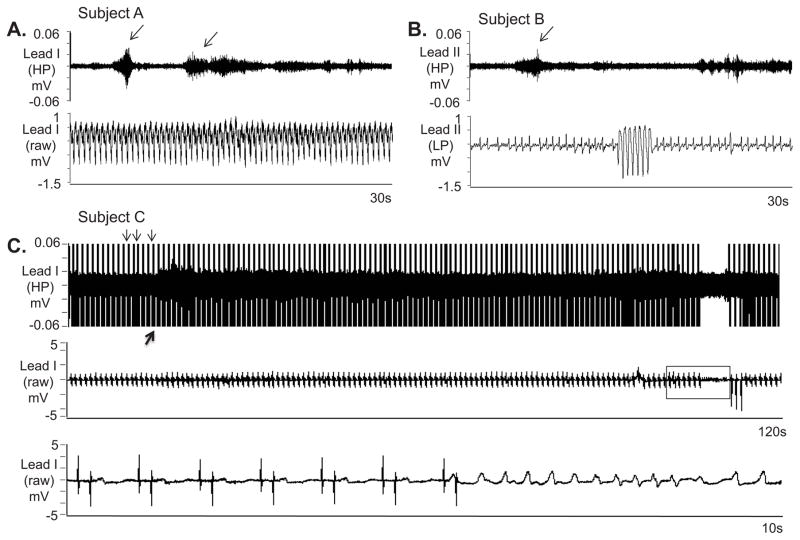
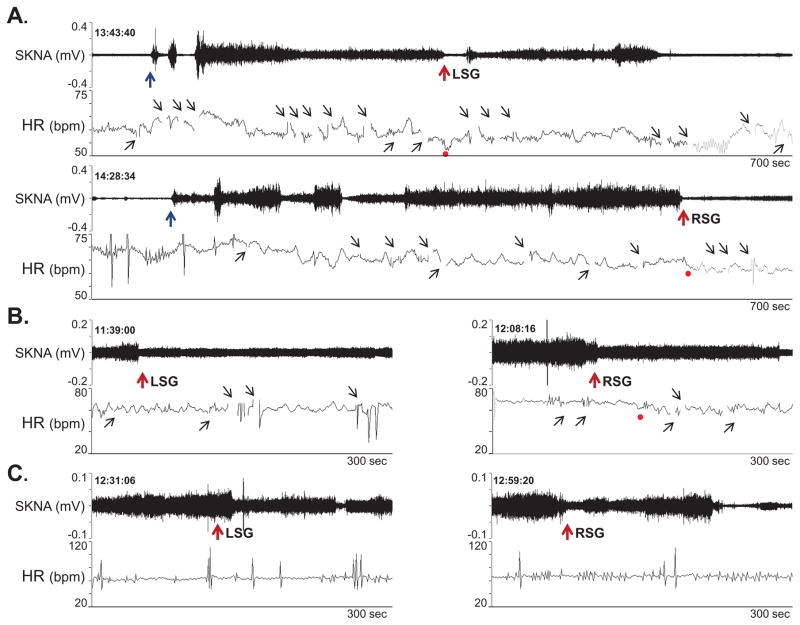
Methods: We recorded neuECG signals from the skin of 56 human subjects. The signals were low-pass filtered to show the ECG and high-pass filtered to show nerve activity. Protocol 1 included 12 healthy volunteers who underwent cold water pressor test and Valsalva maneuver. Protocol 2 included 19 inpatients with epilepsy but without known heart diseases monitored for 24 hours. Protocol 3 included 22 patients admitted with electrical storm and monitored for 39.0 ± 28.2 hours. Protocol 4 included 3 patients who underwent bilateral stellate ganglion blockade with lidocaine injection.
Results: In patients without heart diseases, spontaneous nerve discharges were frequently observed at baseline and were associated with heart rate acceleration. SKNA recorded from chest leads (V1-V6) during cold water pressor test and Valsalva maneuver (protocol 1) was invariably higher than during baseline and recovery periods (P < .001). In protocol 2, the average SKNA correlated with heart rate acceleration (r = 0.73 ± 0.14, P < .05) and shortening of QT interval (P < .001). Among 146 spontaneous ventricular tachycardia episodes recorded in 9 patients of protocol 3, 106 episodes (73%) were preceded by SKNA within 30 seconds of onset. Protocol 4 showed that bilateral stellate ganglia blockade by lidocaine inhibited SKNA.
Conclusion: SKNA is detectable using conventional ECG electrodes in humans and may be useful in estimating sympathetic tone.
Keywords: Cold water pressor test; Microneurography; Sympathetic nerve activity; Ventricular tachycardia.
Copyright © 2016 Heart Rhythm Society. Published by Elsevier Inc. All rights reserved.
Conflict of interest statement
Shien-Fong Lin and Peng-Sheng Chen have equity interest in Arrhythmotech, LLC. Medtronic, St Jude and Cyberonics Inc. donated research equipment to Dr Chen’s research laboratory.
Figures
References
-
- Kligfield P, Gettes LS, Bailey JJ, et al. Recommendations for the standardization and interpretation of the electrocardiogram. Part I: The electrocardiogram and its technology.A scientific statement from the American Heart Association Electrocardiography and Arrhythmias Committee, Council on Clinical Cardiology; the American College of Cardiology Foundation; and the Heart Rhythm Society. Heart Rhythm. 2007;4:394–412. - PubMed
-
- Chakravarthy Marx S, Kumar P, Dhalapathy S, Anitha Marx C. Distribution of sympathetic fiber areas in the sensory nerves of forearm: an immunohistochemical study in cadavers. Rom J Morphol Embryol. 2011;52:605–611. - PubMed
-
- Donadio V, Nolano M, Provitera V, Stancanelli A, Lullo F, Liguori R, Santoro L. Skin sympathetic adrenergic innervation: an immunofluorescence confocal study. Ann Neurol. 2006;59:376–381. - PubMed
-
- Baron R, Janig W, With H. Sympathetic and afferent neurones projecting into forelimb and trunk nerves and the anatomical organization of the thoracic sympathetic outflow of the rat. J Auton Nerv Syst. 1995;53:205–214. - PubMed
-
- Taniguchi T, Morimoto M, Taniguchi Y, Takasaki M, Totoki T. Cutaneous distribution of sympathetic postganglionic fibers from stellate ganglion: A retrograde axonal tracing study using wheat germ agglutinin conjugated with horseradish peroxidase. J Anesth. 1994;8:441–449. - PubMed
Publication types
MeSH terms
Grants and funding
LinkOut - more resources
Full Text Sources
Other Literature Sources
Medical
