Emendation of Propionibacterium acnes subsp. acnes (Deiko et al. 2015) and proposal of Propionibacterium acnes type II as Propionibacterium acnes subsp. defendens subsp. nov
- PMID: 27670798
- PMCID: PMC6978983
- DOI: 10.1099/ijsem.0.001521
Emendation of Propionibacterium acnes subsp. acnes (Deiko et al. 2015) and proposal of Propionibacterium acnes type II as Propionibacterium acnes subsp. defendens subsp. nov
Erratum in
-
Corrigendum: Proposal to reclassify Propionibacterium acnes type I as Propionibacterium acnes subsp. acnes subsp. nov. and Propionibacterium acnes type II as Propionibacterium acnes subsp. defendens subsp. nov.Int J Syst Evol Microbiol. 2017 Nov;67(11):4880. doi: 10.1099/ijsem.0.002385. Int J Syst Evol Microbiol. 2017. PMID: 29130432 Free PMC article. No abstract available.
Abstract
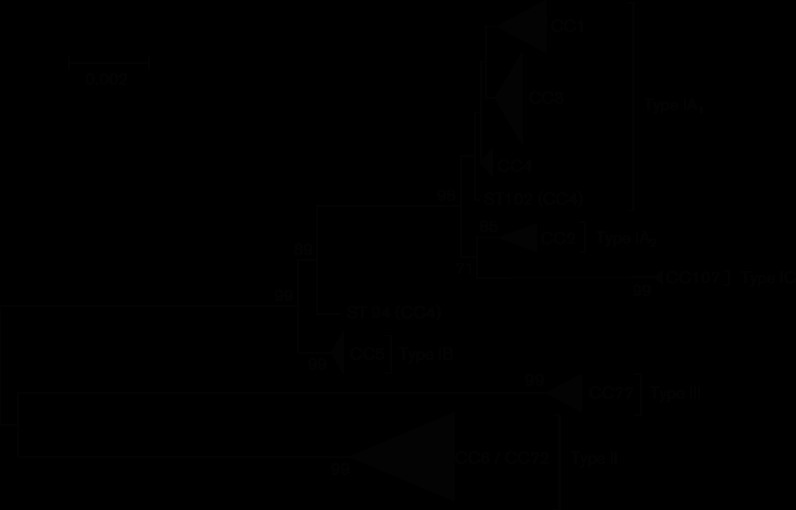
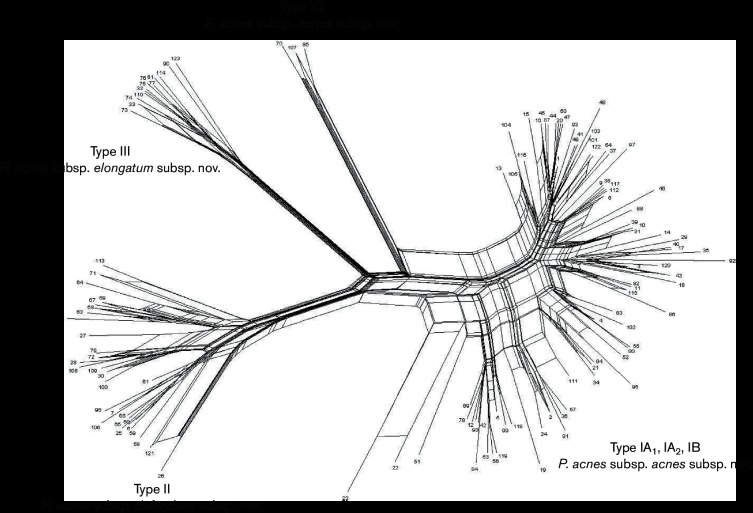
Recently, it has been proposed that strains of Propionibacterium acnes from the type III genetic division should be classified as P. acnessubsp. elongatum subsp. nov., with strains from the type I and II divisions collectively classified as P. acnessubsp. acnes subsp. nov. Under such a taxonomic re-appraisal, we believe that types I and II should also have their own separate rank of subspecies. In support of this, we describe a polyphasic taxonomic study based on the analysis of publicly available multilocus and whole-genome sequence datasets, alongside a systematic review of previously published phylogenetic, genomic, phenotypic and clinical data. Strains of types I and II form highly distinct clades on the basis of multilocus sequence analysis (MLSA) and whole-genome phylogenetic reconstructions. In silico or digital DNA-DNA similarity values also fall within the 70-80 % boundary recommended for bacterial subspecies. Furthermore, we see important differences in genome content, including the presence of an active CRISPR/Cas system in type II strains, but not type I, and evidence for increasing linkage equilibrium within the separate divisions. Key biochemical differences include positive test results for β-haemolytic, neuraminidase and sorbitol fermentation activities with type I strains, but not type II. We now propose that type I strains should be classified as P. acnessubsp. acnes subsp. nov., and type II as P. acnessubsp. defendens subsp. nov. The type strain of P. acnessubsp. acnes subsp. nov. is NCTC 737T (=ATCC 6919T=JCM 6425T=DSM 1897T=CCUG 1794T), while the type strain of P. acnessubsp. defendens subsp. nov. is ATCC 11828 (=JCM 6473=CCUG 6369).
Figures
References
-
- Bae Y., Ito T., Iida T., Uchida K., Sekine M., Nakajima Y., Kumagai J., Yokoyama T., Kawachi H., et al. Intracellular Propionibacterium acnes infection in glandular epithelium and stromal macrophages of the prostate with or without cancer. PLoS One. 2014;9:e90324. doi: 10.1371/journal.pone.0090324. - DOI - PMC - PubMed
-
- Brenner D., Stanley J., Krieg N. Classification of prokaryotic organisms and the concept of bacterial speciation. In: Boone D. R., Castenholz W., Garrity G. M., editors. Bergey's Manual of Systematic Bacteriology. 2nd edn. New York, NY: Springer; 2000. Edited by.
MeSH terms
Substances
Grants and funding
LinkOut - more resources
Full Text Sources
Other Literature Sources
Molecular Biology Databases