. 2016 Sep 27:6:34224.
doi: 10.1038/srep34224.

Stretchable Materials for Robust Soft Actuators towards Assistive Wearable Devices

Affiliations

Stretchable Materials for Robust Soft Actuators towards Assistive Wearable Devices

Gunjan Agarwal et al. Sci Rep. .

Abstract

Soft actuators made from elastomeric active materials can find widespread potential implementation in a variety of applications ranging from assistive wearable technologies targeted at biomedical rehabilitation or assistance with activities of daily living, bioinspired and biomimetic systems, to gripping and manipulating fragile objects, and adaptable locomotion. In this manuscript, we propose a novel two-component soft actuator design and design tool that produces actuators targeted towards these applications with enhanced mechanical performance and manufacturability. Our numerical models developed using the finite element method can predict the actuator behavior at large mechanical strains to allow efficient design iterations for system optimization. Based on two distinctive actuator prototypes' (linear and bending actuators) experimental results that include free displacement and blocked-forces, we have validated the efficacy of the numerical models. The presented extensive investigation of mechanical performance for soft actuators with varying geometric parameters demonstrates the practical application of the design tool, and the robustness of the actuator hardware design, towards diverse soft robotic systems for a wide set of assistive wearable technologies, including replicating the motion of several parts of the human body.


Figures
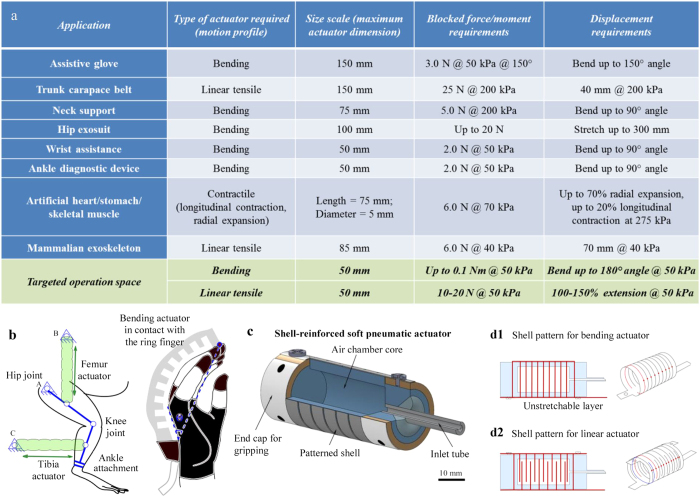
Figure 1
Figure 1
(a) A review of design and performance metrics for soft actuators used in some human-assistive, wearable devices listed in literature, along with references. (b) Schematic diagrams showing two such assistive devices that employ soft pneumatic actuators, for spinal cord rehabilitation using a soft exoskeleton (left) with linear actuators, and for assisting hand motion using a robotic glove (right) with bending actuators. (c) Schematic view of the proposed SPA. The actuator comprises of a soft elastomeric silicone core onto which a shell structure made of a much stiffer material is attached. (d) Schematic showing laser-cut patterns on shell for forming bending (d1) and linear (d2) frames. The bending frame, seen in d1, comprises multiple, equally spaced cuts. The shell is rolled-up as shown, with a thin strip of uncut material forming the unstretchable layer to guide motion in bending. The number of cuts on shell surface is varied to achieve variable stiffness of the structure. The linear frame has a pattern as shown in d2, with alternating slits of the same length. The corresponding shell obtained upon attaching two such symmetric patterns together is seen on the right, to achieve guided linear motion.
Figure 2
Figure 2
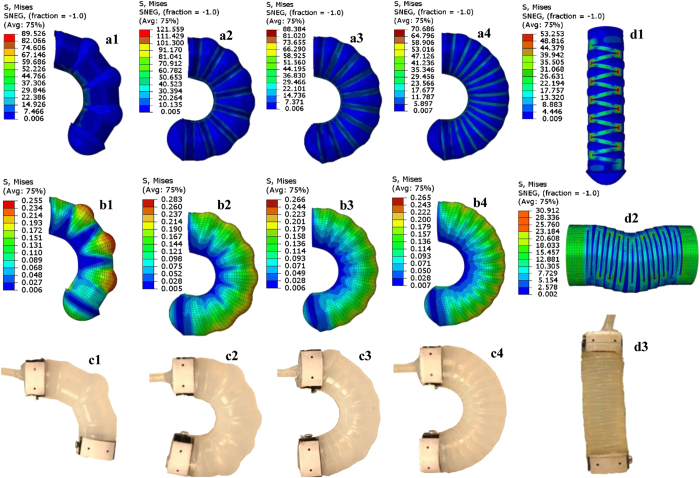
(a–c) Simulation vs. experimental results for bending actuators with various geometries, with 3, 7, 9 and 13 cuts on shell surface shown in c1–c4 (from left to right). The top panel (a1–a4) shows the Von Mises stress contour plots for stresses for the entire actuator structure, combining both the shell and the core material, while the bottom panel (b1–b4) shows the stresses in the soft core alone, for the corresponding geometries in the top panel. All stress values are in MPa. Comparing images in (a,b), it is seen that much larger stresses are incurred in the shell, owing to its significantly larger stiffness (in GPa as compared to the stiffness of the core material in kPa). (d) Von Mises stress contour plots for a linear actuator with 13 cuts on shell surface in free displacement testing (d1) and in blocked force testing (d2). An experimental image of the actuator in free displacement testing is shown in d3.
Figure 3
Figure 3
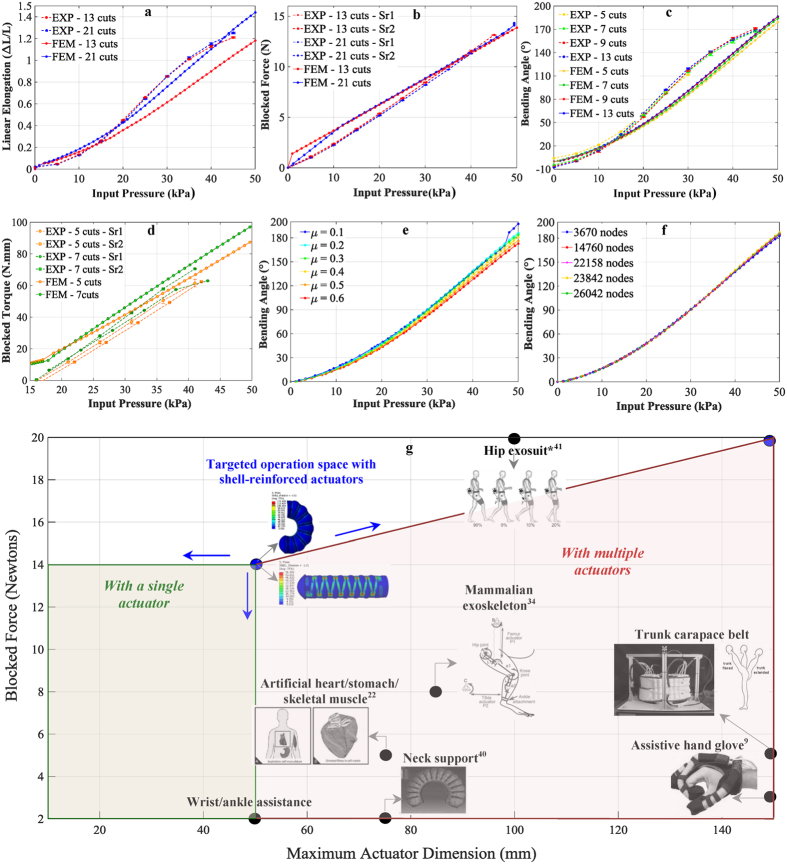
Comparison of simulation and experimental results for linear actuators with 13 and 21 cuts on shell surface, in (a) free displacement testing and (b) blocked force testing. In general, the simulation results approximate the experimental values well. Comparison of simulation and experimental results for bending actuators with 5, 7, 9 and 13 cuts on shell surface, in (c) free displacement testing and (d) blocked torque testing. For blocked torque testing, in this case, the actuator is first bent to a certain angle and then clamped in place. (e) Simulation results obtained with varying values of coefficient of friction μ between shell surface and actuator body, for bending actuators with 9 cuts on shell surface in free displacement condition. (f) Results from mesh convergence testing for a bending actuator with 9 cuts on shell surface in free displacement testing. The legend shows the total number of nodes in the system, including both the shell and the actuator surfaces. (g) Maximum blocked force obtained at 50 kPa input pressure vs. actuator size scale, for actuators employed for the different assistive, wearable devices and applications listed previously in Fig. 1a, along with targeted performance space achieved with actuators presented here. This includes devices for wrist and ankle assistance, a trunk carapace belt, an assistive hand glove, an artificial heart/stomach/skeletal muscle, a mammalian exoskeleton, neck support, and a hip assist exosuit (‘*’Indicates a different actuation mechanism, but comparable performance metrics).

References

    1. Ilievski F., Mazzeo A. D., Shepherd R. F., Chen X. & Whitesides G. M. Soft robotics for chemists. Angewandte Chemie 50, 1890–1895 (2011). - PubMed
    1. Martinez R. V., Fish C. R., Chen X. & Whitesides G. M. Elastomeric Origami: Programmable Paper-Elastomer Composites as Pneumatic Actuators. Advanced Functional Materials 22, 1376–1384 (2012).
    1. Shepherd R. F. et al.. Multigait Soft Robot. Proceedings of the National Academy of Sciences 108, 20400–20403 (2011). - PMC - PubMed
    1. Tolley M. T. et al.. A Resilient, Untethered Soft Robot. Soft Robotics 1, 213–223 (2014).
    1. Lin H.-T., Leisk G. G. & Trimmer B. GoQBot: a caterpillar-inspired soft-bodied rolling robot. Bioinspiration & Biomimetics 6, 026007 (2011). - PubMed