


Live and inactivated vaccine regimens against caecal Salmonella Typhimurium colonisation in laying hens
- PMID: 27671084
- PMCID: PMC5129469
- DOI: 10.1111/avj.12490
Live and inactivated vaccine regimens against caecal Salmonella Typhimurium colonisation in laying hens
Abstract
Objective: In Australia, Salmonella serovar Typhimurium (S. Typhimurium) is the predominant zoonotic serovar in humans and is frequently isolated from layer hens. Vaccination against this serovar has been previously shown to be effective in broilers and the aim of this current study was to assess and determine the best vaccination strategy (live or inactivated) to minimise caecal colonisation by S. Typhimurium.
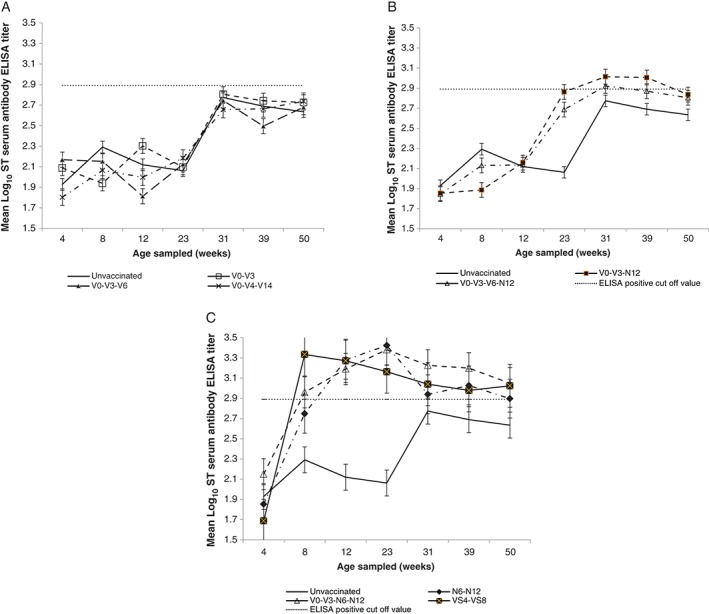
Methods: A long-term experiment (56 weeks) was conducted on ISABROWN pullets using a commercial live aroA deleted mutant S. Typhimurium vaccine and an autogenous inactivated multivalent Salmonella vaccine (containing serovars Typhimurium, Infantis, Montevideo and Zanzibar). These vaccines were administered PO or by SC or IM injection, either alone or in combination. Pullets were vaccinated throughout rearing (to 18 weeks of age) and sequentially bled for antibody titre levels. The birds, vaccinated and controls, were challenged orally with a field isolate of S. Typhimurium at different ages, held for 21 days post-challenge, then euthanased and their caeca cultured for the presence of Salmonella.
Results: None of the oral live-vaccinated groups exhibited lasting protection. When administered twice, the inactivated vaccine gave significant protection at 17 weeks of age and the live vaccine given by SC injection given twice produced significant protection at 17, 25 and 34 weeks.
Conclusions: Vaccination regimens that included parenteral administration of live or inactivated vaccines and thus achieved positive serum antibody levels were able to provide protection against challenge. Hence, vaccination may play a useful role in a management strategy for Salmonella carriage in layer flocks.
Keywords: Salmonella Typhimurium; layer chickens; poultry; vaccines.
© 2016 The Authors. Australian Veterinary Journal published by John Wiley & Sons Australia, Ltd on behalf of Australian Veterinary Association.
Figures
References
-
- Risk assessments of Salmonella in eggs and broiler chickens In: Microbiological risk assessment series 2 . World Health Organization/Food and Agriculture Organization of the United Nations; http://www.fao.org/docrep/fao/005/y4392e/y4392e00.pdf 2002. Accessed January 2009.
-
- Food Standards Australia New Zealand. Public health and safety of eggs and egg products in Australia: explanatory summary of the risk assessment. FSANZ , 2009. http://www.foodstandards.gov.au/publications/Pages/publichealthandsafet5.... Accessed March 2015.
-
- Food Standards Australia New Zealand. Public health and safety of eggs and egg products in Australia. FSANZ , 2009. http://www.foodstandards.gov.au/foodstandards/primaryproductionprocessin.... Accessed December 2011.
-
- Wales AD, Davies RH. A critical review of Salmonella typhimurium infection in laying hens. Avian Pathol 2011;40:429–436. - PubMed
-
- Murray CJ. Salmonella serovars and phage types in humans and animals in Australia 1987–1992. Aust Vet J 1994;71:78–81. - PubMed
MeSH terms
Substances
LinkOut - more resources
Full Text Sources
Other Literature Sources
