


A guide to the 3D structure of the ryanodine receptor type 1 by cryoEM
- PMID: 27671094
- PMCID: PMC5192967
- DOI: 10.1002/pro.3052
A guide to the 3D structure of the ryanodine receptor type 1 by cryoEM
Abstract
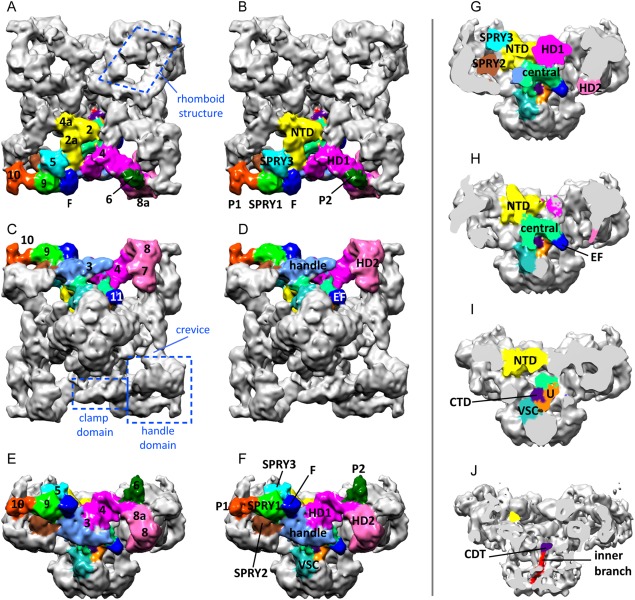
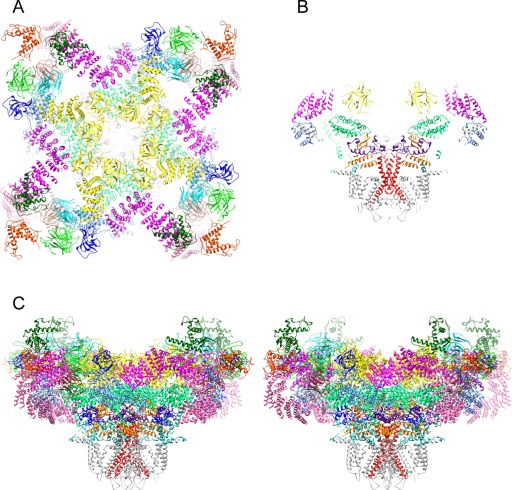
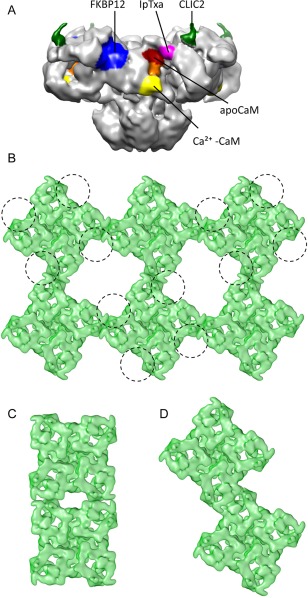
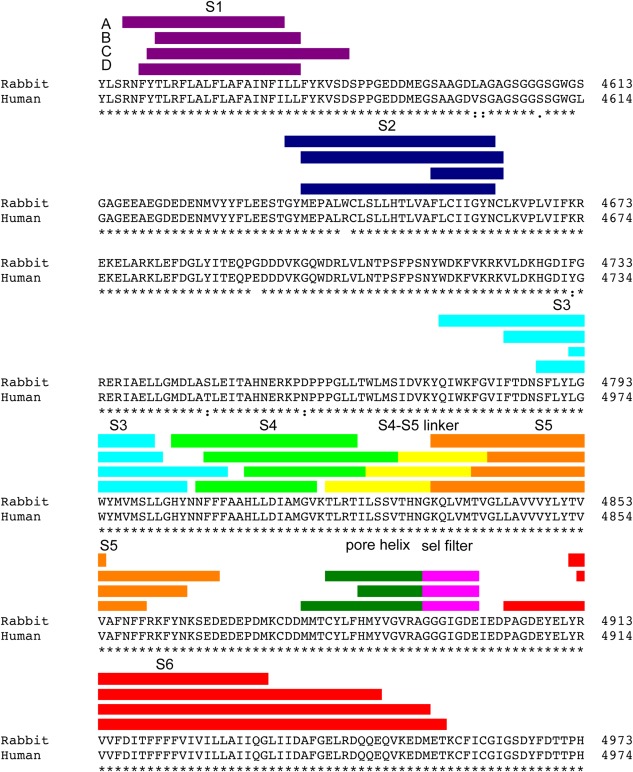
Signal transduction by the ryanodine receptor (RyR) is essential in many excitable cells including all striated contractile cells and some types of neurons. While its transmembrane domain is a classic tetrameric, six-transmembrane cation channel, the cytoplasmic domain is uniquely large and complex, hosting a multiplicity of specialized domains. The overall outline and substructure readily recognizable by electron microscopy make RyR a geometrically well-behaved specimen. Hence, for the last two decades, the 3D structural study of the RyR has tracked closely the technological advances in electron microscopy, cryo-electron microscopy (cryoEM), and computerized 3D reconstruction. This review summarizes the progress in the structural determination of RyR by cryoEM and, bearing in mind the leap in resolution provided by the recent implementation of direct electron detection, analyzes the first near-atomic structures of RyR. These reveal a complex orchestration of domains controlling the channel's function, and help to understand how this could break down as a consequence of disease-causing mutations.
Keywords: 3D reconstruction; allosterism; calcium; cryo electron microscopy; excitation-contraction coupling; ryanodine receptor.
© 2016 The Protein Society.
Figures
References
-
- Ogawa Y, Kurebayashi N, Murayama T (2000) Putative roles of type 3 ryanodine receptor isoforms (RyR3). Trends Cardiovasc Med 10:65–70. - PubMed
-
- Hosoi E, Nishizaki C, Gallagher KL, Wyre HW, Matsuo Y, Sei Y (2001) Expression of the ryanodine receptor isoforms in immune cells. J Immunol 167:4887–4894. - PubMed
-
- Beam KG, Knudson CM, Powell JA (1986) A lethal mutation in mice eliminates the slow calcium current in skeletal muscle cells. Nature 320:168–170. - PubMed
Publication types
MeSH terms
Substances
LinkOut - more resources
Full Text Sources
Other Literature Sources
Molecular Biology Databases
