. 2016 Oct 11;113(41):11591-11596.
doi: 10.1073/pnas.1609981113. Epub 2016 Sep 26.

Grad-seq guides the discovery of ProQ as a major small RNA-binding protein

Affiliations

Grad-seq guides the discovery of ProQ as a major small RNA-binding protein

Alexandre Smirnov et al. Proc Natl Acad Sci U S A. .

Abstract

The functional annotation of transcriptomes and identification of noncoding RNA (ncRNA) classes has been greatly facilitated by the advent of next-generation RNA sequencing which, by reading the nucleotide order of transcripts, theoretically allows the rapid profiling of all transcripts in a cell. However, primary sequence per se is a poor predictor of function, as ncRNAs dramatically vary in length and structure and often lack identifiable motifs. Therefore, to visualize an informative RNA landscape of organisms with potentially new RNA biology that are emerging from microbiome and environmental studies requires the use of more functionally relevant criteria. One such criterion is the association of RNAs with functionally important cognate RNA-binding proteins. Here we analyze the full ensemble of cellular RNAs using gradient profiling by sequencing (Grad-seq) in the bacterial pathogen Salmonella enterica, partitioning its coding and noncoding transcripts based on their network of RNA-protein interactions. In addition to capturing established RNA classes based on their biochemical profiles, the Grad-seq approach enabled the discovery of an overlooked large collective of structured small RNAs that form stable complexes with the conserved protein ProQ. We show that ProQ is an abundant RNA-binding protein with a wide range of ligands and a global influence on Salmonella gene expression. Given its generic ability to chart a functional RNA landscape irrespective of transcript length and sequence diversity, Grad-seq promises to define functional RNA classes and major RNA-binding proteins in both model species and genetically intractable organisms.

Keywords: Hfq; ProQ; RNA–protein interaction; noncoding RNA; small RNA.


Conflict of interest statement

The authors declare no conflict of interest.

Figures
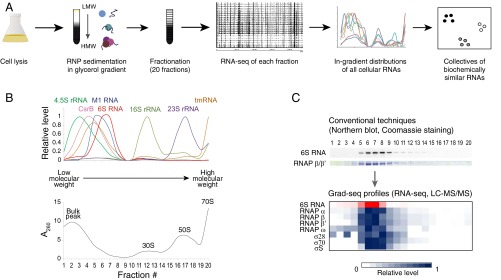
Fig. 1.
Fig. 1.
Grad-seq visualizes the Salmonella RNA interactome. (A) Grad-seq experimental strategy. (B) RNA-seq–based in-gradient distributions of housekeeping RNAs (all profiles are standardized to the range from 0 to 1). M1 and 4.5S RNAs are the RNA subunits of RNase P and SRP, respectively. CsrB is a CsrA-sequestering ncRNA. The UV profile of the corresponding gradient showing the bulk peak of low molecular weight complexes and the positions of ribosomal subunits is provided below. (C) The 6S RNA (in complex with the RNA polymerase holoenzyme) visualized with conventional techniques (Top, cropped from SI Appendix, Fig. S3A) and by Grad-seq (heat map below, all profiles are standardized to the range from 0 to 1).
Fig. 2.
Fig. 2.
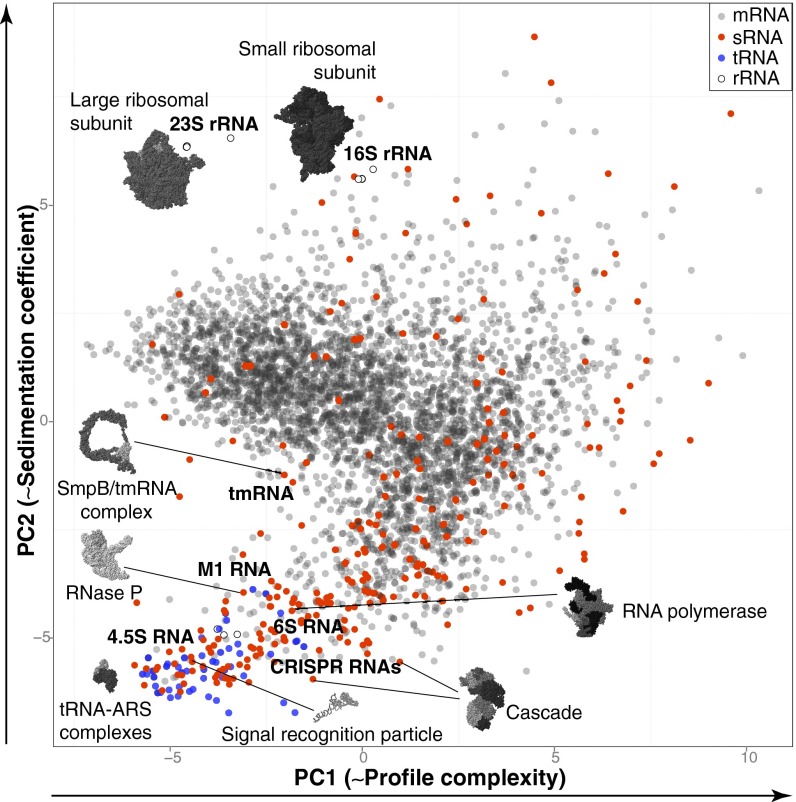
Topology of the Salmonella RNA interactome revealed by PCA of Grad-seq profiles from 3,969 Salmonella transcripts. The number of distinct RNPs formed by an RNA increases from Left to Right (PC1, ∼41% of variance), whereas sedimentation coefficients of major RNPs increase from Bottom to Top (PC2, ∼26% of variance). Select examples of corresponding RNPs are provided.
Fig. 3.
Fig. 3.
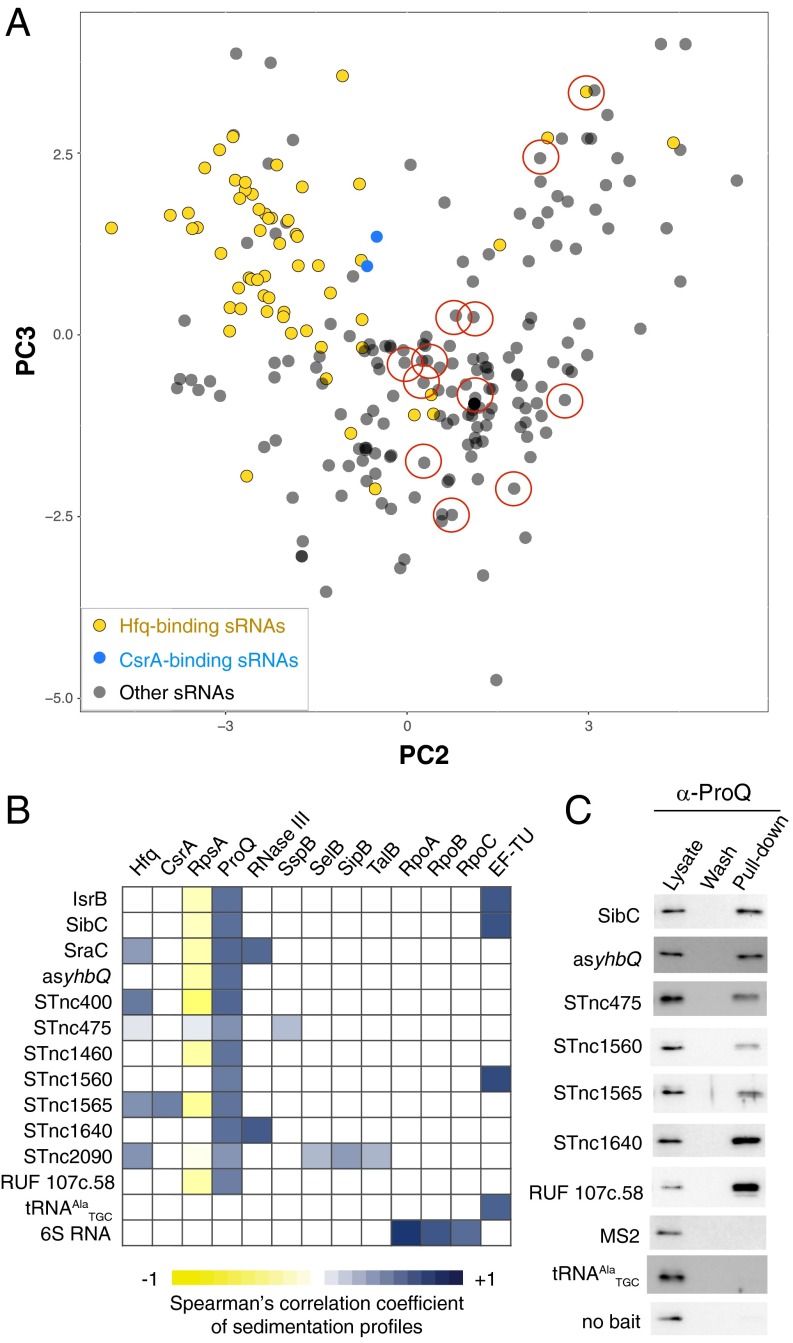
Salmonella sRNA interactome and identification of ProQ as a recurrent sRNA binder. (A) Grad-seq PCA plot of 238 Salmonella sRNAs. PC2 and PC3 are selected to visualize sRNA clusters with finer detail (Materials and Methods provides further information). Only Hfq- and CsrA-associated sRNAs are highlighted (SI Appendix, Fig. S4 shows a complete functional sRNA assignment). sRNAs selected for MS2 aptamer tagging and pull down are circled. (B and C) Pull down of the selected MS2 aptamer-tagged sRNAs from Salmonella lysates and identification of their binding partners. (B) Heat map showing proteins specifically copurified with each MS2 aptamer-tagged sRNA (most ribosomal proteins are omitted for clarity) and Spearman’s correlation coefficients of their sedimentation profiles with the Grad-seq profiles of the bait sRNAs. ProQ is a particularly frequent partner of the selected sRNAs and their sedimentation profiles match, suggesting a stable interaction. (C) ProQ is enriched in the MS2 aptamer-tagged sRNA pull downs, compared with control baits or no bait, as visualized with specific antibodies.
Fig. 4.
Fig. 4.
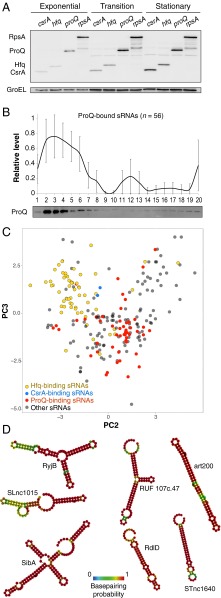
ProQ is a conserved abundant RNA-binding hub associated with a distinct class of highly structured sRNAs. (A) ProQ is an abundant, constitutively expressed protein. Equal amounts of cells with chromosomally FLAG-tagged csrA, hfq, proQ, or rpsA genes were analyzed by Western blotting with anti-FLAG antibodies in three growth phases. (B) Averaged Grad-seq distribution of ProQ-bound sRNAs. As on SI Appendix, Fig. S1C, all individual profiles of ProQ-associated sRNAs were cumulated and presented as an average along the gradient ± SD. Corresponding Western blot probed for ProQ is shown below. Only the 56 ProQ-binding sRNAs that are sufficiently covered in the Grad-seq dataset are shown. (C) Grad-seq PCA plot of Salmonella sRNAs showing segregation of Hfq-, CsrA- and ProQ-binding transcripts (Fig. 3A and SI Appendix, Fig. S9 A and B for a complete functional sRNA assignment). (D) Minimum free energy secondary structures of representative highly enriched ProQ ligands.
Fig. 5.
Fig. 5.
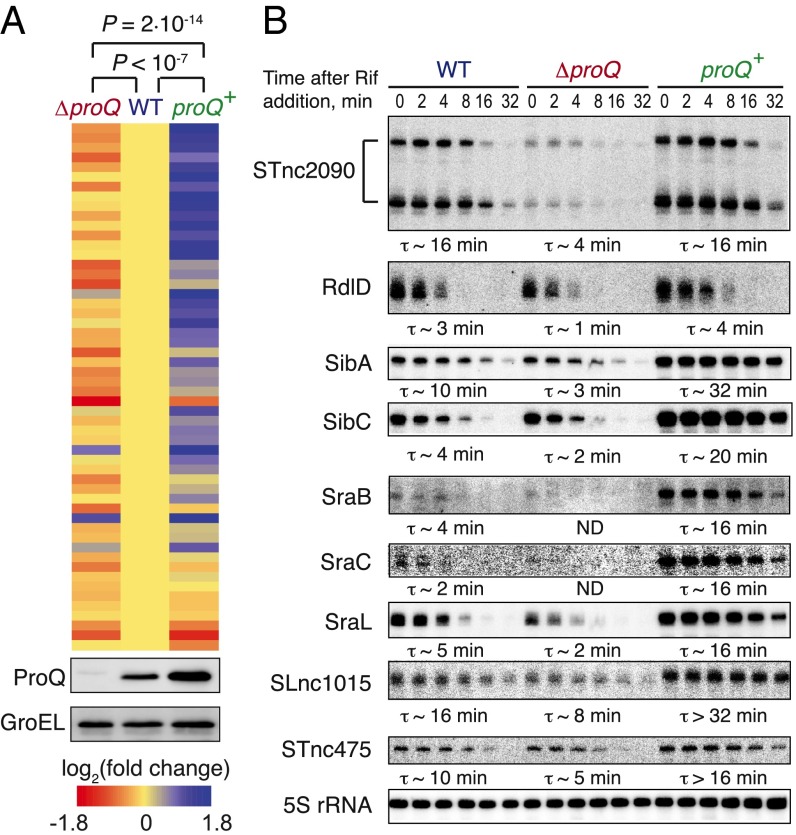
ProQ acts as a stability factor for most of its sRNA ligands. (A) ProQ positively affects the steady-state levels of most of its sRNA ligands. The heat map shows the changes in the abundance of ProQ-associated noncoding RNAs (n = 54) upon proQ deletion (ΔproQ) or complementation (proQ+). Significance of the differences is evaluated by Wilcoxon matched-pairs signed-ranks test. (Lower) Corresponding levels of ProQ in these strains, as revealed by Western blotting with a ProQ-specific antiserum. Only those sRNAs that have been sufficiently covered in the transcriptome dataset are shown. (B) ProQ stabilizes its associated sRNAs in vivo. Samples from WT, ΔproQ, and complemented proQ+ strains were collected in the stationary phase after transcription arrest with rifampicin and analyzed by Northern blotting. Approximate half-lives for major detected species are shown below the blots. ND, not determined (<1 min). A representative of three independent experiments is shown.

Comment in

References

    1. Cech TR, Steitz JA. The noncoding RNA revolution-trashing old rules to forge new ones. Cell. 2014;157(1):77–94. - PubMed
    1. Altman S. Twenty years. RNA. 2015;21(4):513–514. - PMC - PubMed
    1. Patil VS, Zhou R, Rana TM. Gene regulation by non-coding RNAs. Crit Rev Biochem Mol Biol. 2014;49(1):16–32. - PMC - PubMed
    1. Storz G, Vogel J, Wassarman KM. Regulation by small RNAs in bacteria: Expanding frontiers. Mol Cell. 2011;43(6):880–891. - PMC - PubMed
    1. Barquist L, Vogel J. Accelerating discovery and functional analysis of small RNAs with new technologies. Annu Rev Genet. 2015;49:367–394. - PubMed

Publication types

MeSH terms