


Consistency of dementia caregiver intervention classification: an evidence-based synthesis
- PMID: 27671663
- PMCID: PMC5767314
- DOI: 10.1017/S1041610216001514
Consistency of dementia caregiver intervention classification: an evidence-based synthesis
Abstract
Background: There are many systematic reviews and meta-analyses (SRs) of interventions for family caregivers of persons with Alzheimer's disease or a related dementia. A challenge when synthesizing the efficacy of dementia caregiver interventions is the potential discrepancy in how they are categorized. The objective of this study was to systematically examine inconsistencies in how dementia caregiver interventions are classified.
Methods: We searched Ovid Medline®, Ovid PsycINFO®, Ovid Embase®, and the Cochrane Library to identify previous SRs published and indexed in bibliographic databases through January 2015. Following a graphical network analysis, open-coding of classification definitions was conducted. A descriptive analysis was then completed to examine classification consistency of individual interventions across SR grouping labels.
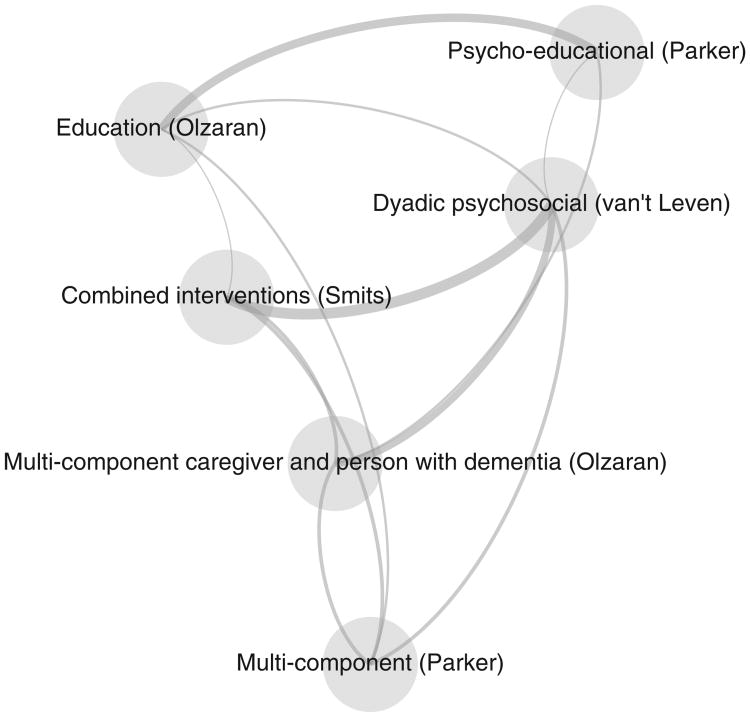
Results: Twenty-three SRs were identified. A graphical network analysis revealed a significant amount of overlap in individual studies included across SRs, but stark differences in how reviews labeled or categorized them. The qualitative content analysis identified seven themes; one of these, content of the intervention, was used to compare classification consistency. When subjecting the classification of interventions to descriptive empirical analysis, extensive inconsistency was apparent.
Conclusions: The substantial inconsistency in how dementia caregiver interventions are classified across SRs has hindered the science and practice of dementia caregiver interventions. Specifically, accurate reporting of intervention components and SRs would allow for more precise assessments of efficacy as well as a fuller determination of how caregiver interventions can best yield benefits for caregivers and persons with dementia.
Keywords: Alzheimer's disease; carers; dementia; interventions; meta-analysis; randomized controlled trial; systematic reviews.
Conflict of interest statement
Figures
References
-
- Brasure M, et al. Nonpharmacologic Interventions for Agitation and Aggression in Dementia Comparative Effectiveness Review. Minneapolis: University of Minnesota; 2015. Prepared by the Minnesota Evidence-Based Practice Center under Contract No. 290-2012-00016-I.
-
- Burgio LD, Gaugler JE. Caregiving for the chronically ill: state of the science and future directions. In: Burgio LD, Gaugler JE, Hilgeman MM, editors. The Spectrum of \Family Caregiving for Adults and Elders with Chronic Illness. New York: Oxford University Press; 2016. pp. 258–278.
-
- Charmaz K. Grounded theory. In: Nagy Hesse-Biber S, Leavy P, editors. Approaches to Qualitative Research A Reader on Theory and Practice. New York: Oxford University Press; 2004. pp. 496–521.
Publication types
MeSH terms
Grants and funding
LinkOut - more resources
Full Text Sources
Other Literature Sources
Medical
Research Materials
