Mischievous responding in Internet Gaming Disorder research
- PMID: 27672496
- PMCID: PMC5028771
- DOI: 10.7717/peerj.2401
Mischievous responding in Internet Gaming Disorder research
Abstract
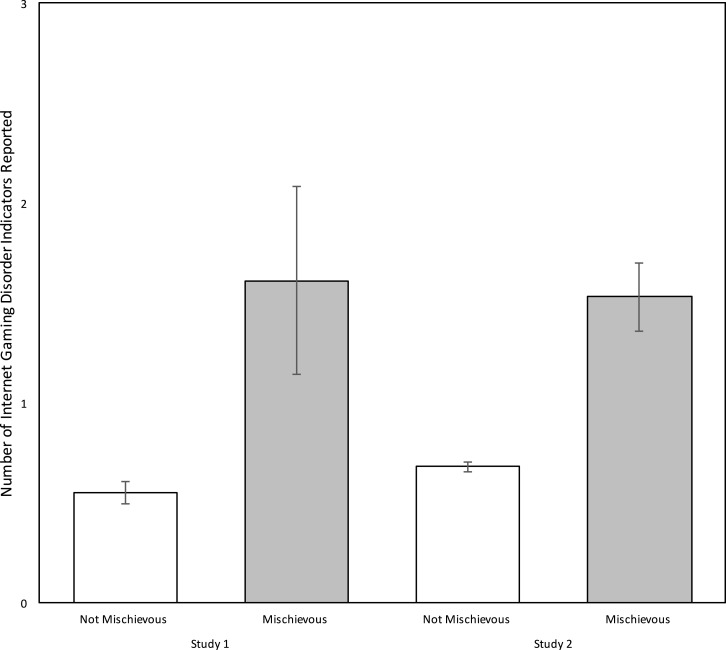
The most recent update to the American Psychiatric Association's (APA) Diagnostic and Statistical Manual of Mental Disorders (DSM-5) included Internet Gaming Disorder as a new potential psychiatric condition that merited further scientific study. The present research was conducted in response to the APA Substance-Related Disorders Working Group's research call to estimate the extent to which mischievous responding-a known problematic pattern of participant self-report responding in questionnaires-is relevant to Internet Gaming Disorder research. In line with a registered sampling and analysis plan, findings from two studies (n tot = 11,908) provide clear evidence that mischievous responding is positively associated with the number of Internet Gaming Disorder indicators participants report. Results are discussed in the context of ongoing problem gaming research and the discussion provides recommendations for improving the quality of scientific practice in this area.
Keywords: Addiction; Computer networks & communications; Internet; Internet Gaming Disorder; Internet-based games; Mischievous responding; Serious games; Video games; Web; computer games.
Conflict of interest statement
The author declares there are no competing interests.
Figures
References
-
- American Psychiatric Association . Diagnostic and statistical manual of mental disorders. 5th ed, text revision. American Psychiatric Association; Washington, D.C.: 2013.
-
- Chess S. Augmented regionalism: ingress as geomediated gaming narrative. Information, Communication & Society. 2014;17:1105–1117. doi: 10.1080/1369118X.2014.881903. - DOI
-
- Duggan M. Who plays video games and identifies as a “gamer”. 2015. http://www.pewinternet.org/2015/12/15/who-plays-video-games-and-identifi... [13 April 2016]. http://www.pewinternet.org/2015/12/15/who-plays-video-games-and-identifi...
-
- Elson M, Przybylski AK, Krämer N. “Technology and human behavior.”. Journal of Media Psychology. 2015;27:203–204. doi: 10.1027/1864-1105/a000170. - DOI
LinkOut - more resources
Full Text Sources
Other Literature Sources
Miscellaneous