


Platelet-Rich Plasma: The Choice of Activation Method Affects the Release of Bioactive Molecules
- PMID: 27672658
- PMCID: PMC5031826
- DOI: 10.1155/2016/6591717
Platelet-Rich Plasma: The Choice of Activation Method Affects the Release of Bioactive Molecules
Abstract
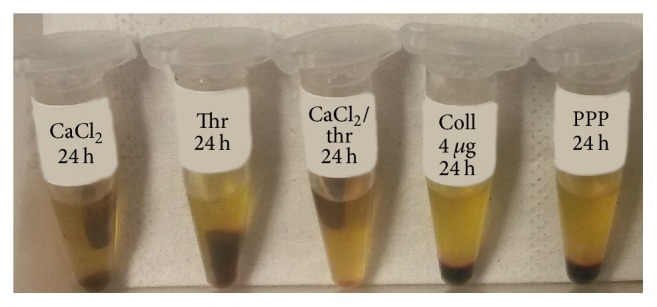
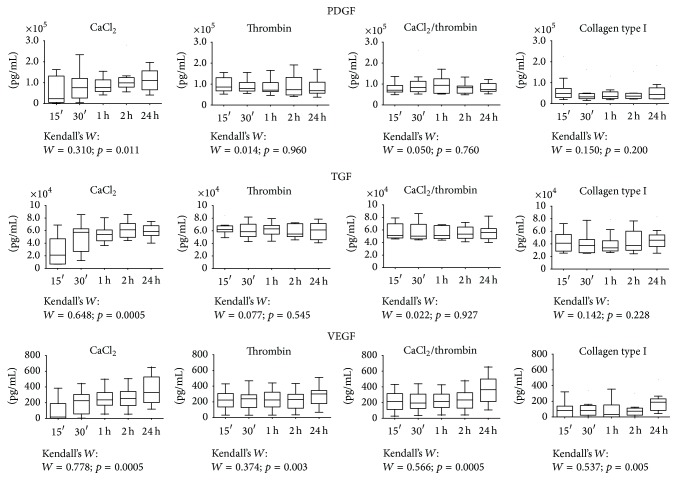
Platelet-Rich Plasma (PRP) is a low-cost procedure to deliver high concentrations of autologous growth factors (GFs). Platelet activation is a crucial step that might influence the availability of bioactive molecules and therefore tissue healing. Activation of PRP from ten voluntary healthy males was performed by adding 10% of CaCl2, 10% of autologous thrombin, 10% of a mixture of CaCl2 + thrombin, and 10% of collagen type I. Blood derivatives were incubated for 15 and 30 minutes and 1, 2, and 24 hours and samples were evaluated for the release of VEGF, TGF-β1, PDGF-AB, IL-1β, and TNF-α. PRP activated with CaCl2, thrombin, and CaCl2/thrombin formed clots detected from the 15-minute evaluation, whereas in collagen-type-I-activated samples no clot formation was noticed. Collagen type I produced an overall lower GF release. Thrombin, CaCl2/thrombin, and collagen type I activated PRPs showed an immediate release of PDGF and TGF-β1 that remained stable over time, whereas VEGF showed an increasing trend from 15 minutes up to 24 hours. CaCl2 induced a progressive release of GFs from 15 minutes and increasing up to 24 hours. The method chosen to activate PRP influences both its physical form and the releasate in terms of GF amount and release kinetic.
Figures
References
-
- Tschon M., Fini M., Giardino R., et al. Lights and shadows concerning platelet products for musculoskeletal regeneration. Frontiers in Bioscience-Elite. 2011;3(1):96–107. - PubMed
-
- Filardo G., Kon E., Roffi A., Di Matteo B., Merli M. L., Marcacci M. Platelet-rich plasma: why intra-articular? A systematic review of preclinical studies and clinical evidence on PRP for joint degeneration. Knee Surgery, Sports Traumatology, Arthroscopy. 2015;23(9):2459–2474. doi: 10.1007/s00167-013-2743-1. - DOI - PMC - PubMed
LinkOut - more resources
Full Text Sources
Other Literature Sources
Research Materials
