


Evaluation of Chromane-Based Bryostatin Analogues Prepared via Hydrogen-Mediated C-C Bond Formation: Potency Does Not Confer Bryostatin-like Biology
- PMID: 27676096
- PMCID: PMC5094189
- DOI: 10.1021/jacs.6b08695
Evaluation of Chromane-Based Bryostatin Analogues Prepared via Hydrogen-Mediated C-C Bond Formation: Potency Does Not Confer Bryostatin-like Biology
Abstract
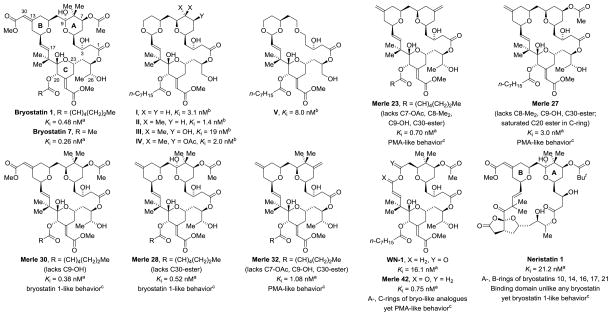
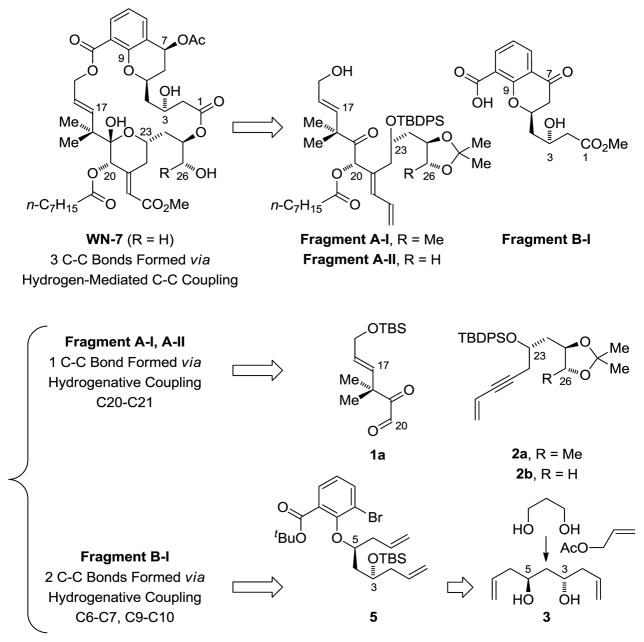
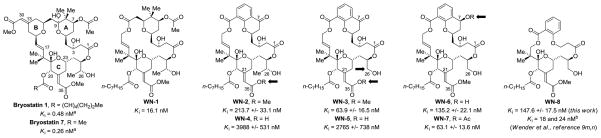
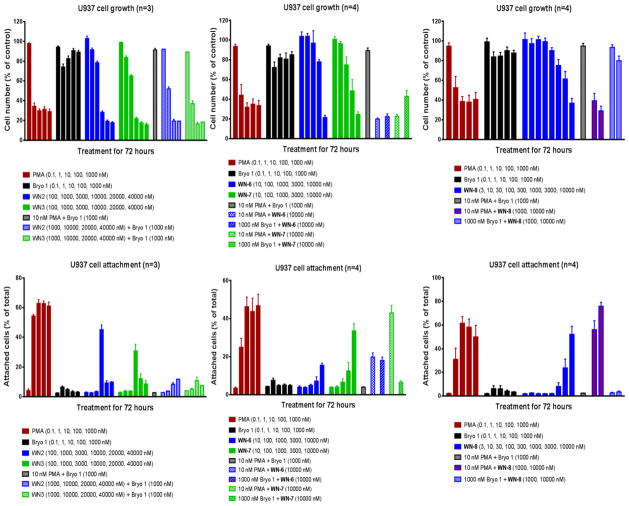
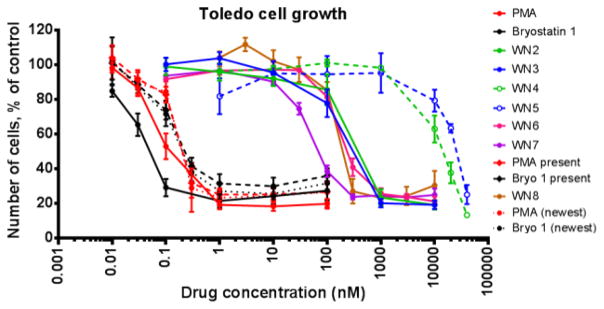
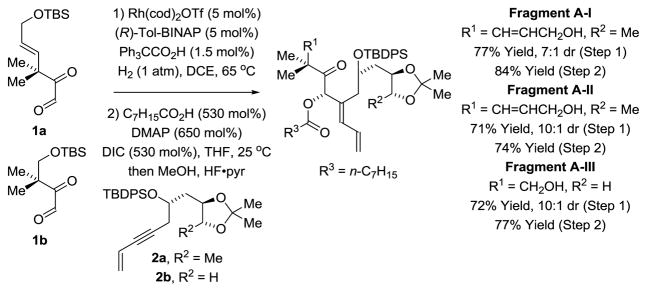
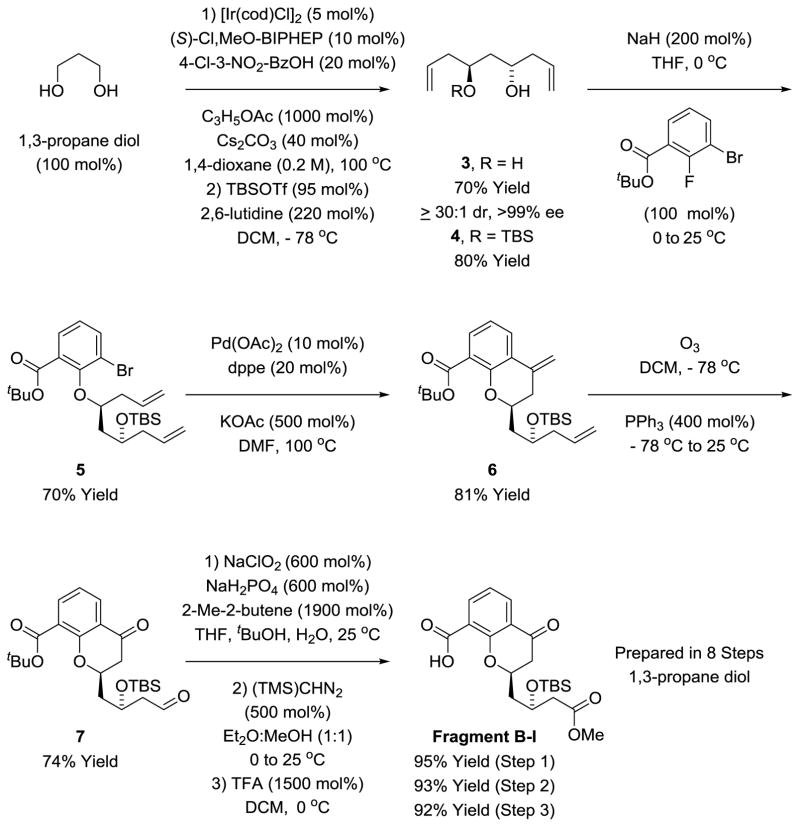
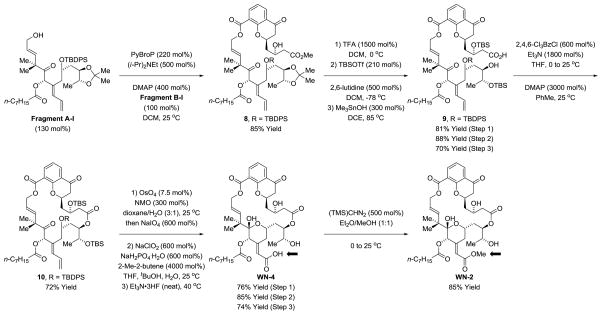
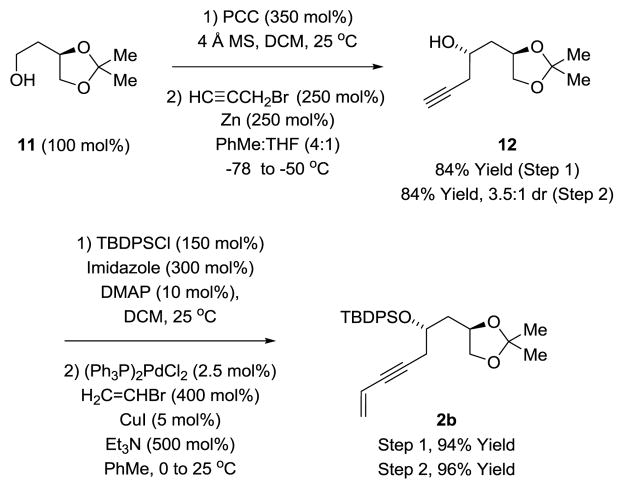
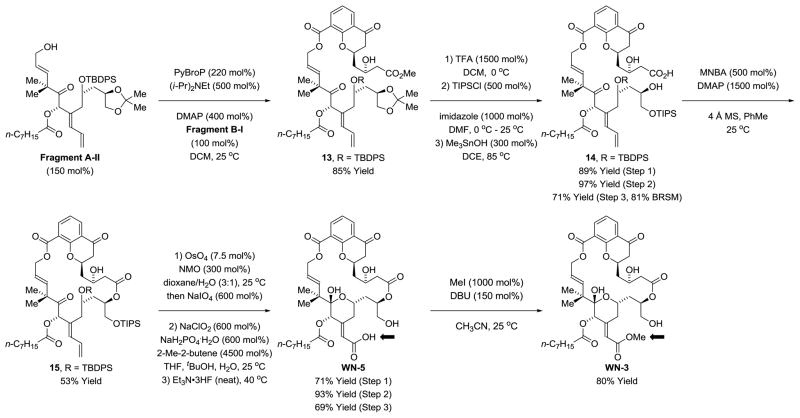
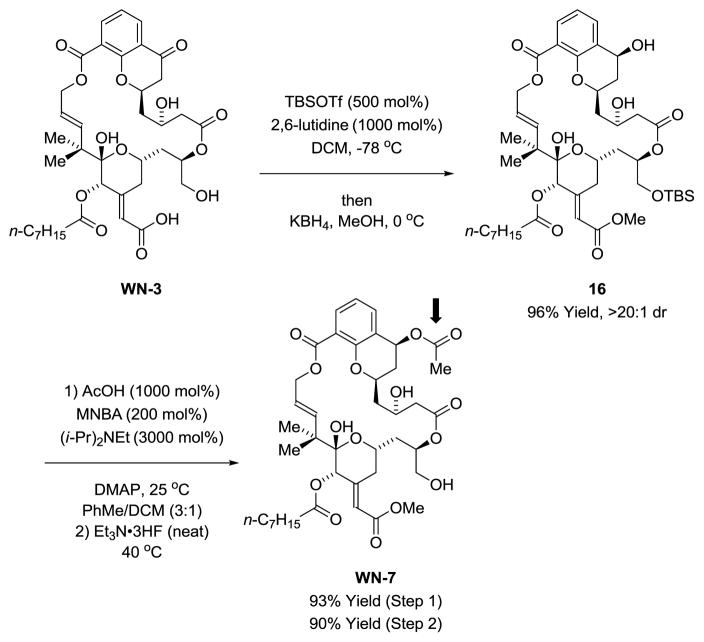
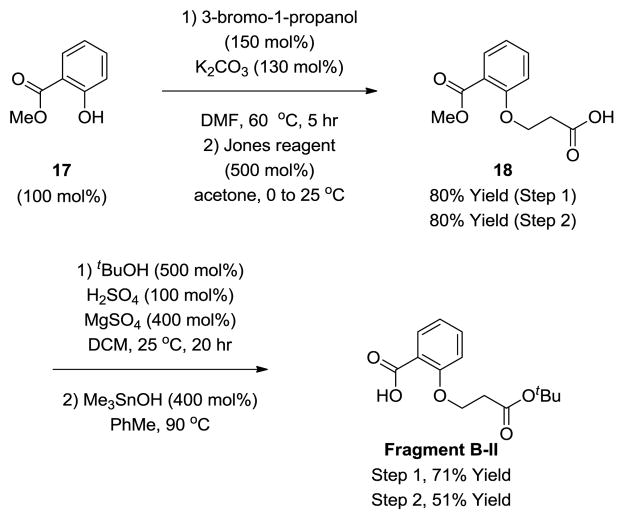
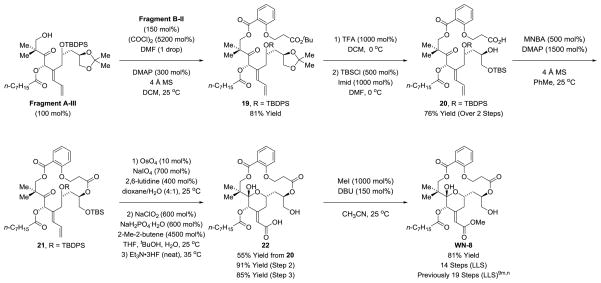
The synthesis and biological evaluation of chromane-containing bryostatin analogues WN-2-WN-7 and the previously reported salicylate-based analogue WN-8 are described. Analogues WN-2-WN-7 are prepared through convergent assembly of the chromane-containing fragment B-I with the "binding domain" fragment A-I or its C26-des-methyl congener, fragment A-II. The synthesis of fragment B-I features enantioselective double C-H allylation of 1,3-propanediol to form the C2-symmetric diol 3 and Heck cyclization of bromo-diene 5 to form the chromane core. The synthesis of salicylate WN-8 is accomplished through the union of fragments A-III and B-II. The highest binding affinities for PKCα are observed for the C26-des-methyl analogues WN-3 (Ki = 63.9 nM) and WN-7 (Ki = 63.1 nM). All analogues, WN-2-WN-8, inhibited growth of Toledo cells, with the most potent analogue being WN-7. This response, however, does not distinguish between phorbol ester-like and bryostatin-like behavior. In contrast, while many of the analogues contain a conserved C-ring in the binding domain and other features common to analogues with bryostatin-like properties, all analogues evaluated in the U937 proliferation and cell attachment assays displayed phorbol ester-like and/or toxic behavior, including WN-8, for which "bryostatin-like PKC modulatory activities" previously was suggested solely on the basis of PKC binding. These results underscore the importance of considering downstream biological effects, as tumor suppression cannot be inferred from potent PKC binding.
Figures
References
-
-
Pettit GR, Day JF, Hartwell JL, Wood HB. Nature. 1970;227:962.Pettit GR, Herald CL, Doubek DL, Herald DL, Arnold E, Clardy J. J Am Chem Soc. 1982;104:6846.Yu HB, Yang F, Li YY, Gan JH, Jiao WH, Lin HW. J Nat Prod. 2015;78:1169.It is believed that the bryostatins actually derives from a bacterial symbiont of B. neritina: Sudek S, Lopanik NB, Waggoner LE, Hildebrand M, Anderson C, Liu H, Patel A, Sherman DH, Haygood MG. J Nat Prod. 2007;70:67.Linneman J, Paulus D, Lim-Fong G, Lopanik NB. PLoS One. 2014;9:e108783.
-
-
-
For selected studies on the binding of bryostatin 1 to PKC isozymes, see: Berkow RL, Kraft AS. Biochem Biophys Res Commun. 1985;131:1109.Kraft AS, Smith JB, Berkow RL. Proc Natl Acad Sci USA. 1986;83:1334.Kazanietz MG, Lewin NE, Gao F, Petit GR, Blumberg PM. Mol Pharmacol. 1994;46:374.
-
-
-
For reviews of the chemistry and biology the bryostatins and their analogues, see: Mutter R, Wills M. Bioorg Med Chem Lett. 2000;8:1841.Hale KJ, Hummersone MG, Manaviazar S, Frigerio M. Nat Prod Rep. 2002;19:413.Kortmansky J, Schwartz GK. Cancer Invest. 2003;21:924.Wender PA, Baryza JL, Hilinski MK, Horan JC, Kan C, Verma VA. In: Drug Discovery Research: New Frontiers in the Post-Genomic Era. Huang Z, editor. Chap 6. Wiley; Hoboken: 2007. p. 127.Hale KJ, Manaviazar S. Chem Asian J. 2010;5:704.Wender PA, Loy BA, Schrier AJ. Isr J Chem. 2011;51:453.Yu L, Krische MJ. In: In Total Synthesis: At the Frontier of Organic Chemistry. Li JJ, Corey EJ, editors. Springer; Heidelberg, Germany: 2013. pp. 103–130.For information on bryostatin 1 in clinical trials for the treatment of cancer, see: (h) http://clinicaltrials.gov.
-
-
- Berkow RL, Kraft AS. Biochem Biophys Res Commun. 1985;131:1109. - PubMed
- De Vries DJ, Herald CL, Pettit GR, Blumberg PM. Biochem Pharmacol. 1988;37:4069. - PubMed
- Wender PA, Cribbs CM, Koehler KF, Sharkey NA, Herald CL, Kamano Y, Pettit GR, Blumberg PM. Proc Nat Acad Sci USA. 1988;85:7197. - PMC - PubMed
-
- Schaufelberger DE, Koleck MP, Beutler JA, Vatakis AM, Alvarado AB, Andrews P, Marzo LV, Muschik GM, Roach J, Ross JT, Lebherz WB, Reeves MP, Eberwein RM, Rodgers LL, Testerman RP, Snader KM, Forenza S. J Nat Prod. 1991;54:1265. - PubMed
Publication types
MeSH terms
Substances
Grants and funding
LinkOut - more resources
Full Text Sources
Other Literature Sources
