Review
. 2017 Mar;43(2):154-168.
doi: 10.1055/s-0036-1586229. Epub 2016 Sep 27.

tPA Modulation of the Blood-Brain Barrier: A Unifying Explanation for the Pleiotropic Effects of tPA in the CNS

Affiliations
Review

tPA Modulation of the Blood-Brain Barrier: A Unifying Explanation for the Pleiotropic Effects of tPA in the CNS

Linda Fredriksson et al. Semin Thromb Hemost. 2017 Mar.

Abstract

The plasminogen activation (PA) system is best known for its role in fibrinolysis. However, it has also been shown to regulate many nonfibrinolytic functions in the central nervous system (CNS). In particular, tissue-type plasminogen activator (tPA) is reported to have pleiotropic activities in the CNS, regulating events such as neuronal plasticity, excitotoxicity, and cerebrovascular barrier integrity, whereas urokinase-type plasminogen activator is mainly associated with tissue remodeling and cell migration. It has been suggested that the role tPA plays in controlling barrier integrity may provide a unifying mechanism for the reported diverse, and often opposing, functions ascribed to tPA in the CNS. Here we will review the possibility that the pleiotropic effects reported for tPA in physiologic and pathologic processes in the CNS may be a consequence of its role in the neurovascular unit in regulation of cerebrovascular responses and subsequently parenchymal homeostasis. We propose that this might offer an explanation for the ongoing debate regarding the neurotoxic versus neuroprotective roles of tPA.


Figures

Figure 1
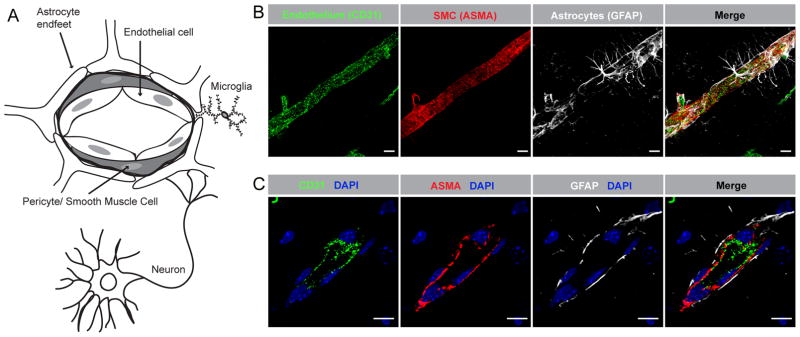
Figure 1
The neurovascular unit (NVU). A) Schematic illustration of the structure and cellular components of the NVU. B) Confocal microscopy image showing the NVU in the naïve adult wild type murine brain. The perivascular astrocytic endfeet (white) completely ensheath the vascular smooth muscle cell (SMC) layer (red) and the endothelial tube (green). C) High magnification confocal image showing the order of cells in the NVU, with the endothelial cells (green) closest to the vessel lumen and the SMCs (red) tightly wrapping around the endothelial tube. Immunofluorescent staining of endothelial cells with anti-CD31 antibodies (CD31), SMC with anti-ASMA antibodies and perivascular astrocytes with anti-GFAP antibodies. Cell nuclei were visualized with DAPI (blue). The images in B display maximum intensity projections generated from confocal Z-stacks (25 μm). Scale bars in B and C 10 μm.
Figure 2
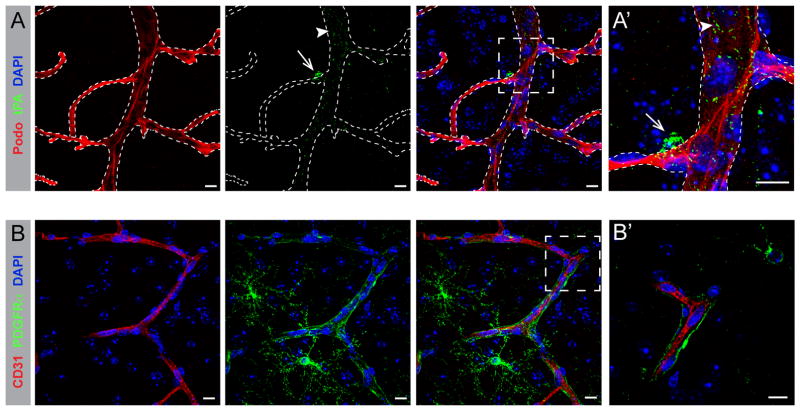
Figure 2
Perivascular expression of tPA and PDGFRα in the NVU. A, A′) Confocal microscopy image showing expression of tPA (green) in the NVU of the naïve wild type murine brain. tPA is expressed as two distinct pools in the NVU; one within the endothelial cells (arrowheads) and another on the abluminal side of the vessels (arrows). Vessels were visualized by immunofluorescent staining using the endothelial cell marker podocalyxin (red, Podo). B, B′) Confocal image showing expression of PDGFRα (green) ensheathing (arrows) the vessel (red) in the NVU of the naïve wild type murine brain. Vessels were visualized by immunofluorescent staining using the endothelial cell markers in A, A′) podocalyxin (Podo) and in B, B′) CD31. Cell nuclei were visualized with DAPI (blue). The images display maximum intensity projections generated from confocal Z-stacks (A, A′ = 17 μm; B = 20 μm; B′ = 4 μm). Scale bars, 10 μm.
Figure 3
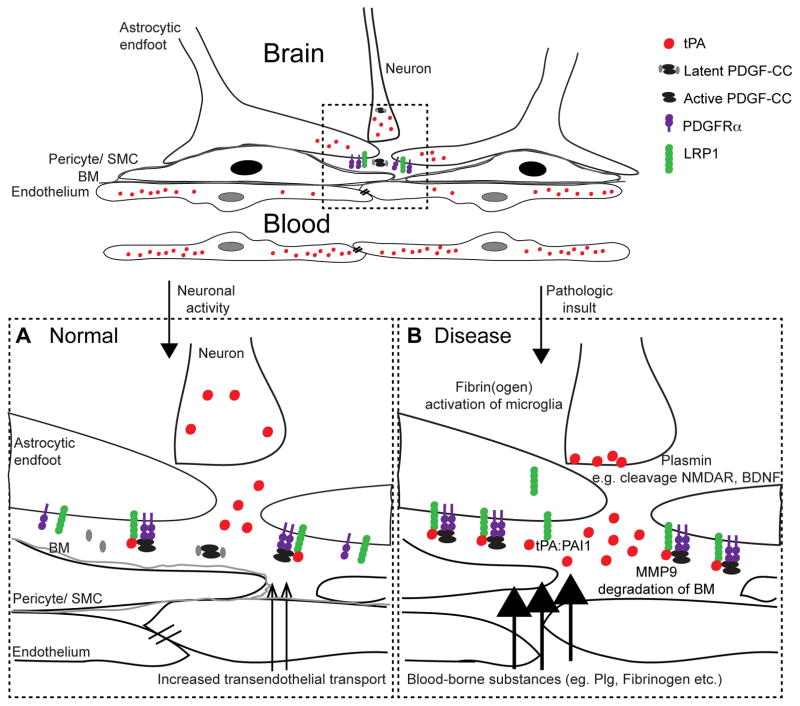
Figure 3
tPA-mediated regulation of BBB integrity. A) Under physiologic conditions tPA is released by activated neurons into the perivascular space where it activates PDGF-CC, and subsequently PDGFRα signaling on perivascular astrocytes, through interaction with LRP, which leads to cerebrovascular changes associated with neuronal activity. B) In pathologic conditions initial increase in BBB permeability is mediated by proteolytic active tPA, potentially in response to the increased energy and metabolic demand in neurons following insult. Excessive signaling via either active tPA or via tPA:PAI-1 complex formation and LDLR signaling, leads to further opening of the barrier and subsequent extravasation of blood-borne substances from the vascular space into the brain parenchyma. Following intravenous treatment with thrombolytic tPA it is plausible that exogenous tPA enters the brain through the breached BBB thereby exacerbating the PDGF-CC/PDGFRα signaling in the NVU.

References

    1. Collen D. Ham-Wasserman lecture: role of the plasminogen system in fibrin-homeostasis and tissue remodeling. Hematology (Am Soc Hematol Educ Program) 2001:1–9. - PubMed
    1. The National Institute of Neurological Disorders and Stroke rt-PA Stroke Study Group. Tissue plasminogen activator for acute ischemic stroke. N Engl J Med. 1995 Dec 14;333(24):1581–1587. - PubMed
    1. Li J, Yu L, Gu X, et al. Tissue plasminogen activator regulates Purkinje neuron development and survival. Proceedings of the National Academy of Sciences of the United States of America. 2013 Jun 25;110(26):E2410–2419. - PMC - PubMed
    1. Seeds NW, Basham ME, Ferguson JE. Absence of tissue plasminogen activator gene or activity impairs mouse cerebellar motor learning. J Neurosci. 2003 Aug 13;23(19):7368–7375. - PMC - PubMed
    1. Minor K, Phillips J, Seeds NW. Tissue plasminogen activator promotes axonal outgrowth on CNS myelin after conditioned injury. J Neurochem. 2009 May;109(3):706–715. - PubMed

Substances