


Dasatinib enhances tumor growth in gemcitabine-resistant orthotopic bladder cancer xenografts
- PMID: 27677700
- PMCID: PMC5039786
- DOI: 10.1186/s13104-016-2256-3
Dasatinib enhances tumor growth in gemcitabine-resistant orthotopic bladder cancer xenografts
Abstract
Background: Systemic chemotherapy with gemcitabine and cisplatin is standard of care for patients with metastatic urothelial bladder cancer. However, resistance formation is common after initial response. The protein Src is known as a proto-oncogene, which is overexpressed in various human cancers. Since there are controversial reports about the role of Src in bladder cancer, we evaluated the efficacy of the Src kinase inhibitor dasatinib in the urothelial bladder cancer cell line RT112 and its gemcitabine-resistant sub-line RT112rGEMCI20 in vitro and in vivo.
Methods: RT112 urothelial cancer cells were adapted to growth in the presence of 20 ng/ml gemcitabine (RT112rGEMCI20) by continuous cultivation at increasing drug concentrations. Cell viability was determined by MTT assay, cell growth kinetics were determined by cell count, protein levels were measured by western blot, and cell migration was evaluated by scratch assays. In vivo tumor growth was tested in a murine orthotopic xenograft model using bioluminescent imaging.
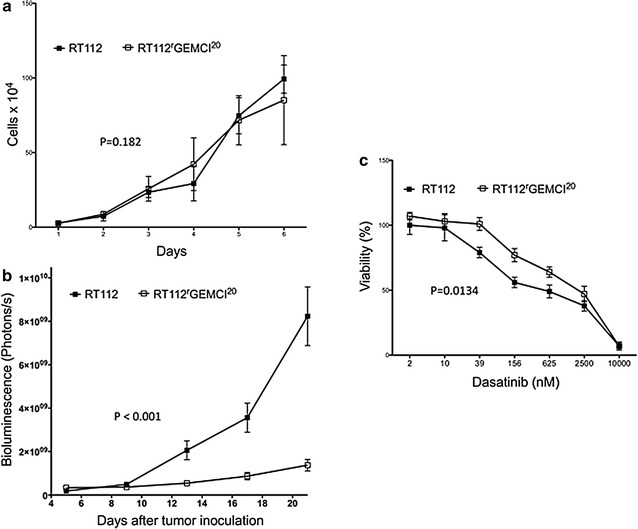
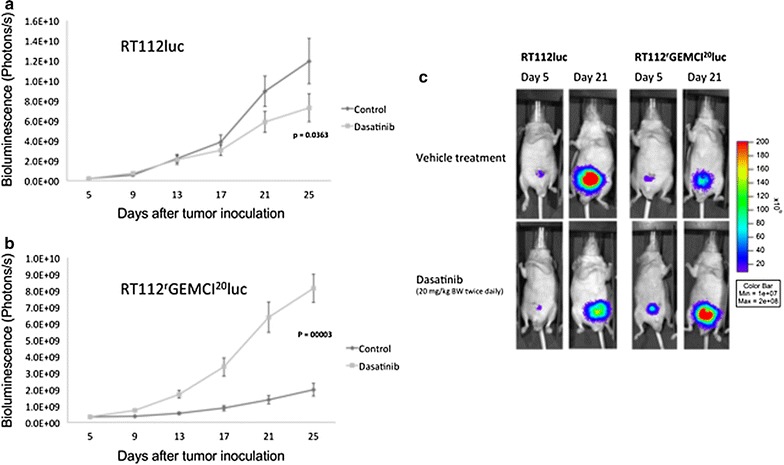
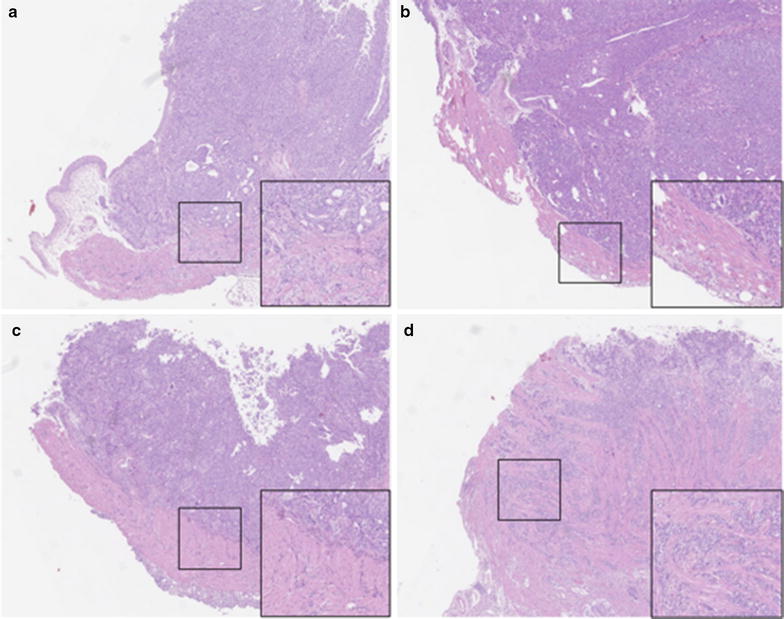
Results: Dasatinib exerted similar effects on Src signaling in RT112 and RT112rGEMCI20 cells but RT112rGEMCI20 cells were less sensitive to dasatinib-induced anti-cancer effects (half maximal inhibitory concentration (IC50) of dasatinib in RT112 cells: 349.2 ± 67.2 nM; IC50 of dasatinib in RT112rGEMCI20 cells: 1081.1 ± 239.2 nM). Dasatinib inhibited migration of chemo-naive and gemcitabine-resistant cells. Most strikingly, dasatinib treatment reduced RT112 tumor growth and muscle invasion in orthotopic xenografts, while it was associated with increased size and muscle-invasive growth in RT112rGEMCI20 tumors.
Conclusion: Dasatinib should be considered with care for the treatment of urothelial cancer, in particular for therapy-refractory cases.
Keywords: Acquired resistance; Cancer cell line collection; Dasatinib; Gemcitabine; Orthotopic xenograft model; Urothelial bladder cancer.
Figures

References
-
- von der Maase H, Sengelov L, Roberts JT, Ricci S, Dogliotti L, Oliver T, Moore MJ, Zimmermann A, Arning M. Long-term survival results of a randomized trial comparing gemcitabine plus cisplatin, with methotrexate, vinblastine, doxorubicin, plus cisplatin in patients with bladder cancer. J Clin Oncol. 2005;23(21):4602–4608. doi: 10.1200/JCO.2005.07.757. - DOI - PubMed
-
- Choueiri TK, Ross RW, Jacobus S, Vaishampayan U, Yu EY, Quinn DI, Hahn NM, Hutson TE, Sonpavde G, Morrissey SC, et al. Double-blind, randomized trial of docetaxel plus vandetanib versus docetaxel plus placebo in platinum-pretreated metastatic urothelial cancer. J Clin Oncol. 2012;30(5):507–512. doi: 10.1200/JCO.2011.37.7002. - DOI - PMC - PubMed
LinkOut - more resources
Full Text Sources
Other Literature Sources
Miscellaneous
