


Adolescent methylmercury exposure affects choice and delay discounting in mice
- PMID: 27677934
- PMCID: PMC5123936
- DOI: 10.1016/j.neuro.2016.09.016
Adolescent methylmercury exposure affects choice and delay discounting in mice
Abstract
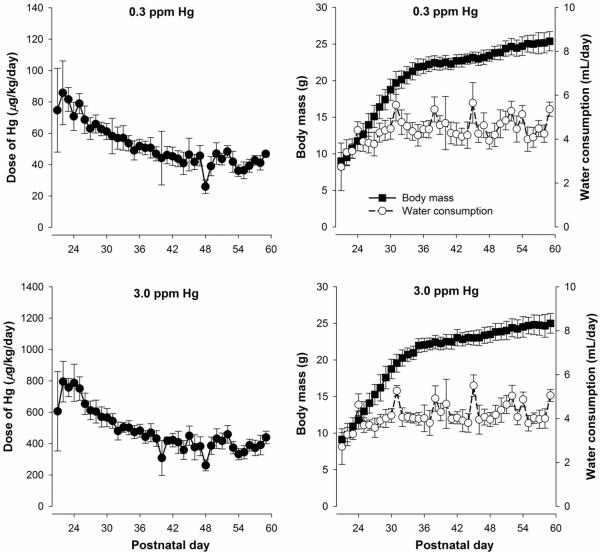
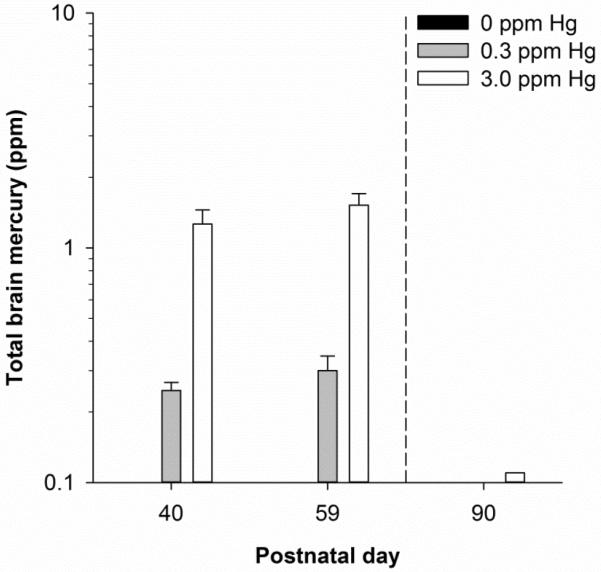
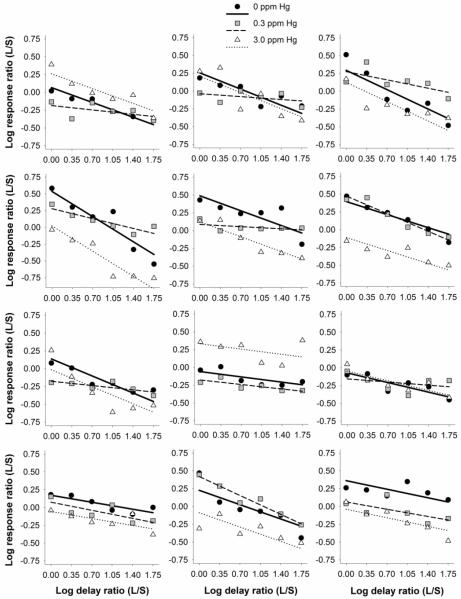
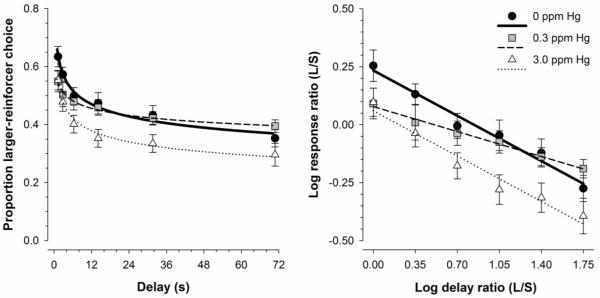
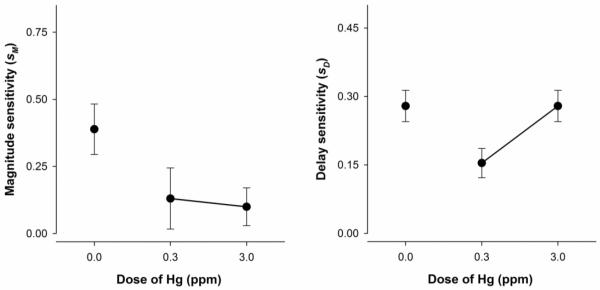
The developing fetus is vulnerable to low-level exposure to methylmercury (MeHg), an environmental neurotoxicant, but the consequences of exposure during the adolescent period remain virtually unknown. The current experiments were designed to assess the effects of low-level MeHg exposure during adolescence on delay discounting, preference for small, immediate reinforcers over large, delayed ones, using a mouse model. Thirty-six male C57BL/6n mice were exposed to 0, 0.3, or 3.0ppm mercury (as MeHg) via drinking water from postnatal day 21 through 59, encompassing the murine adolescent period. As adults, mice lever pressed for a 0.01-cc droplet of milk solution delivered immediately or four 0.01-cc droplets delivered after a delay. Delays ranged from 1.26 to 70.79s, and all were presented within a session. A model based on the Generalized Matching Law indicated that sensitivity to reinforcer magnitude was lower for MeHg-exposed mice relative to controls, indicating that responding in MeHg-exposed mice was relatively indifferent to the larger reinforcer. Sensitivity to reinforcer delay was reduced (delay discounting was decreased) in the 0.3-ppm group, but not in the 3.0-ppm group, compared to controls. Adolescence is a developmental period during which the brain and behavior may be vulnerable to MeHg exposure. As with gestational MeHg exposure, the effects are reflected in the impact of reinforcing stimuli.
Keywords: Adolescence; Delay discounting; Impulsive choice; Matching law; Methylmercury.
Copyright © 2016 Elsevier B.V. All rights reserved.
Figures
References
-
- Adriani W, Boyer F, Gioiosa L, Macrì S, Dreyer J, Laviola G. Increased impulsive behavior and risk proneness following lentivirus-mediated dopamine transporter over-expression in rats' nucleus accumbens. Neuroscience. 2009;159:47–58. - PubMed
-
- Adriani W, Laviola G. Windows of vulnerability to psychopathology and therapeutic strategy in the adolescent rodent model. Behavioural Pharmacology. 2004;15:341–52. - PubMed
-
- Adriani W, Macrì S, Pacifici R, Laviola G. Peculiar vulnerability to nicotine oral self-administration in mice during early adolescence. Neuropsychopharmacology. 2002;27(2):212–224. - PubMed
-
- Anderson DR. Information theory and entropy. Springer; New York: 2008.
-
- Avila I, Reilly MP, Sanabria F, Posadas-Sánchez D, Chavez CL, Banerjee N, Castañeda E. Modeling operant behavior in the Parkinsonian rat. Behavioural Brain Research. 2009;198(2):298–305. http://doi.org/10.1016/j.bbr.2008.11.033. - DOI - PMC - PubMed
MeSH terms
Substances
Grants and funding
LinkOut - more resources
Full Text Sources
Other Literature Sources
Medical
Research Materials
