


Current State of Child Health in Rural America: How Context Shapes Children's Health
- PMID: 27677973
- PMCID: PMC5373918
- DOI: 10.1111/jrh.12222
Current State of Child Health in Rural America: How Context Shapes Children's Health
Abstract
Purpose: Children's health is influenced by the context in which they live. We provide a descriptive essay on the status of children in rural America to highlight features of the rural environment that may affect health.
Description: We compiled information concerning components of the rural environment that may contribute to health outcomes. Areas addressed include the economic characteristics, provider availability, uniquely rural health risks, health services use, and health outcomes among rural children.
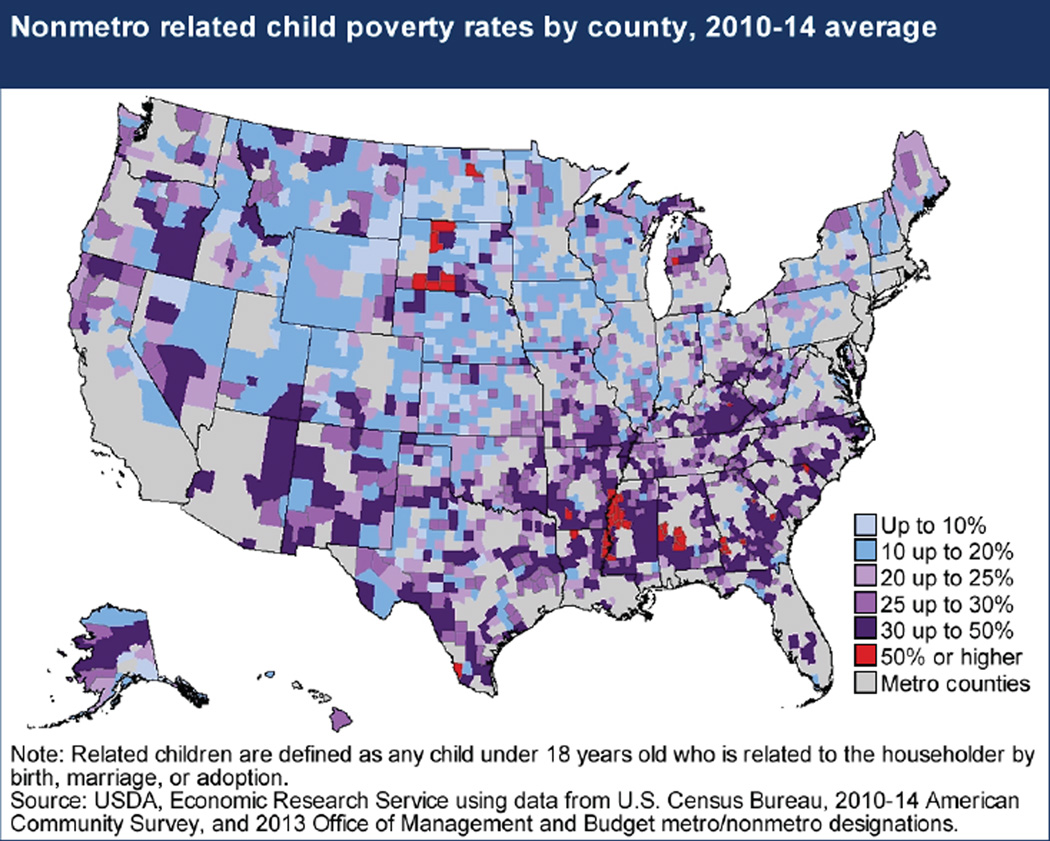
Assessment: Nearly 12 million children live in the rural United States. Rural counties are economically disadvantaged, leading to higher rates of poverty among rural versus urban children. Rural and urban children are approximately equally likely to be insured, but Medicaid insures a higher proportion of children in rural areas. While generally similar in health, rural children are more likely to be overweight or obese than urban children. Rural parents are less likely to report that their children received preventive medical or oral health visits than urban parents. Rural children are more likely to die than their urban peers, largely due to unintentional injury.
Conclusion: Improving rural children's health will require both increased public health surveillance and research that creates solutions appropriate for rural environments, where health care professionals may be in short supply. Most importantly, solutions must be multisectoral, engaging education, economic development, and other community perspectives as well as health care.
Keywords: children's health; epidemiology; health disparities; rural; social determinants of health.
© 2016 National Rural Health Association.
Figures
References
-
- Andersen RM. Revisiting the behavioral model and access to medical care: does it matter? Journal of Health and Social Behavior. 1995;36(1):1–10. - PubMed
-
- Andersen RM. National health surveys and the behavioral model of health services use. Medical Care. 2008;46(7):647–653. - PubMed
-
- Stokols D. Translating social ecological theory into guidelines for community health promotion. American Journal of Health Promotion. 1996;10(4):282–298. - PubMed
-
- Enders A. Presented at the Health Outcomes Among Children & Families Living in Rural Communities Conference. Bethesda, MD: Eunice Kennedy Shriver National Institute of Child Health and Human Development; 2011. Dec, Inclusion of Families of Children with Disabilities in Health Services Research.
Publication types
MeSH terms
Grants and funding
LinkOut - more resources
Full Text Sources
Other Literature Sources
Medical
