


Evaluating Google Flu Trends in Latin America: Important Lessons for the Next Phase of Digital Disease Detection
- PMID: 27678084
- PMCID: PMC6394128
- DOI: 10.1093/cid/ciw657
Evaluating Google Flu Trends in Latin America: Important Lessons for the Next Phase of Digital Disease Detection
Abstract
Background: Latin America has a substantial burden of influenza and rising Internet access and could benefit from real-time influenza epidemic prediction web tools such as Google Flu Trends (GFT) to assist in risk communication and resource allocation during epidemics. However, there has never been a published assessment of GFT's accuracy in most Latin American countries or in any low- to middle-income country. Our aim was to evaluate GFT in Argentina, Bolivia, Brazil, Chile, Mexico, Paraguay, Peru, and Uruguay.
Methods: Weekly influenza-test positive proportions for the eight countries were obtained from FluNet for the period January 2011-December 2014. Concurrent weekly Google-predicted influenza activity in the same countries was abstracted from GFT. Pearson correlation coefficients between observed and Google-predicted influenza activity trends were determined for each country. Permutation tests were used to examine background seasonal correlation between FluNet and GFT by country.
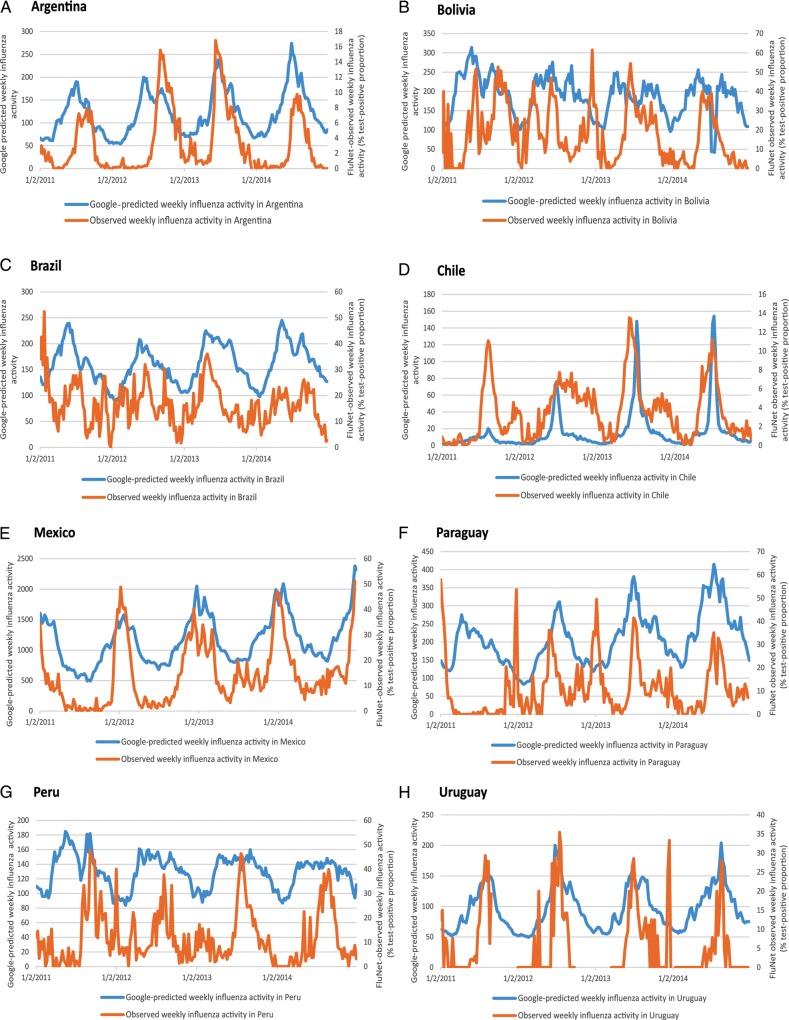
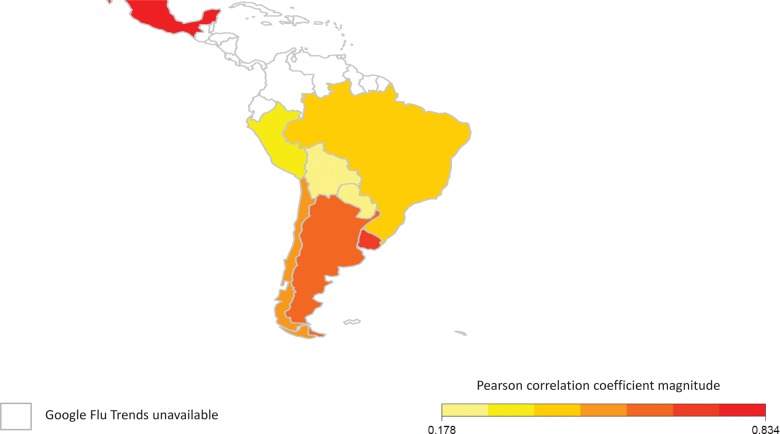
Results: There were frequent GFT prediction errors, with correlation ranging from r = -0.53 to 0.91. GFT-predicted influenza activity best correlated with FluNet data in Mexico follow by Uruguay, Argentina, Chile, Brazil, Peru, Bolivia and Paraguay. Correlation was generally highest in the more temperate countries with more regular influenza seasonality and lowest in tropical regions. A substantial amount of autocorrelation was noted, suggestive that GFT is not fully specific for influenza virus activity.
Conclusions: We note substantial inaccuracies with GFT-predicted influenza activity compared with FluNet throughout Latin America, particularly among tropical countries with irregular influenza seasonality. Our findings offer valuable lessons for future Internet-based biosurveillance tools.
Keywords: Google Flu Trends; Latin America; digital epidemiology.
© The Author 2016. Published by Oxford University Press for the Infectious Diseases Society of America. All rights reserved. For permissions, e-mail journals.permissions@oup.com.
Figures
Comment in
-
Editorial Commentary: Perspectives on the Future of Internet Search Engines and Biosurveillance Systems.Clin Infect Dis. 2017 Jan 1;64(1):42-43. doi: 10.1093/cid/ciw660. Epub 2016 Sep 26. Clin Infect Dis. 2017. PMID: 27678086 No abstract available.
References
-
- Desai R, Hall AJ, Lopman BA et al. Norovirus disease surveillance using Google Internet query share data. Clin Infect Dis 2012; 55:e75–8. - PubMed
-
- Ginsberg J, Mohebbi MH, Patel RS, Brammer L, Smolinski MS, Brilliant L. Detecting influenza epidemics using search engine query data. Nature 2009; 457:1012–4. - PubMed
-
- Polgreen PM, Chen YL, Pennock DM, Nelson FD. Using Internet searches for influenza surveillance. Clin Infect Dis 2008; 47:1443–8. - PubMed
Publication types
MeSH terms
LinkOut - more resources
Full Text Sources
Other Literature Sources
Medical
