


The Added Value of Circulating Tumor Cell Enumeration to Standard Markers in Assessing Prognosis in a Metastatic Castration-Resistant Prostate Cancer Population
- PMID: 27678453
- PMCID: PMC5368027
- DOI: 10.1158/1078-0432.CCR-16-1224
The Added Value of Circulating Tumor Cell Enumeration to Standard Markers in Assessing Prognosis in a Metastatic Castration-Resistant Prostate Cancer Population
Abstract
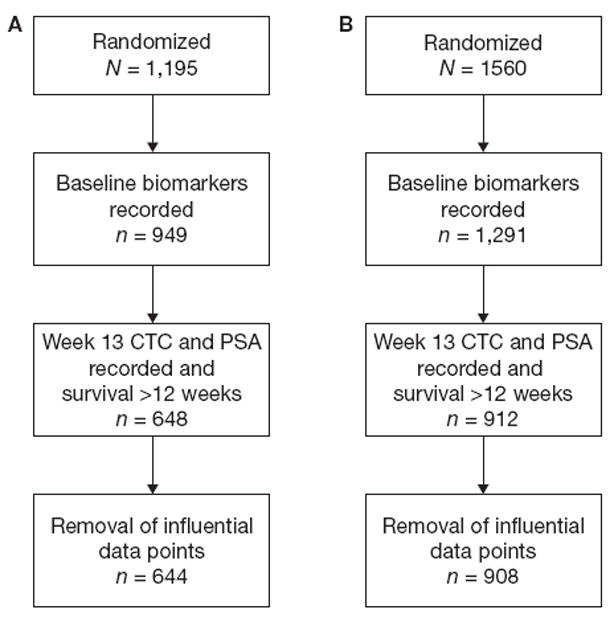
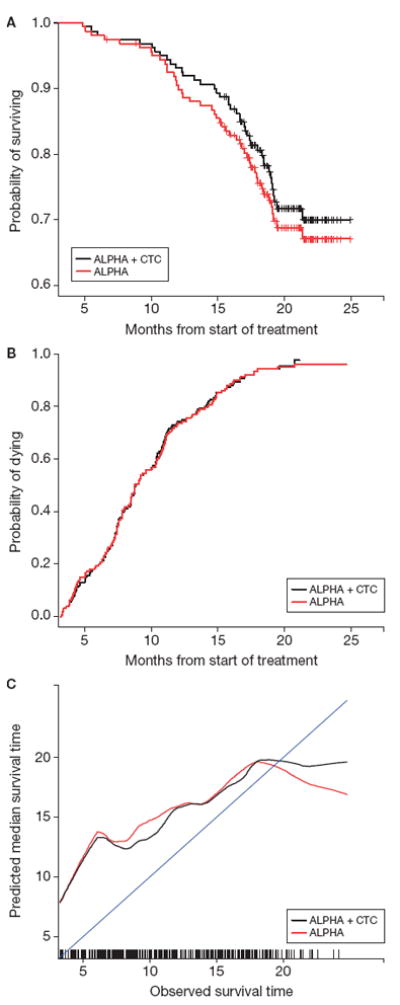
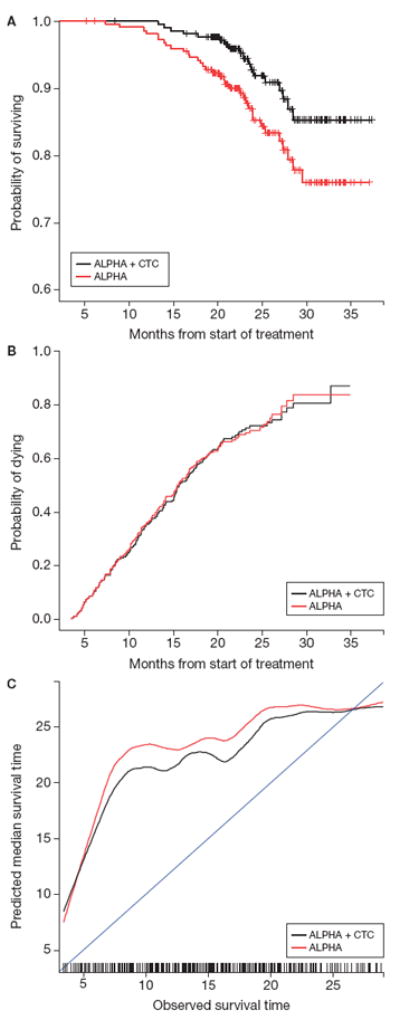
Purpose: Metastatic castration-resistant prostate cancer (mCRPC) is a heterogeneous disease for which better prognostic models for survival are needed. We examined the added value of circulating tumor cell (CTC) enumeration relative to common prognostic laboratory measures from patients with CRPC.Methods: Utility of CTC enumeration as a baseline and postbaseline prognostic biomarker was examined using data from two prospective randomized registration-directed trials (COU-AA-301 and ELM-PC4) within statistical models used to estimate risk for survival. Discrimination and calibration were used to measure model predictive accuracy and the added value for CTC enumeration in the context of a Cox model containing albumin, lactate dehydrogenase (LDH), PSA, hemoglobin, and alkaline phosphatase (ALK). Discrimination quantifies how accurately a risk model predicts short-term versus long-term survivors. Calibration measures the closeness of actual survival time to the predicted survival time.Results: Adding CTC enumeration to a model containing albumin, LDH, PSA, hemoglobin, and ALK ("ALPHA") improved its discriminatory power. The weighted c-index for ALPHA without CTCs was 0.72 (SE, 0.02) versus 0.75 (SE, 0.02) for ALPHA + CTCs. The increase in discrimination was restricted to the lower-risk cohort. In terms of calibration, adding CTCs produced a more accurate model-based prediction of patient survival. The absolute prediction error for ALPHA was 3.95 months (SE, 0.28) versus 3.75 months (SE, 0.22) for ALPHA + CTCs.Conclusions: Addition of CTC enumeration to standard measures provides more accurate assessment of patient risk in terms of baseline and postbaseline prognosis in the mCRPC population. Clin Cancer Res; 23(8); 1967-73. ©2016 AACR.
©2016 American Association for Cancer Research.
Conflict of interest statement
Figures
References
-
- Cohen SJ, Punt CJ, Iannotti N, Saidman BH, Sabbath KD, Gabrail NY, et al. Relationship of circulating tumor cells to tumor response, progression-free survival, and overall survival in patients with metastatic colorectal cancer. J Clin Oncol. 2008;26:3213–21. - PubMed
-
- Cristofanilli M, Budd GT, Ellis MJ, Stopeck A, Matera J, Miller MC, et al. Circulating tumor cells, disease progression, and survival in metastatic breast cancer. N Engl J Med. 2004;351:781–91. - PubMed
-
- de Bono JS, Scher HI, Montgomery RB, Parker C, Miller MC, Tissing H, et al. Circulating tumor cells predict survival benefit from treatment in metastatic castration-resistant prostate cancer. Clin Cancer Res. 2008;14:6302–9. - PubMed
-
- US Food and Drug Administration. [21 December, 2015];CellSearch™ Epithelial Cell Kit/CellSpotter™ Analyzer - K031588. Available from US FDA Web site [Internet]. Available from: http://www.fda.gov/MedicalDevices/ProductsandMedicalProcedures/DeviceApp....
-
- US Food and Drug Administration. [21 December, 2015];CellSearch™ Epithelial Cell Kit/CellSpotter™ Analyzer - K071729 510(k) Summary. US FDA Web site [Internet]. Available from: http://www.accessdata.fda.gov/cdrh_docs/reviews/K071729.pdf.
Publication types
MeSH terms
Substances
Grants and funding
LinkOut - more resources
Full Text Sources
Other Literature Sources
Research Materials
Miscellaneous
