


The synthetic xylulose-1 phosphate pathway increases production of glycolic acid from xylose-rich sugar mixtures
- PMID: 27679669
- PMCID: PMC5029101
- DOI: 10.1186/s13068-016-0610-2
The synthetic xylulose-1 phosphate pathway increases production of glycolic acid from xylose-rich sugar mixtures
Abstract
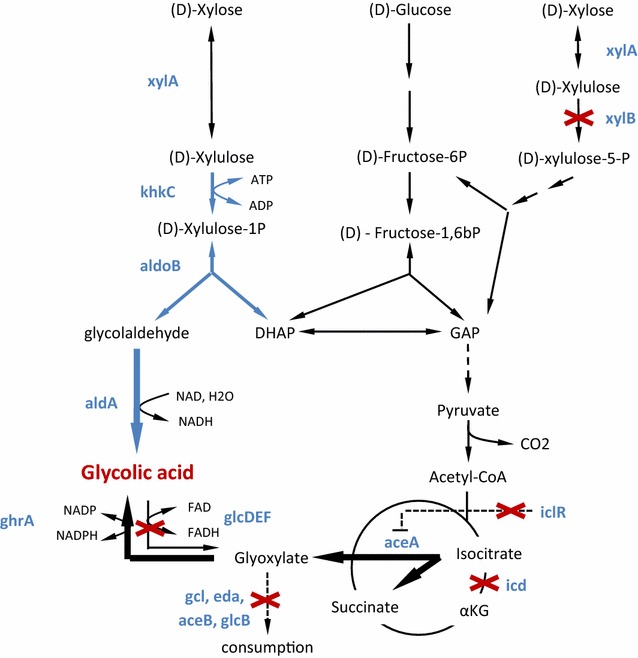
Background: Glycolic acid (GA) is a two-carbon hydroxyacid with applications in the cosmetic, textile, and medical industry. Microbial GA production from all sugars can be achieved by engineering the natural glyoxylate shunt. The synthetic (d)-xylulose-1 phosphate (X1P) pathway provides a complementary route to produce GA from (d)-xylose. The simultaneous operation of the X1P and glyoxylate pathways increases the theoretical GA yield from xylose by 20 %, which may strongly improve GA production from hemicellulosic hydrolysates.
Results: We herein describe the construction of an E. coli strain that produces GA via the glyoxylate pathway at a yield of 0.31 , 0.29 , and 0.37 g/g from glucose, xylose, or a mixture of glucose and xylose (mass ratio: 33:66 %), respectively. When the X1P pathway operates in addition to the glyoxylate pathway, the GA yields on the three substrates are, respectively, 0.39 , 0.43 , and 0.47 g/g. Upon constitutive expression of the sugar permease GalP, the GA yield of the strain which simultaneously operates the glyoxylate and X1P pathways further increases to 0.63 g/g when growing on the glucose/xylose mixture. Under these conditions, the GA yield on the xylose fraction of the sugar mixture reaches 0.75 g/g, which is the highest yield reported to date.
Conclusions: These results demonstrate that the synthetic X1P pathway has a very strong potential to improve GA production from xylose-rich hemicellulosic hydrolysates.
Keywords: Escherichia coli; Glucose; Glycolic acid; Synthetic pathway; Xylose.
Figures

References
-
- Kataoka M, Sasaki M, Hidalgo AR, Nakano M, Shimizu S. Glycolic acid production using ethylene glycol-oxidizing microorganisms. Biosci Biotechnol Biochem. 2001 - PubMed
-
- Miltenberger K. Hydroxycarboxylic acids aliphatic. Ullmanns Encycl Ind Chem. 2000
-
- Gilding DK, Reed AM. Biodegradable polymers for use in surgery—polyglycolic/poly(actic acid) homo- and copolymers: 1. Polymer. 1979;20:1459–1464. doi: 10.1016/0032-3861(79)90009-0. - DOI
LinkOut - more resources
Full Text Sources
Other Literature Sources
Molecular Biology Databases
