


Contemporary Fatherhood and Its Consequences for Paternal Psychological Well-being - A Cross-sectional Study of Fathers in Central Europe
- PMID: 27679796
- PMCID: PMC5020060
- DOI: 10.3389/fpubh.2016.00199
Contemporary Fatherhood and Its Consequences for Paternal Psychological Well-being - A Cross-sectional Study of Fathers in Central Europe
Abstract
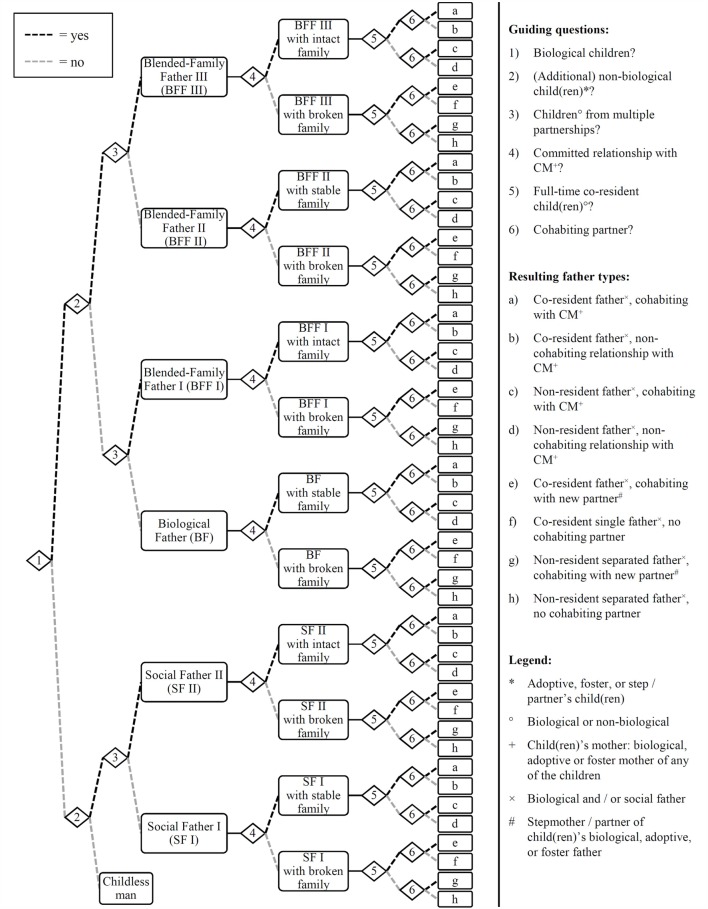
The emotional consequences of fatherhood are markedly conditional on the context in which fatherhood is lived out. This study examines the association between different contemporary forms of fatherhood and paternal psychological well-being. The data are from an anonymous online survey of 3615 biological fathers, stepfathers, adoptive fathers, and foster fathers across the German-speaking countries of Central Europe. First, a detailed characterization of the different existing family constellations is provided. Second, the consequences of these different contemporary forms of fatherhood for paternal psychological well-being are investigated. Fathers of all ages (M = 40.11, range: 19-72) with at least one child under the age of 18 were included in the present analysis (N = 2785). The presented findings demonstrate that a family structure consisting of two biological parents with biological children seems to be most beneficial to paternal well-being, while some other forms of contemporary fatherhood are associated with impaired well-being, independently of sociodemographic or relationship aspects. More specifically, a history of family separation in non-residential biological fathers and blended-family fathers, and the concomitant loss of father-child contact, is shown to be particularly disadvantageous for the well-being of these fathers. Shared living arrangements, maintaining regular contact with biological children, or forming a new intact family could protect these fathers from negative outcomes.
Keywords: family structure; fatherhood; non-residential parenting; parental involvement; psychological well-being.
References
-
- Knoester C, Eggebeen DJ. The effects of the transition to parenthood and subsequent children on men’s well-being and social participation. J Fam Issues (2006) 27(11):1532–60. 10.1177/0192513X06290802 - DOI
-
- Skevik A. ‘Absent fathers’ or ‘reorganized families’? Variations in father-child contact after parental break-up in Norway. Sociol Rev (2006) 54(1):114–32. 10.1111/j.1467-954X.2006.00604.x - DOI
-
- Yeung WJ, Sandberg JF, Davis-Kean PE, Hofferth SL. Children’s time with fathers in intact families. J Marriage Fam (2001) 63(1):136–54. 10.1111/j.1741-3737.2001.00136.x - DOI
-
- Parker K, Wang W. Modern Parenthood: Roles of Moms and Dads Converge as They Balance Work and Family. Washington, DC: Pew Research Center; (2013).
LinkOut - more resources
Full Text Sources
Other Literature Sources
