Review
. 2016 Oct 1;473(19):2911-35.
doi: 10.1042/BCJ20160010.

The role of TREX in gene expression and disease

Affiliations
Review

The role of TREX in gene expression and disease

Catherine G Heath et al. Biochem J. .

Abstract

TRanscription and EXport (TREX) is a conserved multisubunit complex essential for embryogenesis, organogenesis and cellular differentiation throughout life. By linking transcription, mRNA processing and export together, it exerts a physiologically vital role in the gene expression pathway. In addition, this complex prevents DNA damage and regulates the cell cycle by ensuring optimal gene expression. As the extent of TREX activity in viral infections, amyotrophic lateral sclerosis and cancer emerges, the need for a greater understanding of TREX function becomes evident. A complete elucidation of the composition, function and interactions of the complex will provide the framework for understanding the molecular basis for a variety of diseases. This review details the known composition of TREX, how it is regulated and its cellular functions with an emphasis on mammalian systems.

Keywords: NXF1; RNA processing; THO; mRNA export; nucleocytoplasmic; transport.


Figures

Figure 1.
Figure 1.. Overview of NXF1- and TREX-dependent mRNP formation and nucleocytoplasmic transport.
During gene expression, the TREX complex is recruited co-transcriptionally by a direct interaction with the phosphorylated C-terminal domain (CTD) of the large subunit of RNA polymerase II and via the PRP19:U2AF2 complex. Each processing step undergone by the pre-mRNA (5′-capping, co- and posttranscriptional splicing, 3′-end processing) acts as a trigger for TREX assembly and deposition along the transcript. Once bound to the mRNA, the combined action of adaptor (red and pink) and co-adaptor proteins (e.g. THOC5, CHTOP and CPSF6) recruit the NXF1:NXT1 heterodimer and cause a conformation change in NXF1, allowing exposure of its RBD for interaction with mRNA. In turn, the adaptor protein hands the mRNA over to NXF1. This process is promoted by protein arginine methyltransferase 1 (PRMT1) through arginine methylation of both the co-adaptor CHTOP, facilitating its interaction with NXF1, and the adaptor ALYREF, which reduces its RNA-binding activity enabling RNA handover to NXF1. Additional adaptor proteins, such as SR proteins and ZC3H3, can also recruit NXF1 to mRNA. Subsequently, direct interactions of NXF1 with the TREX-2 complex and nucleoporins allow the mRNP to dock at the nuclear pore, thus promoting export of the mRNP. At the nuclear pore export, adaptors are released from the mRNP, this is predicted to revert NXF1 to a low-affinity RNA-binding state that primes it for release from the mRNP. DBP5 and GLE1 trigger the release of NXF1 from the mRNP on the cytoplasmic side of the nuclear pore for recycling back to the nucleus.
Figure 2.
Figure 2.. Schematics of the domain structures for mRNA export factors.
The major characterized domains within TREX subunits and NXF1 are shown. Each protein and domain is drawn approximately to scale and the size of each protein in amino acids is shown on the right hand side. RBD, RNA-binding domain; R-rich, arginine-rich; RS-rich, arginine/serine-rich; RRM, RNA recognition motif (not necessarily involved in RNA binding). UBM, UAP56 (DDX39B)-binding motif; WxHD corresponds to the recently identified motif which binds EIF4AIII [12]. The other domains are all well characterized. Note that THOC2 is not drawn to scale due to its size.
Figure 3.
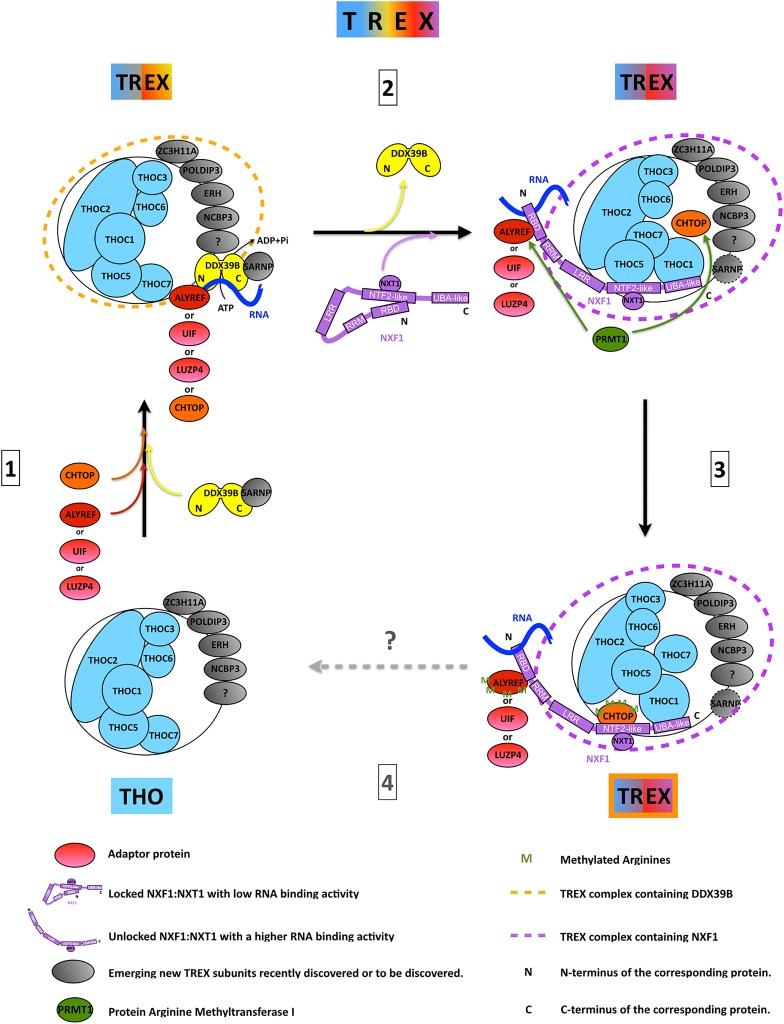
Figure 3.. The life cycle of the TREX complex.
The THO complex constitutes a salt-resistant core of tightly associated proteins (light blue). During gene expression, it dynamically associates with a variety of proteins (red, orange, yellow, purple and gray) to form the TREX complex, whose composition evolves during mRNP formation. THO is able to recruit the adaptor proteins (red), the co-adaptor CHTOP and the RNA helicase DDX39B. The DDX39B RNA helicase is thought to use rounds of ATP hydrolysis to load adaptors and co-adaptors onto the RNA. In turn, they recruit the mRNA export receptor NXF1:p15, which displaces DDX39B. While the co-adaptor THOC5, as a part of THO, is likely to associate early with the NTF2L domain of NXF1, arginine methylation of the second major co-adaptor CHTOP is a prerequisite for it to bind that same domain. This suggests that rearrangements occur within TREX. It is currently unclear whether the additional subunits (gray) are all part of the same TREX complex or belong to variants of a remodeled TREX complex. It is also unknown whether the same THO complex is recycled for further rounds of mRNP assembly (putative step 4).
Figure 4.
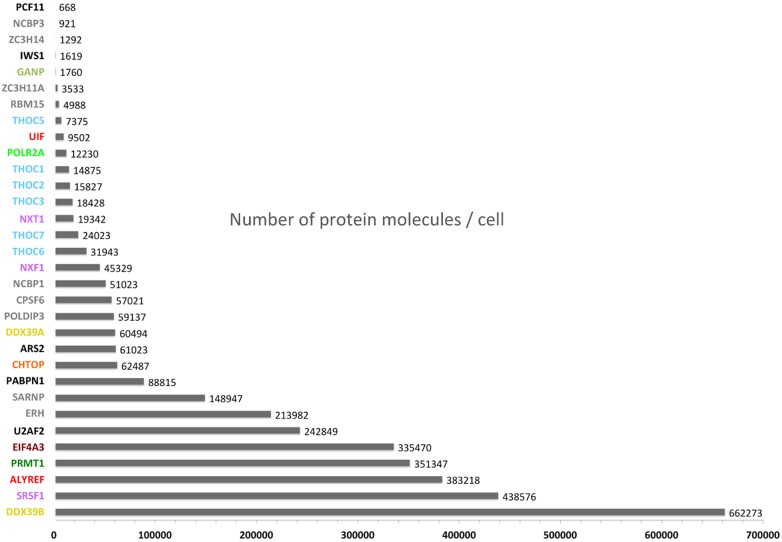
Figure 4.. The number of protein molecules per cell for mRNA export and processing factors.
This graph shows the average number of protein molecules per cell for a mouse NIH3T3 fibroblast cell line. The data were extracted from ref. [115].
Figure 5.
Figure 5.. An overview of the biological processes involving TREX.
ESC: embryonic stem cell.

References

    1. Topisirovic I., Svitkin Y.V., Sonenberg N. and Shatkin A.J. (2011) Cap and cap-binding proteins in the control of gene expression. Wiley Interdiscip. Rev. 2, 277–298 doi: 10.1002/wrna.52 - DOI - PubMed
    1. Girard C., Will C.L., Peng J., Makarov E.M., Kastner B., Lemm I. et al. (2012) Post-transcriptional spliceosomes are retained in nuclear speckles until splicing completion. Nat. Commun. 3, 994 doi: 10.1038/ncomms1998 - DOI - PubMed
    1. Proudfoot N.J. (2011) Ending the message: poly(A) signals then and now. Genes Dev. 25, 1770–1782 doi: 10.1101/gad.17268411 - DOI - PMC - PubMed
    1. Kilchert C., Wittmann S. and Vasiljeva L. (2016) The regulation and functions of the nuclear RNA exosome complex. Nat. Rev. Mol. Cell Biol. doi: 10.1038/nrm.2015.15 - DOI - PubMed
    1. Trcek T., Sato H., Singer R.H. and Maquat L.E. (2013) Temporal and spatial characterization of nonsense-mediated mRNA decay. Genes Dev. 27, 541–551 doi: 10.1101/gad.209635.112 - DOI - PMC - PubMed

Publication types