


Narrowing the focus on the assessment of psychosis-related PTSD: a methodologically orientated systematic review
- PMID: 27679976
- PMCID: PMC5040819
- DOI: 10.3402/ejpt.v7.32095
Narrowing the focus on the assessment of psychosis-related PTSD: a methodologically orientated systematic review
Abstract
Background: Posttraumatic stress disorder (PTSD) in response to psychosis and associated experiences (psychosis-related PTSD, or PR-PTSD) is the subject of a growing field of research. However, a wide range of PR-PTSD prevalence rates has been reported. This may be due to definitional and methodological inconsistencies in the assessment of PR-PTSD.
Objective: The focus of the review is two-fold. (1) To identify factors that enhance, or detract from, the robustness of PR-PTSD assessment and (2) to critically evaluate the evidence in relation to these identified criteria, including the impact on PR-PTSD prevalence rates.
Method: Four quality criteria, whose development was informed by mainstream PTSD research, were selected to evaluate findings on PR-PTSD prevalence. Two criteria related to assessment of psychosis-related stressors (participant identification of worst moments of discrete threat events; psychometrically robust trauma measure) and two focussed on PR-PTSD symptom measurement (adequate time elapsed since trauma; use of validated PTSD interview) in the context of psychosis.
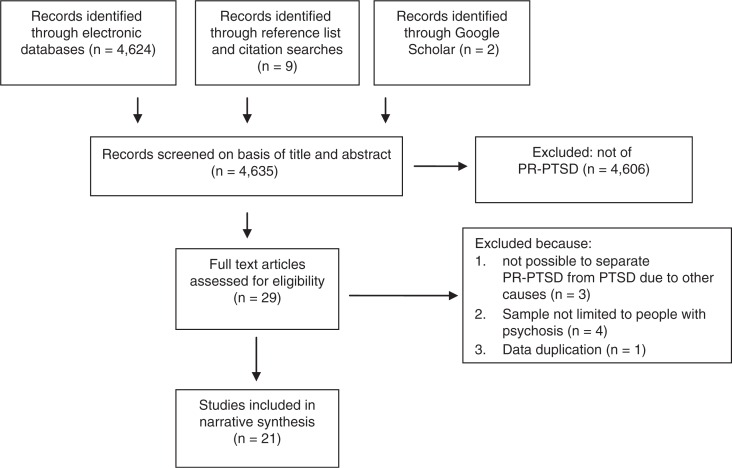
Results: Twenty-one studies of PR-PTSD, with prevalence rates ranging from 11 to 51%, were evaluated. Fourteen studies (67%) used robust PTSD measures but PR-trauma was not specifically defined or assessed with validated measures. Eleven studies (52%) assessed PTSD before sufficient time had elapsed since the trauma. Due to significant methodological limitations, it was not possible to review PR-PTSD rates and provide a revised estimate of prevalence.
Conclusions: Methodological limitations are common in existing studies of PR-PTSD prevalence. Specific recommendations for improving assessment of psychosis-related trauma are made to guide the development of this new and emerging field. The review concludes with a proposed conceptualisation of PR-PTSD in the context of current diagnostic systems. The utility of the PR-PTSD term and its theoretical underpinnings are discussed.
Keywords: PTSD; Psychosis; assessment; psychosis-related PTSD; trauma.
Conflict of interest statement
and funding There is no conflict of interest in the present study for any of the authors.
References
-
- Abdelghaffar W, Ouali U, Jomli R, Zgueb Y, Nacef F. Post-traumatic stress disorder in first episode psychosis: Prevalence and related factors. Clinical Schizophrenia & related psychoses. 2016 doi: http://dx.doi.org/10.3371/csrp.ABOU.123015. - DOI - PubMed
-
- Achim A.M, Maziade M, Raymond É, Olivier D, Mérette C, Roy M.A. How prevalent are anxiety disorders in schizophrenia? A meta-analysis and critical review on a significant association. Schizophrenia Bulletin. 2011;37(4):811–821. doi: http://dx.doi.org/10.1093/schbul/sbp148. - DOI - PMC - PubMed
-
- Allen P, Larøi F, McGuire P.K, Aleman A. The hallucinating brain: A review of structural and functional neuroimaging studies of hallucinations. Neuroscience and Biobehavioral Reviews. 2008;32:175–191. doi: http://dx.doi.org/10.1016/j.neubiorev.2007.07.012. - DOI - PubMed
-
- American Psychiatric Association. Diagnostic and statistical manual of mental disorders. 5th ed. Arlington, VA: Author; 2013.
-
- Beattie N, Shannon C, Kavanagh M, Mulholland C. Predictors of PTSD symptoms in response to psychosis and psychiatric admission. Journal of Nervous & Mental Disease. 2009;197:56–60. doi: http://dx.doi.org/10.1097/NMD.0b013e31819273a8. - DOI - PubMed
Publication types
LinkOut - more resources
Full Text Sources
Other Literature Sources
Research Materials
