


Effect of complementary food supplementation on breastfeeding and home diet in rural Bangladeshi children
- PMID: 27680994
- PMCID: PMC5081719
- DOI: 10.3945/ajcn.116.135509
Effect of complementary food supplementation on breastfeeding and home diet in rural Bangladeshi children
Abstract
Background: Complementary food supplements (CFSs) can enhance growth where stunting is common, but substitution for the usual diet may reduce observed benefits.
Objective: We aimed to characterize dietary diversity from home foods in a CFS efficacy trial and determine whether supplementation reduced breastfeeding frequency or displaced home foods.
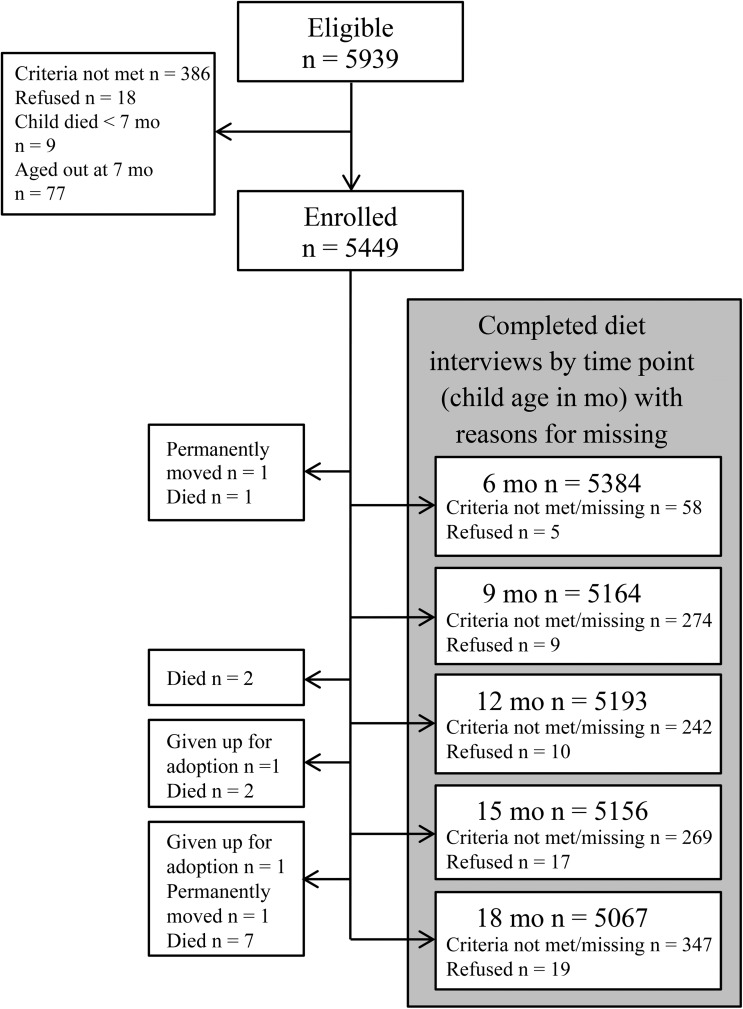
Design: In a cluster-randomized controlled trial in rural Bangladesh, children (n = 5499) received, for 1 y starting at age 6 mo, periodic child feeding counseling for mothers (control) or counseling plus 1 of 4 CFSs fed as a daily snack. Breastfeeding status and past 24-h diet were assessed at enrollment and every 3 mo thereafter until 18 mo of age. A 7-food group dietary diversity score (DDS) was calculated from home foods only, and a DDS ≥4 constituted minimum dietary diversity (MDD).
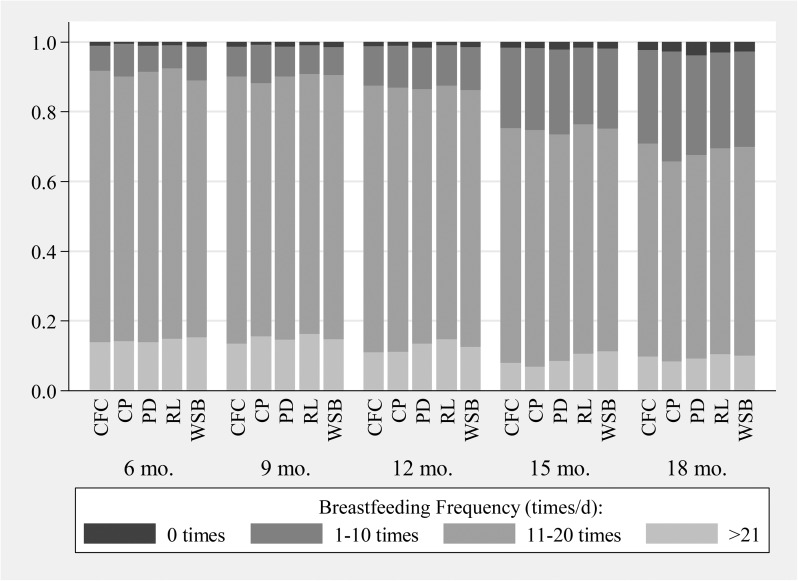
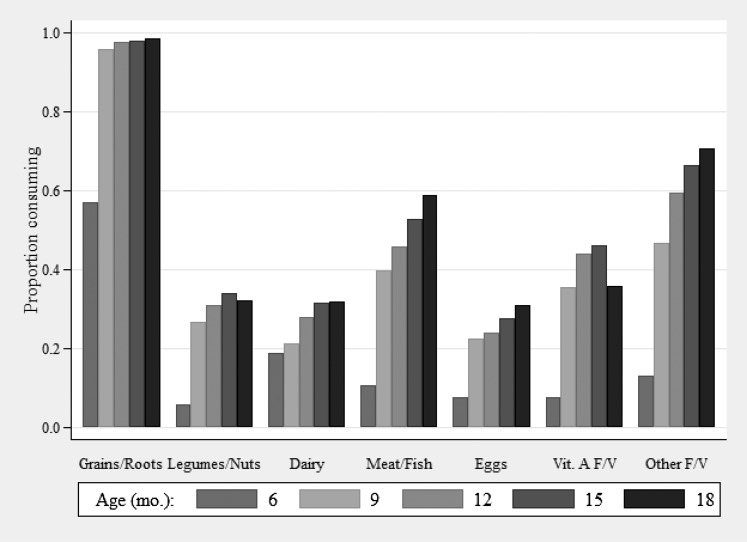
Results: Most children (97%) were breastfed through 18 mo of age, and 24-h breastfeeding frequency did not differ by supplementation group. Child dietary diversity was low; only 51% of children met the MDD by 18 mo. Rice, potatoes, and biscuits (cookies) were the most frequently consumed foods, whereas the legumes, dairy, eggs, and vitamin A-rich fruit and vegetable food groups were each consumed by <50% of children. The odds of meeting the MDD through the consumption of home foods were equal or greater in the supplemented groups compared with the control group at all ages. High socioeconomic status and any maternal education were associated with increased odds of MDD at age 18 mo, whereas child sex and household food security were not associated with MDD.
Conclusions: In a setting where daily complementary food supplementation improved linear growth, there was no evidence that supplementation displaced breastfeeding or home foods, and the supplementation may have improved dietary diversity. Pathways by which supplementation with fortified foods may enhance dietary diversity, such as an improved appetite and increased body size, need elucidation. This trial was registered at clinicaltrials.gov as NCT01562379.
Keywords: Bangladesh; breastfeeding; complementary food; dietary diversity; growth; stunting; supplementation.
Figures
References
-
- UNICEF/WHO-World Bank. Joint child malnutrition estimates. New York: UNICEF; Geneva (Switzerland): WHO; Washington (DC): World Bank; 2015.
-
- Adair LS, Fall CH, Osmond C, Stein AD, Martorell R, Ramirez-Zea M, Sachdev HS, Dahly DL, Bas I, Norris SA, et al. Associations of linear growth and relative weight gain during early life with adult health and human capital in countries of low and middle income: findings from five birth cohort studies. Lancet 2013;382:525–34. - PMC - PubMed
-
- Ruel MT. Operationalizing dietary diversity: a review of measurement issues and research priorities. J Nutr 2003;133(11 Suppl 2):3911S–26S. - PubMed
Publication types
MeSH terms
Associated data
LinkOut - more resources
Full Text Sources
Other Literature Sources
Medical
Miscellaneous
