. 2016 Sep 29;16(1):225.
doi: 10.1186/s12866-016-0843-z.

Investigation of Streptococcus salivarius-mediated inhibition of pneumococcal adherence to pharyngeal epithelial cells

Affiliations

Investigation of Streptococcus salivarius-mediated inhibition of pneumococcal adherence to pharyngeal epithelial cells

Jayne Manning et al. BMC Microbiol. .

Abstract

Background: Pneumococcal adherence to the nasopharyngeal epithelium is a critical step in colonisation and disease. The probiotic bacterium, Streptococcus salivarius, can inhibit pneumococcal adherence to epithelial cells in vitro. We investigated the mechanism(s) of inhibition using a human pharyngeal epithelial cell line (Detroit 562) following pre-administration of two different strains of S. salivarius.

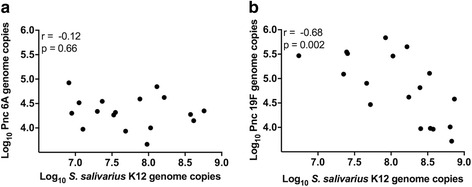
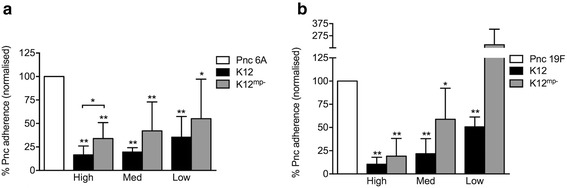
Results: Whilst the bacteriocin-encoding megaplasmids of S. salivarius strains K12 and M18 were essential to prevent pneumococcal growth on solid media, they were not required to inhibit pneumococcal adherence. Experiments testing S. salivarius K12 and two pneumococcal isolates (serotypes 19F and 6A) showed that inhibition of 19F may involve S. salivarius-mediated blocking of pneumococcal binding sites: a negative correlation was observed between adherence of K12 and 19F, and no inhibition occurred when K12 was prevented from contacting epithelial cells. K12-mediated inhibition of adherence by 6A may involve additional mechanisms, since no correlation was observed between adherence of K12 and 6A, and K12 could inhibit 6A adherence in the absence of cell contact.

Conclusions: These results suggest that S. salivarius employs several mechanisms, including blocking pneumococcal binding sites, to reduce pneumococcal adherence to pharyngeal epithelial cells. These findings extend our understanding of how probiotics may inhibit pneumococcal adherence and could assist with the development of novel strategies to prevent pneumococcal colonisation in the future.

Keywords: Adherence; Colonisation; Pneumococcus; Probiotic mechanisms; Probiotics; Respiratory tract; Streptococcus pneumoniae; Streptococcus salivarius.


Figures
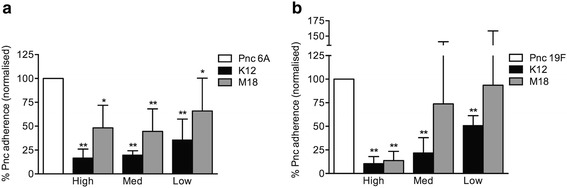
Fig. 1
Fig. 1
Pneumococcal adherence of serotypes 6A (a) and 19F (b) to pharyngeal epithelial cells following pre-administration of S. salivarius. Approximately 1.4 × 106 CFU pneumococci were added to D562 monolayers at an MOI of 11:1. Pneumococcal adherence was determined when incubated with pneumococci alone (Pnc, normalised to 100 %), or pre-incubated for 1 h with S. salivarius K12 or M18 at high (~1.6 × 107 CFU), medium (~1.6 × 106 CFU), or low (~1.6 × 105 CFU) doses. Data are mean + SD; n ≥ 3. * indicates p < 0.05, ** indicates p < 0.001 when compared to Pnc alone (Student’s t-test)
Fig. 2
Fig. 2
Correlation of adherence of S. salivarius K12 and pneumococcal serotype 6A (a) and 19F (b) adherence to pharyngeal epithelial cells. Adherence of S. salivarius and pneumococci to D562 monolayers was determined following pre-incubation for 1 h with high (~1.6 × 10⁷ CFU), medium (~1.6 × 10⁶ CFU), or low (~1.6 × 10⁵ CFU) doses of S. salivarius K12 and subsequent incubation with ~1.4 × 10⁶ CFU pneumococci for 1 h. r = Spearman rank correlation coefficient
Fig. 3
Fig. 3
Adherence of pneumococcal serotypes 6A (a) and 19F (b) to pharyngeal epithelial cells following pre-administration of megaplasmid positive (K12) and negative (K12 mp−) S. salivarius K12 strains. Approximately 1.5 × 10⁶ CFU pneumococci were added to D562 monolayers at an MOI of 10:1. Pneumococcal adherence was determined when incubated with pneumococci alone (Pnc, normalised to 100 %), or pre-incubated for 1 h with S. salivarius K12 or S. salivarius K12mp - at high (~2 × 10⁷ CFU); medium (~2 × 10⁶ CFU, med); or low (~2 × 10⁵ CFU) doses. Data are mean + SD; n ≥ 6. * indicates p < 0.05, ** indicates p < 0.001 when compared to Pnc alone (Student’s t test)
Fig. 4
Fig. 4
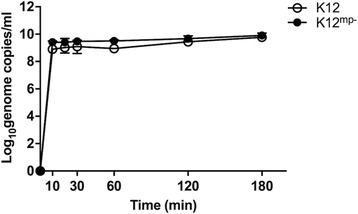
Time course of S. salivarius adherence to D562 cells. Cells were inoculated with either ~1.1 × 105 CFU of S. salivarius K12 or ~1.9 × 10⁵ CFU of S. salivarius K12mp- and the number of adherent bacteria measured over three hours. Median ± IQR for both S. salivarius isolates are depicted (n ≥ 2)
Fig. 5
Fig. 5
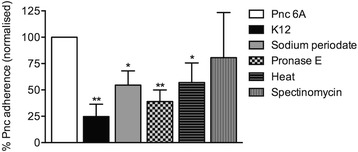
Adherence of pneumococcal serotype 6A to pharyngeal epithelial cells following pre-administration of treated S. salivarius K12. Approximately 1.5 × 106 CFU pneumococci were added to D562 monolayers at an MOI of 10:1. Pneumococcal adherence was determined when incubated with pneumococci alone (Pnc, normalised to 100 %), or pre-incubated for 1 h with approximately 1.5 × 107 CFU S. salivarius K12 (untreated), or treated with sodium periodate, Pronase E, heat-killed (heat), or spectinomycin. Data are mean + SD; n ≥ 3. * indicates p < 0.05, ** indicates p < 0.001 when compared to Pnc alone (Student’s t test)

References

    1. Simell B, Auranen K, Kayhty H, Goldblatt D, Dagan R, O'Brien KL, et al. The fundamental link between pneumococcal carriage and disease. Expert Rev Vaccines. 2012;11:841–55. doi: 10.1586/erv.12.53. - DOI - PubMed
    1. O'Brien KL, Wolfson LJ, Watt JP, Henkle E, Deloria-Knoll M, McCall N, et al. Burden of disease caused by Streptococcus pneumoniae in children younger than 5 years: global estimates. Lancet. 2009;374:893–902. doi: 10.1016/S0140-6736(09)61204-6. - DOI - PubMed
    1. Weinberger DM, Malley R, Lipsitch M. Serotype replacement in disease after pneumococcal vaccination. Lancet. 2011;378:1962–73. doi: 10.1016/S0140-6736(10)62225-8. - DOI - PMC - PubMed
    1. Licciardi PV, Toh QZ, Dunne EM, Wong SS, Mulholland EK, Tang M, et al. Protecting against Pneumococcal Disease: Critical Interactions between Probiotics and the Airway Microbiome. PLoS Pathog. 2012 - PMC - PubMed
    1. Prince T, McBain AJ, O'Neill CA. Lactobacillus reuteri protects epidermal keratinocytes from Staphylococcus aureus-induced cell death by competitive exclusion. Appl Environ Microbiol. 2012;78:5119–26. doi: 10.1128/AEM.00595-12. - DOI - PMC - PubMed

LinkOut - more resources