


Effects of early life stress on depression, cognitive performance and brain morphology
- PMID: 27682320
- PMCID: PMC5195852
- DOI: 10.1017/S0033291716002403
Effects of early life stress on depression, cognitive performance and brain morphology
Abstract
Background: Childhood early life stress (ELS) increases risk of adulthood major depressive disorder (MDD) and is associated with altered brain structure and function. It is unclear whether specific ELSs affect depression risk, cognitive function and brain structure.
Method: This cross-sectional study included 64 antidepressant-free depressed and 65 never-depressed individuals. Both groups reported a range of ELSs on the Early Life Stress Questionnaire, completed neuropsychological testing and 3T magnetic resonance imaging (MRI). Neuropsychological testing assessed domains of episodic memory, working memory, processing speed and executive function. MRI measures included cortical thickness and regional gray matter volumes, with a priori focus on the cingulate cortex, orbitofrontal cortex (OFC), amygdala, caudate and hippocampus.
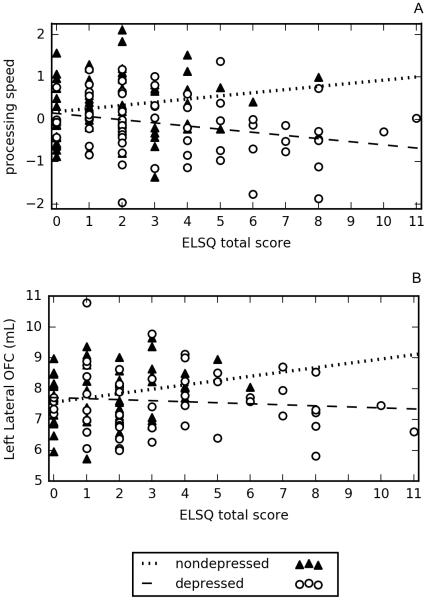
Results: Of 19 ELSs, only emotional abuse, sexual abuse and severe family conflict independently predicted adulthood MDD diagnosis. The effect of total ELS score differed between groups. Greater ELS exposure was associated with slower processing speed and smaller OFC volumes in depressed subjects, but faster speed and larger volumes in non-depressed subjects. In contrast, exposure to ELSs predictive of depression had similar effects in both diagnostic groups. Individuals reporting predictive ELSs exhibited poorer processing speed and working memory performance, smaller volumes of the lateral OFC and caudate, and decreased cortical thickness in multiple areas including the insula bilaterally. Predictive ELS exposure was also associated with smaller left hippocampal volume in depressed subjects.
Conclusions: Findings suggest an association between childhood trauma exposure and adulthood cognitive function and brain structure. These relationships appear to differ between individuals who do and do not develop depression.
Keywords: Brain volumes; depression; magnetic resonance imaging; neuropsychological testing; trauma.
Figures

References
-
- Brewin CR. Episodic memory, perceptual memory, and their interaction: foundations for a theory of posttraumatic stress disorder. Psychological Bulletin. 2014;140:69–97. - PubMed
-
- Brown WG, Harris TO. Social Origins of Depression: A Study of Psychiatric Disorder in Women. The Free Press; New York: 1978.
-
- Cohen RA, Grieve S, Hoth KF, Paul RH, Sweet L, Tate D, Gunstad J, Stroud L, McCaffery J, Hitsman B, Niaura R, Clark CR, McFarlane A, Bryant R, Gordon E, Williams LM. Early life stress and morphometry of the adult anterior cingulate cortex and caudate nuclei. Biological Psychiatry. 2006;59:975–982. - PubMed
-
- Cole J, Costafreda SG, McGuffin P, Fu CH. Hippocampal atrophy in first episode depression: a meta-analysis of magnetic resonance imaging studies. Journal of Affective Disorders. 2011;134:483–487. - PubMed
Publication types
MeSH terms
Grants and funding
LinkOut - more resources
Full Text Sources
Other Literature Sources
