. 2016 Dec;46(12):2761-2766.
doi: 10.1002/eji.201646647. Epub 2016 Oct 19.

IL-1β, IL-18, and eicosanoids promote neutrophil recruitment to pore-induced intracellular traps following pyroptosis

Affiliations

IL-1β, IL-18, and eicosanoids promote neutrophil recruitment to pore-induced intracellular traps following pyroptosis

Ine Jorgensen et al. Eur J Immunol. 2016 Dec.

Abstract

Inflammasomes activate caspase-1, initiating a lytic form of programmed cell death termed pyroptosis, which is an important innate immune defense mechanism against intracellular infections. We recently demonstrated in a mouse infection model of pyroptosis that instead of releasing bacteria into the extracellular space, bacteria remain trapped within the pyroptotic cell corpse, termed the pore-induced intracellular trap (PIT). This trapping mediates efferocytosis of the PIT and associated bacteria by neutrophils; bacteria are subsequently killed via neutrophil ROS. Using this pyroptosis model, we now show that the pro-inflammatory cytokines IL-1β and IL-18 and inflammatory lipid mediators termed eicosanoids are required for effective clearance of bacteria downstream of pyroptosis. We further show that IL-1β, IL-18, and eicosanoids affect this in part by mediating neutrophil recruitment to the PIT. This is in addition to our prior findings that complement is also important to attract neutrophils. Thus, the PIT initiates a robust and coordinated innate immune response involving multiple mediators that attract neutrophils to efferocytose the PIT and its entrapped bacteria.

Keywords: Caspase-1; Inflammasome; Neutrophil recruitment; Pore-induced intracellular trap; Pyroptosis.


Figures

Figure 1
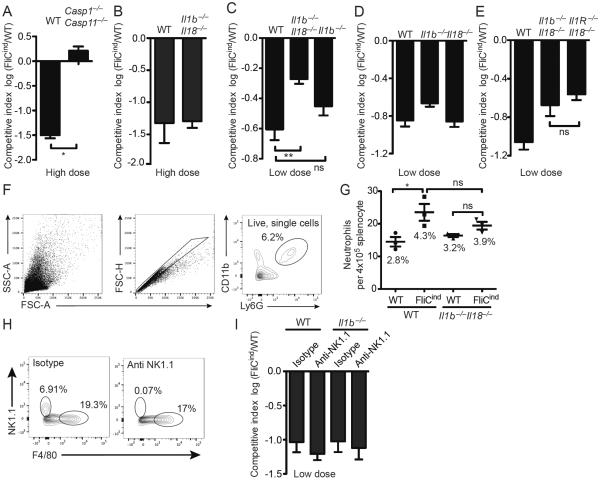
Figure 1. IL-1β, IL-18, and pyroptosis cooperatively clear FliCind S. Typhimurium
(A–E, H, I) Mice (n=5) were infected with (A, B) high dose (105 CFUs) or (C–I) low dose (103 CFUs) (of 1:1 ratio of FliCind AmpR and WT KanR S. Typhimurium IP for 17 hours prior to doxycycline injection; organs were harvested 7 hours later. CIs are expressed as the log FliCind/WT (Amp/Kan CFUs). (F–G) Mice were infected with WT or FliCind S. Typhimurium and treated with doxycycline at 24 hours pi for 5 hours. Spleens were prepared for single cell suspension, stained and analyzed by flow cytometry. Neutrophils were defined as the CD11b+ Ly6G+. (F) The gating strategy represents a WT mouse infected with FliCind S. Typhimurium. (G) The mean percentage of neutrophils of the total splenocytes population is stated in the figure for each condition. (H–I) For NK-cell depletion, mice were injected with 75 ng anti-NK1.1 PK136 or isotype control C1.18.4 (BioXCell) at −3 and −1 dpi. Depletion of NK1.1-positive cells was confirmed by flow cytometry (left). NK cells were defined as NK1.1+ F4/80, and the percentage of each cell type is indicated. All data are shown as mean + SE of n=3 (F, G) and n=5 (A–E, H, I) mice and are from single experiments representative of two (A, H, I) or three (B–G) experiments. * p < 0.05; two-tailed student t-test.
Figure 2
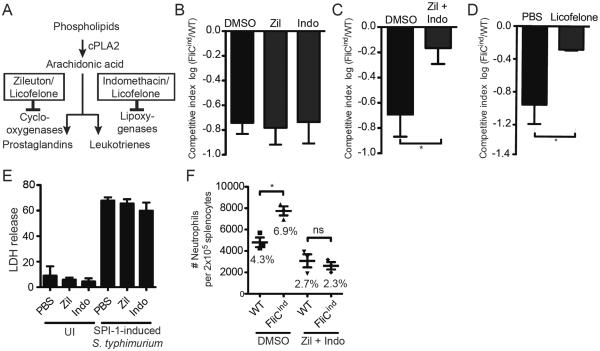
Figure 2. Prostaglandins and leukotrienes are required to clear FliCind S. Typhimurium
(A) Schematic overview of eicosanoid synthesis and inhibitor action. (B–D) Mice (n=5) were infected with 103 CFUs of 1:1 ratio of FliCind AmpR and WT KanR S. Typhimurium IP for 17 hours, then treated with doxycycline in the presence of (B, C) DMSO vehicle, (B) indomethacin, zileuton, (C) a combination of indomethacin and zileution, or (D) licofelone and harvested 7 hours later. CIs are expressed as the log FliCind/WT (Amp/Kan CFUs). (E) WT BMMs in vitro were pre-treated with PBS, zileuton, or indomethacin for 4 hours, and infected with S. Typhimurium MOI 50 SPI-1 in the presence of inhibitors. Cytotoxicity was measured by % LDH release at 2 hours post infection. (F) Mice (n=3) were infected with WT or FliCind S. Typhimurium and both groups of mice were treated with doxycycline and inhibitors as in (A), and splenocytes analyzed by flow cytometry. Neutrophils were defined as CD11b+ Ly6G+. The mean percentage of neutrophils of the total splenocytes population is stated in the figure for each condition. All data are shown as mean + SE of n=5 (B–D), and n=3 (F) mice. All panels (A–F) are representative of three independent experiments. * p < 0.05; two-tailed student t-test.

References

    1. Zychlinsky A, Prevost MC, Sansonetti PJ. Shigella flexneri induces apoptosis in infected macrophages. Nature. 1992;358:167–169. DOI: 10.1038/358167a0. - PubMed
    1. Moltke Von J, Trinidad NJ, Moayeri M, Kintzer AF, Wang SB, Van Rooijen N, Brown CR, et al. Rapid induction of inflammatory lipid mediators by the inflammasome in vivo. Nature. 2012;490:107–111. DOI: 10.1038/nature11351. - PMC - PubMed
    1. Miao EA, Leaf IA, Treuting PM, Mao DP, Dors M, Sarkar A, Warren SE, et al. Caspase-1-induced pyroptosis is an innate immune effector mechanism against intracellular bacteria. Nature Immunology. 2010;11:1136–1142. DOI: 10.1038/ni.1960. - PMC - PubMed
    1. Aachoui Y, Leaf IA, Hagar JA, Fontana MF, Campos CG, Zak DE, Tan MH, et al. Caspase-11 protects against bacteria that escape the vacuole. Science. 2013;339:975–978. DOI: 10.1126/science.1230751. - PMC - PubMed
    1. Aachoui Y, Kajiwara Y, Leaf IA, Mao D, Ting JP-Y, Coers J, Aderem A, et al. Canonical Inflammasomes Drive IFN-γ to Prime Caspase-11 in Defense against a Cytosol-Invasive Bacterium. Cell Host Microbe. 2015;18:320–332. DOI: 10.1016/j.chom.2015.07.016. - PMC - PubMed

Publication types

LinkOut - more resources