


Measures of Diagnostic Accuracy: Basic Definitions
- PMID: 27683318
- PMCID: PMC4975285
Measures of Diagnostic Accuracy: Basic Definitions
Abstract
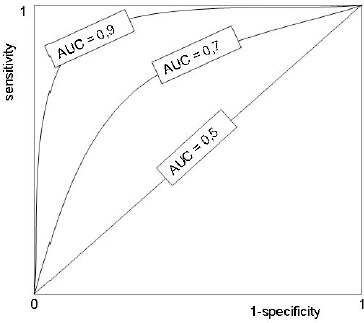
Diagnostic accuracy relates to the ability of a test to discriminate between the target condition and health. This discriminative potential can be quantified by the measures of diagnostic accuracy such as sensitivity and specificity, predictive values, likelihood ratios, the area under the ROC curve, Youden's index and diagnostic odds ratio. Different measures of diagnostic accuracy relate to the different aspects of diagnostic procedure: while some measures are used to assess the discriminative property of the test, others are used to assess its predictive ability. Measures of diagnostic accuracy are not fixed indicators of a test performance, some are very sensitive to the disease prevalence, while others to the spectrum and definition of the disease. Furthermore, measures of diagnostic accuracy are extremely sensitive to the design of the study. Studies not meeting strict methodological standards usually over- or under-estimate the indicators of test performance as well as they limit the applicability of the results of the study. STARD initiative was a very important step toward the improvement the quality of reporting of studies of diagnostic accuracy. STARD statement should be included into the Instructions to authors by scientific journals and authors should be encouraged to use the checklist whenever reporting their studies on diagnostic accuracy. Such efforts could make a substantial difference in the quality of reporting of studies of diagnostic accuracy and serve to provide the best possible evidence to the best for the patient care. This brief review outlines some basic definitions and characteristics of the measures of diagnostic accuracy.
Keywords: AUC; DOR; NPV; PPV; diagnostic accuracy; likelihood ratio; predictive values; sensitivity; specificity.
References
-
- Raslich MA, Markert RJ, Stutes SA. Selecting and interpreting diagnostic tests. Biochemia Medica 2007;17(2):139-270.
-
- Obuchowski NA, Lieber ML, Wians FH., Jr ROC curves in clinical chemistry: uses, misuses, and possible solutions. Clin Chem. 2004;50(7):1118-1125 - PubMed
-
- Glas AS, Lijmer JG, Prins MH, Bonsel GJ, Bossuyt PM. The diagnostic odds ratio: a single indicator of test performance. J Clin Epidemiol. 2003;56(11):1129-1135. - PubMed
LinkOut - more resources
Full Text Sources
Other Literature Sources