Comparison of the effects of mini-implant and traditional anchorage on patients with maxillary dentoalveolar protrusion
- PMID: 27684189
- PMCID: PMC8384353
- DOI: 10.2319/051016-375.1
Comparison of the effects of mini-implant and traditional anchorage on patients with maxillary dentoalveolar protrusion
Abstract
Objective: To compare the treatment effects of mini-implants as anchor units with conventional methods of anchorage reinforcement in maxillary dentoalveolar protrusion patients in terms of skeletal, dental, and soft tissue changes.
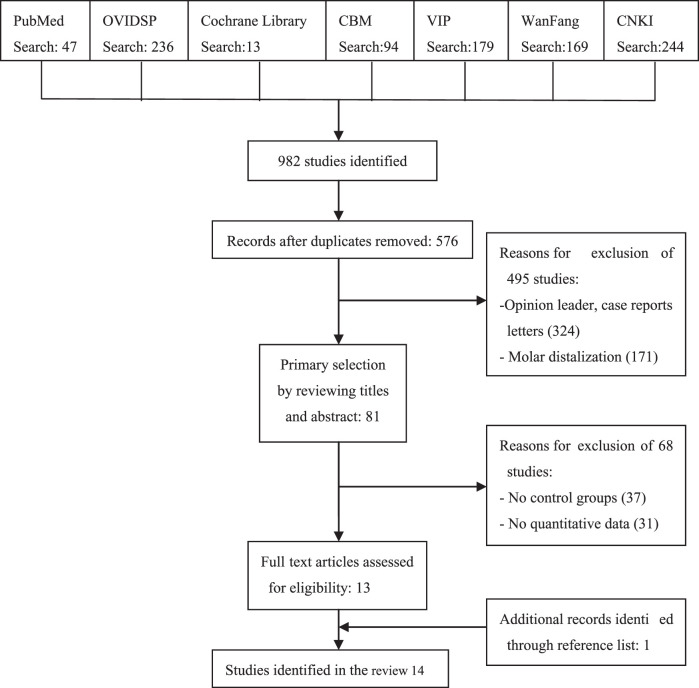
Materials and methods: We searched the databases of the Cochrane Library, PubMed, OVIDSP, CBM, VIP, WanFang Data, and CNKI covering December 1966 to March 2016 for randomized controlled trials (RCTs) and clinical controlled trials that compared the treatment effects of mini-implants with conventional anchorage reinforcement in maxillary dentoalveolar protrusion patients. Literature filtering, data extraction, and methodological quality evaluation were finished independently by two researchers and disagreements were solved by discussion. Meta-analysis was performed when possible; otherwise descriptive assessment was done.
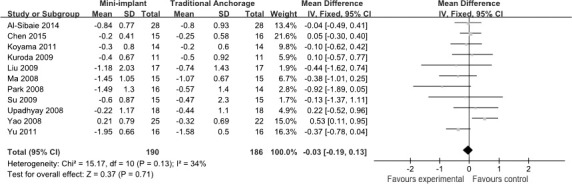
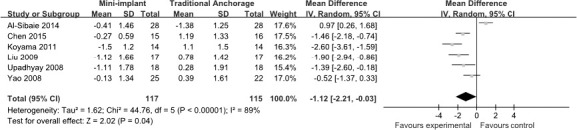
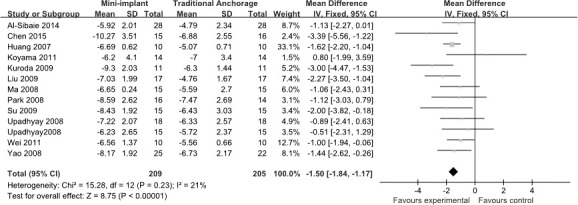
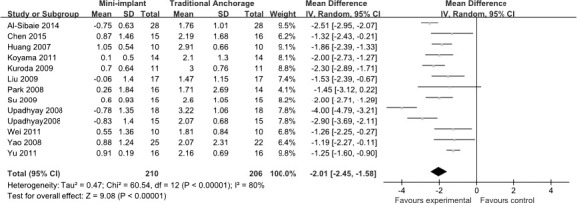
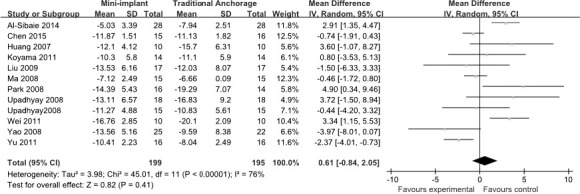
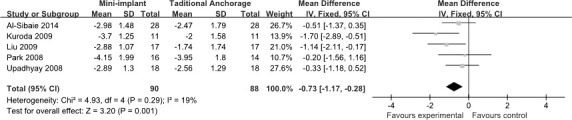
Results: Through a predefined search strategy, we finally included 14 eligible studies. Eight outcomes were evaluated in this study: maxillary incisor retraction, maxillary molar movement, U1-SN, SNA, SN-MP, UL-E Plane, NLA and G-Sn-Pg.
Conclusions: Mini-implant anchorage was more effective in retracting the anterior teeth, produced less anchorage loss, and had a greater effect on SN-MP for the high-angle patients than did traditional anchorage. Both mini-implants and traditional anchorage underwent decreases in on U1-SN and SNA. More qualified RCTs are required to make reliable recommendations about the anchorage capacity of mini-implant and traditional anchorage in patients with maxillary dentoalveolar protrusion, especially on the UL-E plane, NLA, and G-Sn-Pg.
Keywords: Implant; Protrusion; Systematic review; Traditional anchorage.
Figures


References
-
- Upadhyay M, Yadav S, Nagaraj K, Patil S. Treatment effects of mini implants for en-masse retraction of anterior teeth in bialveolar dental protrusion patients: a randomized controlled trial. Am J Orthod Dentofacial Orthop. 2008;134:18–29. - PubMed
-
- Melsen B, Bosch C. Different approaches to anchorage: a survey and an evaluation. Angle Orthod. 1997;67:23–30. - PubMed
-
- Proffit WR. The second stage of comprehensive treatment: correction of molar relationship and space closure. In: Proffit WR, Fields HW Jr, editors. Contemporary orthodontics. 3rd ed. St. Louis: Mosby-Yearbook; 1997. pp. 573–577.
-
- Upadhyay M, Yadav S, Patil S. Mini-implant anchorage for en-masse retraction of maxillary anterior teeth: a clinical cephalometric study. Am J Orthod Dentofacial Orthop. 2008;134:803–810. - PubMed
-
- Costa A, Raffaini M, Melsen B. Miniscrews as orthodontic anchorage: a preliminary report. Int J Adult Orthod Orthognath Surg. 1998;13:201–229. - PubMed
Publication types
MeSH terms
Substances
LinkOut - more resources
Full Text Sources
Other Literature Sources
Research Materials