


A study of physical activity comparing people with Charcot-Marie-Tooth disease to normal control subjects
- PMID: 27684376
- PMCID: PMC5592965
- DOI: 10.1080/09638288.2016.1211180
A study of physical activity comparing people with Charcot-Marie-Tooth disease to normal control subjects
Abstract
Purpose: Charcot Marie Tooth disease (CMT) describes a group of hereditary neuropathies that present with distal weakness, wasting and sensory loss. Small studies indicate that people with CMT have reduced daily activity levels. This raises concerns as physical inactivity increases the risk of a range of co- morbidities, an important consideration in the long-term management of this disease. This study aimed to compare physical activity, patterns of sedentary behavior and overall energy expenditure of people with CMT and healthy matched controls.
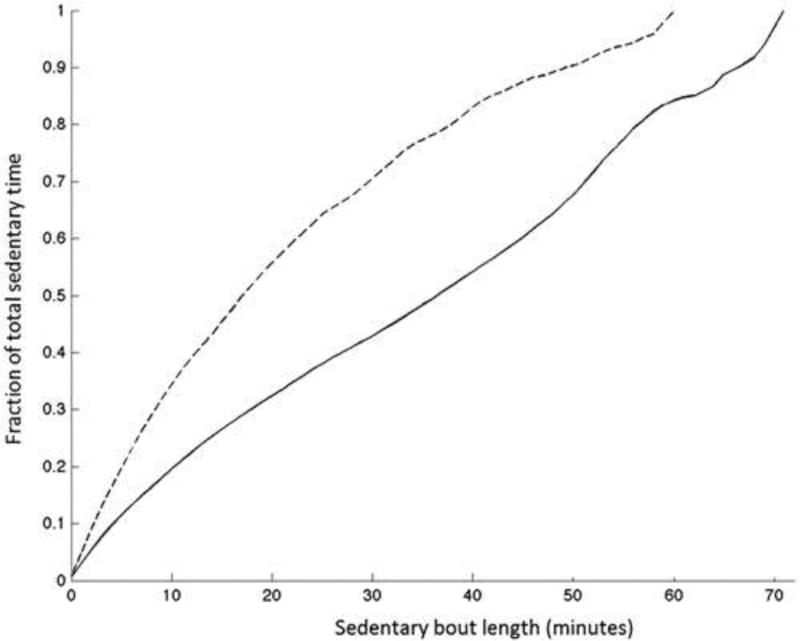
Methods: We compared 20 people with CMT and 20 matched controls in a comparison of physical activity measurement over seven days, using an activity monitor. Patterns of sedentary behavior were explored through a power law analysis.
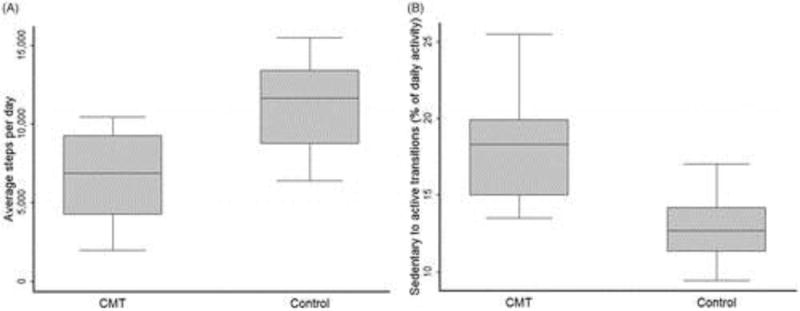
Results: Results showed a decrease in daily steps taken in the CMT group, but somewhat paradoxically, they demonstrate shorter bouts of sedentary activity and more frequent transitions from sedentary to active behaviors. No differences were seen in energy expenditure or time spent in sedentary, moderate or vigorous activity.
Conclusion: The discrepancy between energy expenditure and number of steps could be due to higher energy requirements for walking, but also may be due to an over-estimation of energy expenditure by the activity monitor in the presence of muscle wasting. Alternatively, this finding may indicate that people with CMT engage more in activities or movement not related to walking. Implications for Rehabilitation Charcot-Marie-Tooth disease: • People with Charcot-Marie-Tooth disease did not show a difference in energy expenditure over seven days compared to healthy controls, but this may be due to higher energy costs of walking, and/or an over estimation of energy expenditure by the activity monitor in a population where there is muscle wasting. This needs to be considered when interpreting activity monitor data in people with neuromuscular diseases. • Compared to healthy controls, people with Charcot-Marie-Tooth disease had a lower step count over seven days, but exhibited more frequent transitions from sedentary to active behaviors • High Body Mass Index and increased time spent sedentary were related factors that have implications for general health status. • Understanding the profile of physical activity and behavior can allow targeting of rehabilitation interventions to address mobility and fitness.
Keywords: Accelerometer; energy expenditure; peripheral neuropathy; physical activity monitoring; step count.
Conflict of interest statement
The authors report no declarations of interest.
Figures
References
-
- Kalkman JS, Schillings ML, Zwarts MJ, et al. The development of a model of fatigue in neuromuscular disorders: a longitudinal study. J Psychosom Res. 2007;62:571–579. - PubMed
-
- Newman CJ, Walsh M, O’Sullivan R, et al. The characteristics of gait in Charcot-Marie-Tooth disease types I and II. Gait Posture. 2007;26:120–127. - PubMed
-
- Don R, Serrao M, Vinci P, et al. Foot drop and plantar flexion failure determine different gait strategies in Charcot-Marie-Tooth patients. Clin Biomech (Bristol, Avon) 2007;22:905–916. - PubMed
-
- Menotti F, Felici F, Damiani A, et al. Charcot-Marie-Tooth 1A patients with low level of impairment have a higher energy cost of walking than healthy individuals. Neuromuscul Disord. 2011;21:52–57. - PubMed
MeSH terms
Grants and funding
LinkOut - more resources
Full Text Sources
Other Literature Sources
Medical
