


Comparison of soft tissue balancing, femoral component rotation, and joint line change between the gap balancing and measured resection techniques in primary total knee arthroplasty: A meta-analysis
- PMID: 27684862
- PMCID: PMC5265955
- DOI: 10.1097/MD.0000000000005006
Comparison of soft tissue balancing, femoral component rotation, and joint line change between the gap balancing and measured resection techniques in primary total knee arthroplasty: A meta-analysis
Abstract
Background: This meta-analysis was designed to compare the accuracy of soft tissue balancing and femoral component rotation as well as change in joint line positions, between the measured resection and gap balancing techniques in primary total knee arthroplasty.
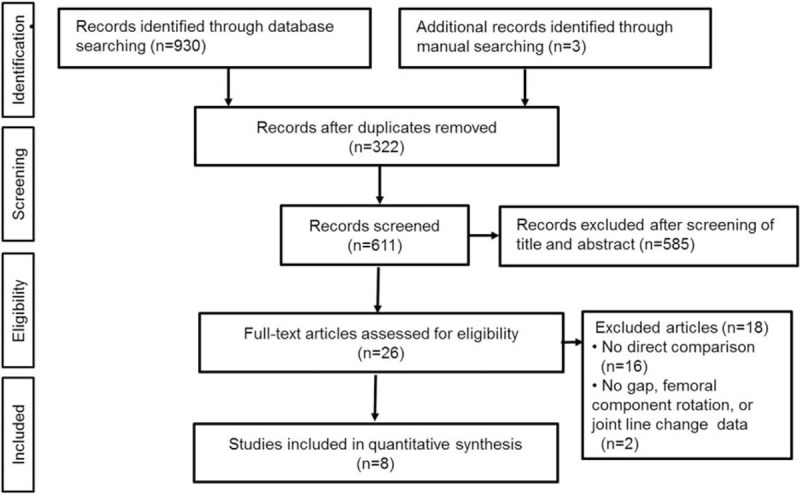
Methods: Studies were included in the meta-analysis if they compared soft tissue balancing and/or radiologic outcomes in patients who underwent total knee arthroplasty with the gap balancing and measured resection techniques. Comparisons included differences in flexion/extension, medial/lateral flexion, and medial/lateral extension gaps (LEGs), femoral component rotation, and change in joint line positions. Finally, 8 studies identified via electronic (MEDLINE, EMBASE, and the Cochrane Library) and manual searches were included. All 8 studies showed a low risk of selection bias and provided detailed demographic data. There was some inherent heterogeneity due to uncontrolled bias, because all included studies were observational comparison studies.
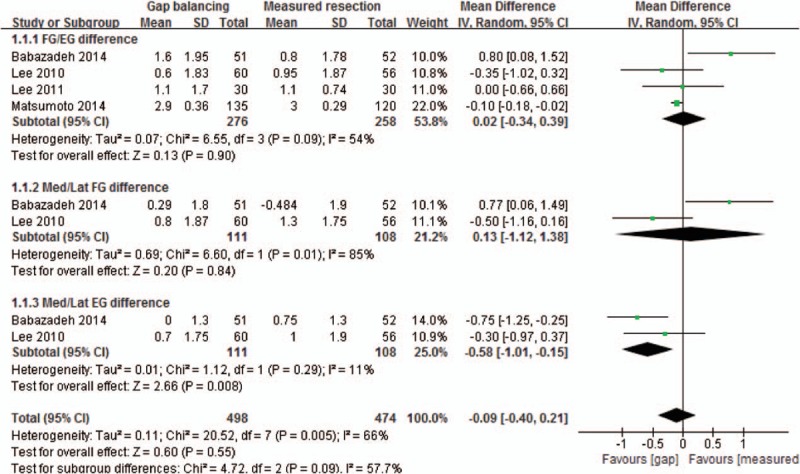
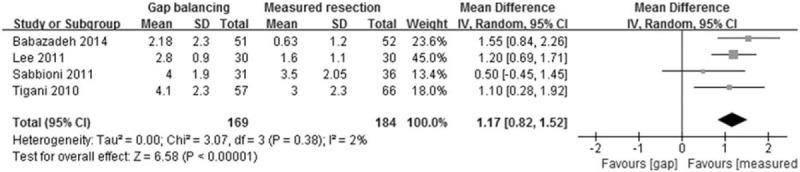
Results: The pooled mean difference in gap differences between the gap balancing and measured resection techniques did not differ significantly (-0.09 mm, 95% confidence interval [CI]: -0.40 to +0.21 mm; P = 0.55), except that the medial/LEG difference was 0.58 mm greater for measured resection than gap balancing (95% CI: -1.01 to -0.15 mm; P = 0.008). Conversely, the pooled mean difference in femoral component external rotation (0.77°, 95% CI: 0.18° to 1.35°; P = 0.01) and joint line change (1.17 mm, 95% CI: 0.82 to 1.52 mm; P < 0.001) were significantly greater for the gap balancing than the measured resection technique.
Conclusion: The gap balancing and measured resection techniques showed similar soft tissue balancing, except for medial/LEG difference. However, the femoral component was more externally rotated and the joint line was more elevated with gap balancing than measured resection. These differences were minimal (around 1 mm or 1°) and therefore may have little effect on the biomechanics of the knee joint. This suggests that the gap balancing and measured resection techniques are not mutually exclusive.
Conflict of interest statement
The authors have no conflicts of interest to declare.
Figures

References
-
- Huizinga MR, Brouwer RW, Bisschop R, et al. Long-term follow-up of anatomic graduated component total knee arthroplasty: a 15- to 20-year survival analysis. J Arthroplasty 2012; 27:1190–1195. - PubMed
-
- Karachalios T, Varitimidis S, Bargiotas K, et al. An 11- to 15-year clinical outcome study of the Advance Medial Pivot total knee arthroplasty: pivot knee arthroplasty. Bone Joint J 2016; 98-b:1050–1055. - PubMed
-
- Noble PC, Conditt MA, Cook KF, et al. The John Insall Award: patient expectations affect satisfaction with total knee arthroplasty. Clin Orthop Relat Res 2006; 452:35–43. - PubMed
-
- Hohman DW, Jr, Nodzo SR, Phillips M, et al. The implications of mechanical alignment on soft tissue balancing in total knee arthroplasty. Knee Surg Sports Traumatol Arthrosc 2015; 23:3632–3636. - PubMed
Publication types
MeSH terms
LinkOut - more resources
Full Text Sources
Other Literature Sources
Medical
Miscellaneous
