


Axillary lymph node micrometastases decrease triple-negative early breast cancer survival
- PMID: 27685443
- PMCID: PMC5117781
- DOI: 10.1038/bjc.2016.283
Axillary lymph node micrometastases decrease triple-negative early breast cancer survival
Abstract
Background: Triple-negative breast cancers (TNBCs) are the most deadly form of breast cancer (BC) subtypes. Axillary lymph node involvement (ALNI) has been described to be prognostic in BC taken as a whole, but its prognostic value in each subtype is unclear. We explored the prognostic impact of ALNI and especially of small size axillary metastases in early TNBCs.
Methods: We analysed in this multicentre study all patients treated for early TNBC in 12 French cancer centres. We explored the correlation between clinicopathological data and ALNI, with a specific focus on the dichotomisation between macrometastases and occult metastases, which is defined as the presence of isolated tumour cells or micrometastases. The prognostic value of ALNI both in terms of disease-free survival (DFS) and overall survival (OS) was also explored.
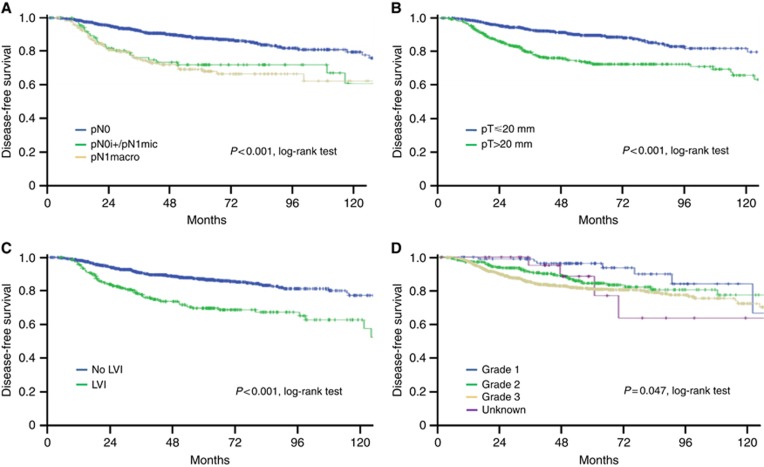
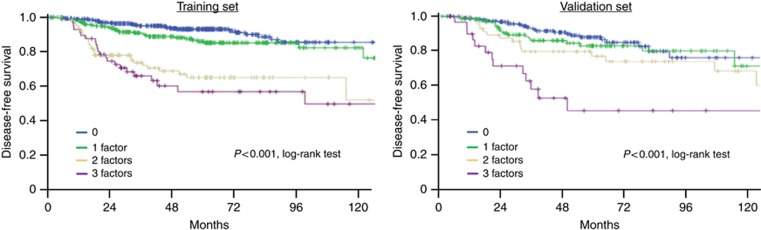
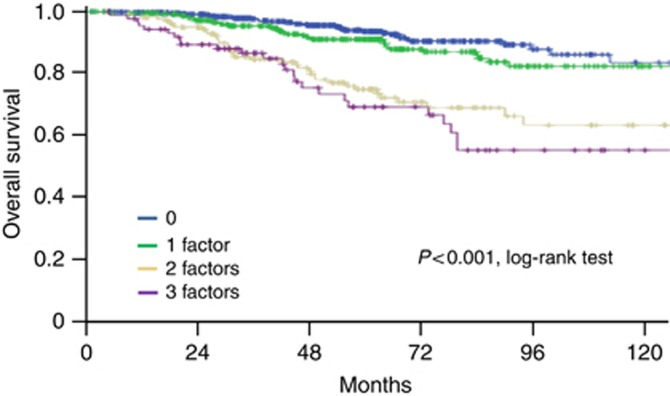
Results: We included 1237 TNBC patients. Five-year DFS and OS were 83.7% and 88.5%, respectively. The identified independent prognostic features for DFS were tumour size >20 mm (hazard ratio (HR)=1.86; 95% CI: 1.11-3.10, P=0.018), lymphovascular invasion (HR=1.69; 95% CI: 1.21-2.34, P=0.002) and ALNI both in case of macrometastases (HR=1.97; 95% CI: 1.38-2.81, P<0.0001) and occult metastases (HR=1.72; 95% CI: 1.1-2.71, P=0.019). DFS and OS were similar between tumours with occult metastases and macrometastases. Tumours presenting at least two pejorative features (out of ALNI, lymphovascular invasion and large tumour size) displayed a significantly poorer DFS in both the training set and validation set, independently of chemotherapy administration. Tumours with no more than one of the above-cited pejorative features had a 5-year OS of ⩾90% vs 70% for other cases (P<0.0001).
Conclusions: Axillary lymph node involvement is a key prognostic feature for early TNBC when isolated tumour cells were identified in lymph nodes. This impact is independent of chemotherapy use.
Figures
References
-
- Aigner J, Smetanay K, Hof H, Sinn H-P, Sohn C, Schneeweiss A, Marmé F (2013) Omission of axillary dissection according to ACOSOG Z0011: impact on adjuvant treatment recommendations. Ann Surg Oncol 20: 1538–1544. - PubMed
-
- Bertucci F, Finetti P, Cervera N, Esterni B, Hermitte F, Viens P, Birnbaum D (2008) How basal are triple-negative breast cancers? Int J Cancer 123: 236–240. - PubMed
-
- Carter CL, Allen C, Henson DE (1989) Relation of tumor size, lymph node status, and survival in 24 740 breast cancer cases. Cancer 63: 181–187. - PubMed
-
- Chia SK, Speers CH, Bryce CJ, Hayes MM, Olivotto IA (2004) Ten-year outcomes in a population-based cohort of node-negative, lymphatic, and vascular invasion-negative early breast cancers without adjuvant systemic therapies. J Clin Oncol 22: 1630–1637. - PubMed
Publication types
MeSH terms
LinkOut - more resources
Full Text Sources
Other Literature Sources
Medical
