Review
. 2016 Sep 29;9(1):100.
doi: 10.1186/s13045-016-0334-6.

Protein glycosylation in cancers and its potential therapeutic applications in neuroblastoma

Affiliations
Review

Protein glycosylation in cancers and its potential therapeutic applications in neuroblastoma

Wan-Ling Ho et al. J Hematol Oncol. .

Abstract

Glycosylation is the most complex post-translational modification of proteins. Altered glycans on the tumor- and host-cell surface and in the tumor microenvironment have been identified to mediate critical events in cancer pathogenesis and progression. Tumor-associated glycan changes comprise increased branching of N-glycans, higher density of O-glycans, generation of truncated versions of normal counterparts, and generation of unusual forms of terminal structures arising from sialylation and fucosylation. The functional role of tumor-associated glycans (Tn, sTn, T, and sLea/x) is dependent on the interaction with lectins. Lectins are expressed on the surface of immune cells and endothelial cells or exist as extracellular matrix proteins and soluble adhesion molecules. Expression of tumor-associated glycans is involved in the dysregulation of glycogenes, which mainly comprise glycosyltransferases and glycosidases. Furthermore, genetic and epigenetic mechanisms on many glycogenes are associated with malignant transformation. With better understanding of all aspects of cancer-cell glycomics, many tumor-associated glycans have been utilized for diagnostic, prognostic, and therapeutic purposes. Glycan-based therapeutics has been applied to cancers from breast, lung, gastrointestinal system, melanomas, and lymphomas but rarely to neuroblastomas (NBs). The success of anti-disialoganglioside (GD2, a glycolipid antigen) antibodies sheds light on glycan-based therapies for NB and also suggests the possibility of protein glycosylation-based therapies for NB. This review summarizes our understanding of cancer glycobiology with a focus of how protein glycosylation and associated glycosyltransferases affect cellular behaviors and treatment outcome of various cancers, especially NB. Finally, we highlight potential applications of glycosylation in drug and cancer vaccine development for NB.

Keywords: Cancer; Glycan-based therapeutics; Glycosyltransferase; Lectin; Neuroblastoma; Protein glycosylation; Treatment.


Figures
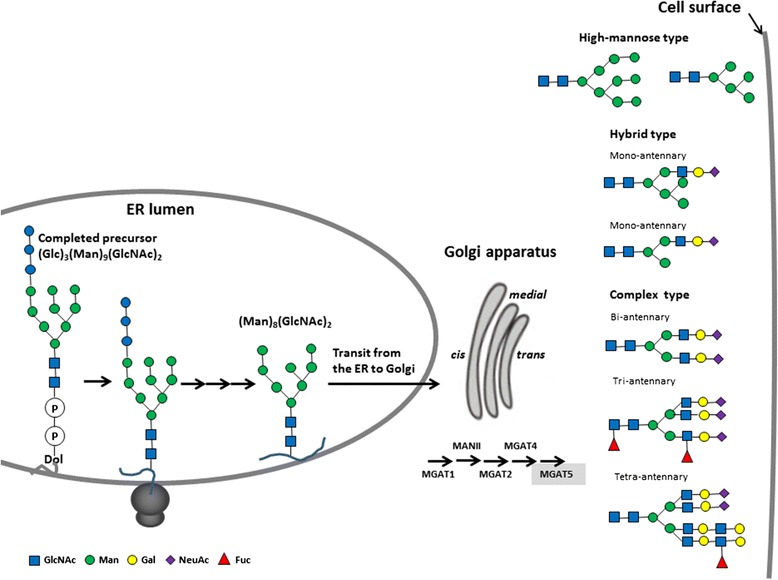
Fig. 1
Fig. 1
An overview of the process of N-glycosylation. Glycosyltransferases involved in the synthesis are indicated. Additional modifications exist (not shown). Dol dolichopyrophosphate, MGAT β1,6-N-acetylglucosaminyltransferase, MANII mannosidase II, GlcNAc N-acetylglucosamine, Man mannose, Gal galactose, NeuAc N-acetylneuraminic acid, Fuc fucose. Glycosyltransferases shown in Table 1 are highlighted, except B4GALNT3
Fig. 2
Fig. 2
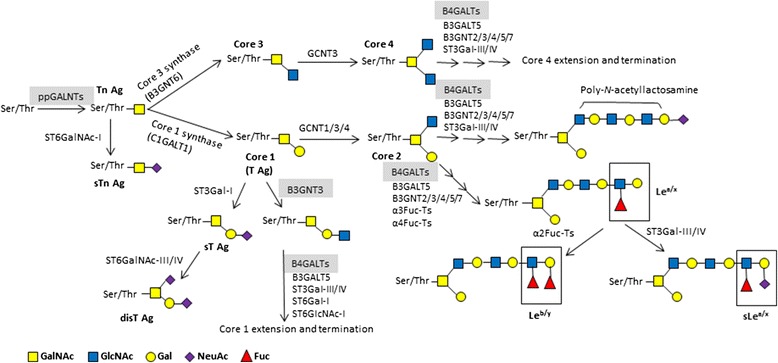
Biosynthetic pathways of mucin-type O-glycans. Glycosyltransferases involved in the synthesis are indicated. Additional modifications exist (not shown). B3GALT5 β1,3-galactosyltransferase 5, B3GNT β1,3-N-acetylglucosaminyltransferase; B4GALTs, β1,4-galactosyltransferases, C1GALT1, core 1 β1,3-galactosyltransferase, Fuc-T fucosyltransferase, GCNT β1,6-N-acetylglucosaminyltransferase, ST3Gal Gal: α2,3-sialyltransferase, ST6Gal-I Gal: α2,6-sialyltransferase-I, ST6GalNAc GalNAc: α2,6-sialyltransferase, ST6GlcNAc-I GlcNAc: α2,6-sialyltransferase-I, ppGALNTs UDPGalNAc-polypeptide N-acetylgalactosaminyltransferases, GalNAc N-acetylgalactosamine, GlcNAc N-acetylglucosamine, Gal galactose, NeuAc N-acetylneuraminic acid, Fuc fucose. Glycosyltransferases shown in Table 1 are highlighted, except B4GALNT3
Fig. 3
Fig. 3
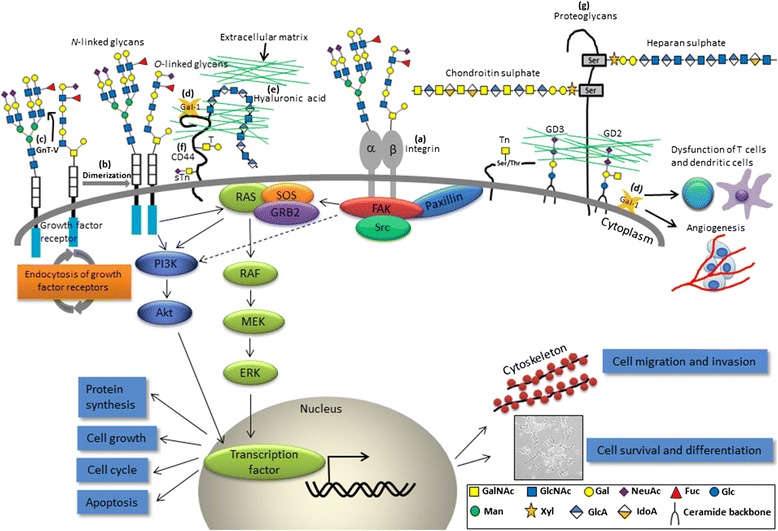
Altered glycans and related pathophysiological events involved in NB progression. a β1,4-N-acetylgalactosaminyltransferase 3 (B4GALNT3) and β1,4-galactosyltransferase 3 (B4GALT3) exhibit differential effects on malignant phenotypes by modification of β1 integrin in NB cells; b N-acetylgalactosaminyltransferase 2 (GALNT2) modifies O-glycans on IGF-1R, thereby suppressing IGF-1-induced IGF-1R dimerization and downstream signaling; c N-acetylglucosaminyltransferase V (GnT-V) modulates the sensitivity of NB to apoptosis; d Gal-1 promotes attachment of NB cells to the extracellular matrix (ECM) and endothelial cells through binding to CD44. Besides, Gal-1 may dampen the function of T cells and dendritic cells as well. Glycosaminoglycans present as e free polysaccharides (hyaluronic acid), a major counterreceptor for f CD44, or g as part of proteoglycans (heparan sulfate and chondroitin sulfate). GalNAc N-acetylgalactosamine, GlcNAc N-acetylglucosamine, Gal galactose, NeuAc, N-acetylneuraminic acid, Fuc fucose, Glc glucose, Man mannose, Xyl xylose, GlcA glucuronic acid, IdoA iduronic acid

References

    1. Fuster MM, Esko JD. The sweet and sour of cancer: glycans as novel therapeutic targets. Nat Rev Cancer. 2005;5(7):526–542. doi: 10.1038/nrc1649. - DOI - PubMed
    1. Weis WI, Drickamer K. Structural basis of lectin-carbohydrate recognition. Annu Rev Biochem. 1996;65:441–473. doi: 10.1146/annurev.bi.65.070196.002301. - DOI - PubMed
    1. Banh A, Zhang J, Cao H, Bouley DM, Kwok S, Kong C, et al. Tumor galectin-1 mediates tumor growth and metastasis through regulation of T-cell apoptosis. Cancer Res. 2011;71(13):4423–4431. doi: 10.1158/0008-5472.CAN-10-4157. - DOI - PMC - PubMed
    1. Tang D, Yuan Z, Xue X, Lu Z, Zhang Y, Wang H, et al. High expression of galectin-1 in pancreatic stellate cells plays a role in the development and maintenance of an immunosuppressive microenvironment in pancreatic cancer. Int J Cancer. 2012;130(10):2337–2348. doi: 10.1002/ijc.26290. - DOI - PubMed
    1. Miyazaki K, Sakuma K, Kawamura YI, Izawa M, Ohmori K, Mitsuki M, et al. Colonic epithelial cells express specific ligands for mucosal macrophage immunosuppressive receptors siglec-7 and -9. J Immunol. 2012;188(9):4690–4700. doi: 10.4049/jimmunol.1100605. - DOI - PubMed

Publication types