Review
. 2016 Sep 22:8:102.
doi: 10.1186/s13148-016-0268-4. eCollection 2016.

The emerging role of lysine methyltransferase SETD8 in human diseases

Affiliations
Review

The emerging role of lysine methyltransferase SETD8 in human diseases

Ciro Milite et al. Clin Epigenetics. .

Abstract

SETD8/SET8/Pr-SET7/KMT5A is the only known lysine methyltransferase (KMT) that monomethylates lysine 20 of histone H4 (H4K20) in vivo. Lysine residues of non-histone proteins including proliferating cell nuclear antigen (PCNA) and p53 are also monomethylated. As a consequence, the methyltransferase activity of the enzyme is implicated in many essential cellular processes including DNA replication, DNA damage response, transcription modulation, and cell cycle regulation. This review aims to provide an overview of the roles of SETD8 in physiological and pathological pathways and to discuss the progress made to date in inhibiting the activity of SETD8 by small molecules, with an emphasis on their discovery, selectivity over other methyltransferases and cellular activity.


Figures
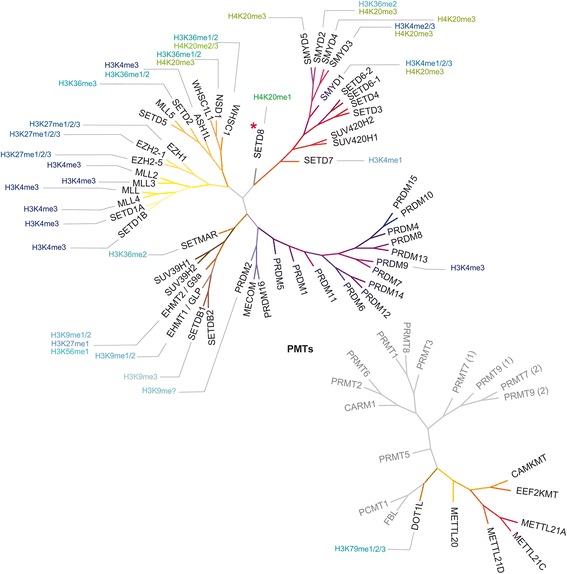
Fig. 1
Fig. 1
Phylogenetic tree of protein methyltransferases (PMTs; obtained with the Structural Genomic Consortium ChromoHub [102] and modified with Adobe Illustrator CS5). Specific modifications induced on histones H3 (shades of blue) and H4 (shades of green) are also shown. SETD8 is highlighted with a rubine red asterisk
Fig. 2
Fig. 2
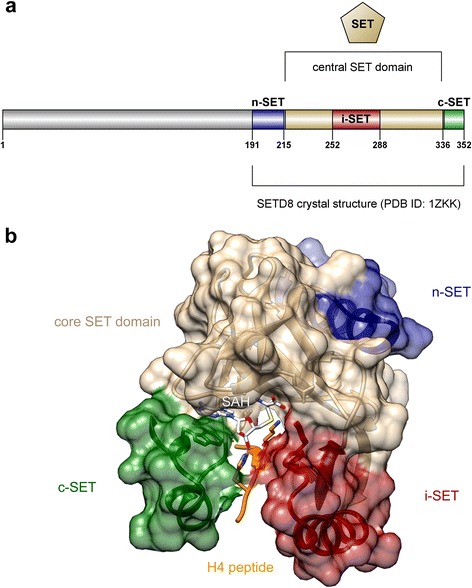
SETD8 protein structure. a Cartoon showing the C-terminal core SET domain and the locations of the n-SET, i-SET, and c-SET regions (obtained with). b Crystal structure of the SETD8 SET domain (tan), showing bound H4 peptide and substrate residue Lys20 (orange), n-SET (blue), i-SET (dark red), c-SET (dark green) regions, and product cofactor S-adenosyl homocysteine (SAH; white). The picture was prepared using Illustrator for Biological Sequences (IBS) [103] (panel a) and UCSF Chimera [104] (panel b, coordinates from Protein Data Bank (PDB) ID code 1ZKK, chain A) and modified with Adobe Illustrator CS5
Fig. 3
Fig. 3
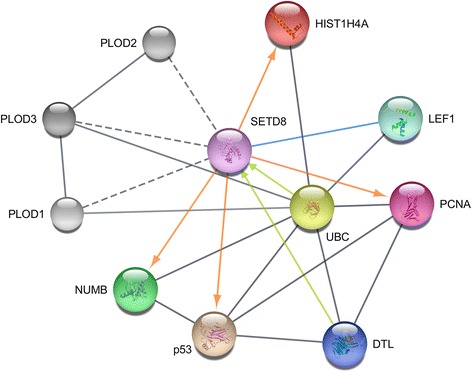
SETD8 protein–protein interaction network, obtained with Cytoscape v. 3.4.0 [105] using STRING database [106]. Only proteins directly interacting with SETD8 are displayed as colored glass-like marbles: histone cluster 1, H4a (HIST1H4a, red), lymphoid enhancer-binding factor 1 (LEF1, aquamarine), proliferating cell nuclear antigen (PCNA, violet red), denticleless protein homolog (DTL, also known as CDT2, persian blue), tumor protein p53 (p53, tan), protein numb homolog (NUMB, green). SETD8 is depicted in orchid. Direct interactions of SETD8 with protein targets leading to post-translational modifications are depicted as orange arrows, protein–protein interactions leading to SETD8 degradation as lime arrows, binding interactions as cornflower lines. Other interactions are shown as gray lines. Interactions of SETD8 with proteins PLOD1–3 (procollagen-lysine, 2-oxoglutarate 5-dioxygenase, shades of gray) were also retrieved from the interrogation of the STRING database, yet we found no evidence in the literature. Therefore they are shown as dotted gray lines

References

    1. Greer EL, Shi Y. Histone methylation: a dynamic mark in health, disease and inheritance. Nat Rev Genet. 2012;13(5):343–357. doi: 10.1038/nrg3173. - DOI - PMC - PubMed
    1. Black Joshua C, Van Rechem C, Whetstine Johnathan R. Histone lysine methylation dynamics: establishment, regulation, and biological impact. Mol Cell. 2012;48(4):491–507. doi: 10.1016/j.molcel.2012.11.006. - DOI - PMC - PubMed
    1. Campos EI, Reinberg D. Histones: annotating chromatin. Annu Rev Genet. 2009;43(1):559–599. doi: 10.1146/annurev.genet.032608.103928. - DOI - PubMed
    1. Esteller M. Cancer epigenomics: DNA methylomes and histone-modification maps. Nat Rev Genet. 2007;8(4):286–298. doi: 10.1038/nrg2005. - DOI - PubMed
    1. Jenuwein T, Allis CD. Science. 2001;293:1074–1080. doi: 10.1126/science.1063127. - DOI - PubMed