


Review
doi: 10.3390/bios6040050.
Recent Advances in the Fabrication and Application of Screen-Printed Electrochemical (Bio)Sensors Based on Carbon Materials for Biomedical, Agri-Food and Environmental Analyses
Affiliations
- PMID: 27690118
- PMCID: PMC5192370
- DOI: 10.3390/bios6040050
Item in Clipboard
Review
Recent Advances in the Fabrication and Application of Screen-Printed Electrochemical (Bio)Sensors Based on Carbon Materials for Biomedical, Agri-Food and Environmental Analyses
Biosensors (Basel).
.
Abstract
This review describes recent advances in the fabrication of electrochemical (bio)sensors based on screen-printing technology involving carbon materials and their application in biomedical, agri-food and environmental analyses. It will focus on the various strategies employed in the fabrication of screen-printed (bio)sensors, together with their performance characteristics; the application of these devices for the measurement of selected naturally occurring biomolecules, environmental pollutants and toxins will be discussed.
Keywords: Environmental; agri-food; amperometry; biomedical; biosensor; screen-printed; voltammetry.
Conflict of interest statement
The authors declare no conflict of interest.
Figures
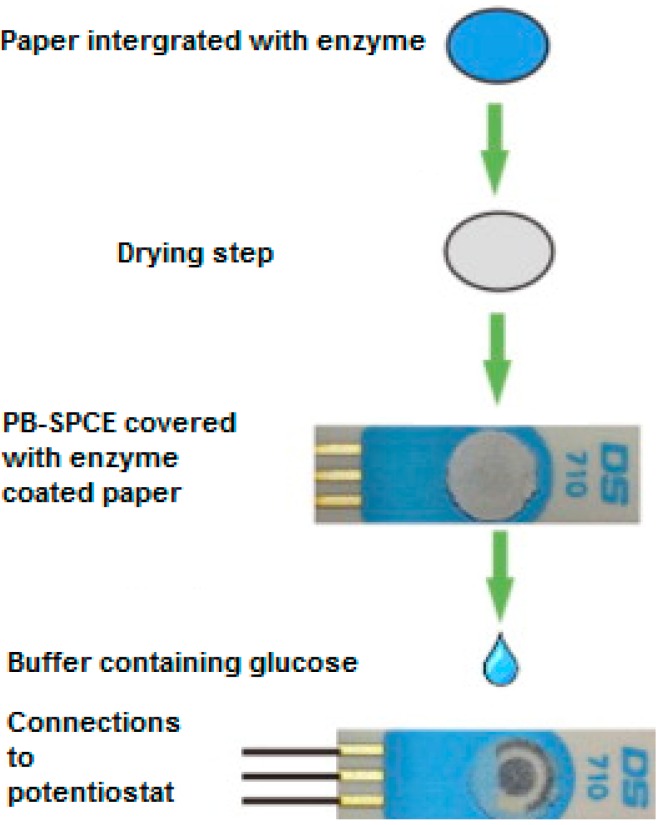
Schematic illustration of glucose oxidase paper disc preparation and integration with the prussian blue-screen-printed carbon electrodes (SPCE). Adapted from [13].

Schematic displaying the interaction between the immobilized enzyme GLDH and glutamate at the surface of the electrode and the subsequent generation of the analytical response. Reproduced with permission from [22].
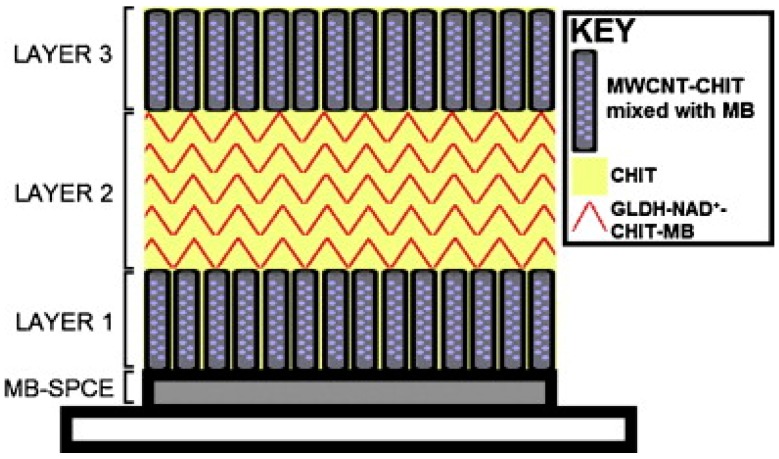
A schematic diagram displaying the layer-by-layer drop coating fabrication procedure used to construct the reagentless glutamate biosensor, based on a MB-SPCE electrode. Reproduced with permission from [24].

The reaction scheme of L-ascorbic acid at a polyaniline (PANI)-SPCE. Adapted from [40].

Cyclic voltammograms of 1.0 mM ascorbic acid (a), 1.0 mM dopamine (b), 1.0 mM uric acid at a screen printed electrode (A) and a screen-printed graphene electrode (SPGNE) (B). Supporting electrolyte: 0.1 M phosphate buffer saline (pH 7.0). Scan rate 50 mV/s. Adapted from [46].

(A) Sensor connected to electronic hardware for data acquisition; (B) Schematic diagram of membrane role, with SEM image of nylon-6 coating; (C) Photograph demonstrating the in-situ analysis of ascorbic acid in fruit. Adapted from [50].
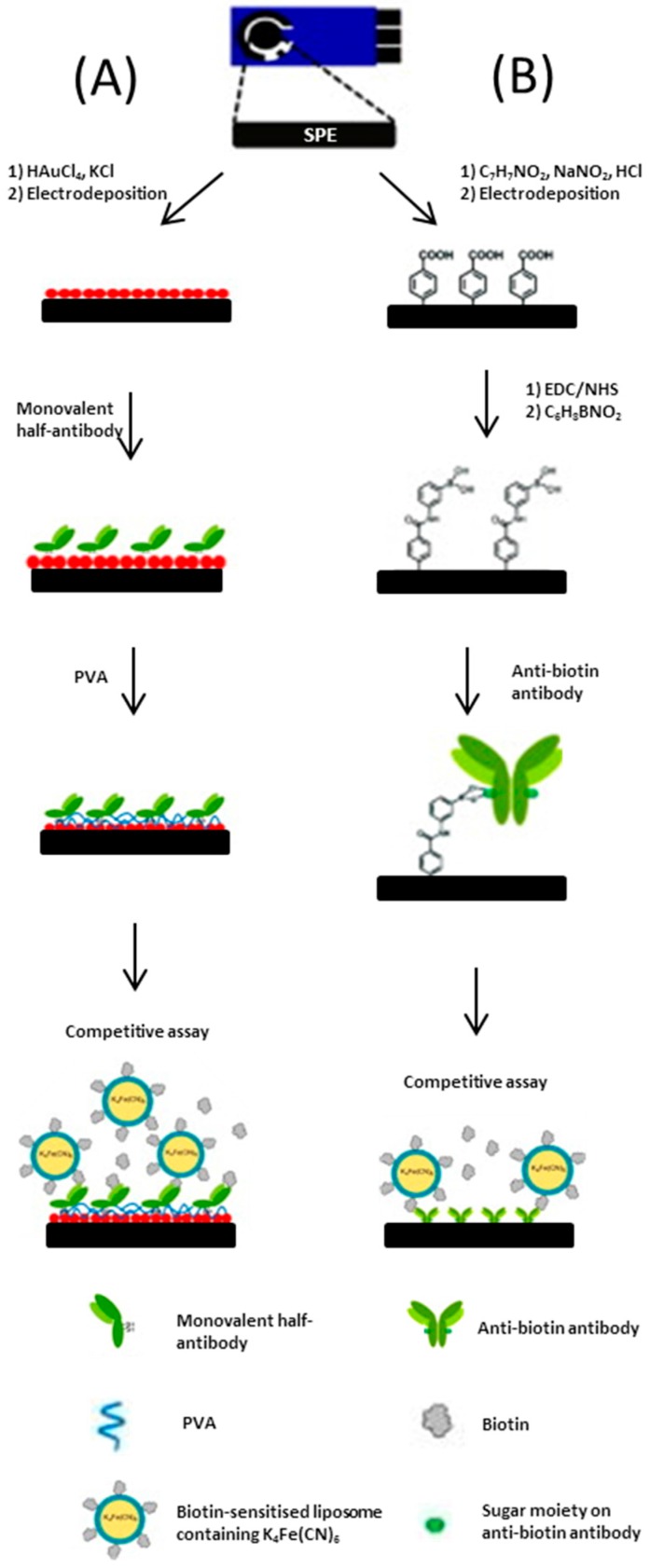
(A) Schematic representation of the method used to prepare a monovalent half-antibody/gold nanoparticles/screen printed graphene electrode electrochemical immunosensor and its mechanism of operation; (B) Schematic representation of the preparation of an antibody/anti-biotion antibody/screen printed graphene electrode electrochemical immunosensor and its mechanism of operation (drawing not to scale). Adapted from [57].

(a) Electrode array comprising 12 screen-printed carbon electrodes modified with cobalt phthalocyanine (CoPC) and an Ag/AgCl counter/reference electrode printed on an alumina substrate; (b) array in the prototype biosensor system operating in the field powered from a car battery via the lighter socket. Reproduced with permission [81].
References
-
- Hart J.P., Wring S.A. Screen-printed voltammetric and amperometric electrochemical sensors for decentralised testing. Electroanalysis. 1994;6:617–624. doi: 10.1002/elan.1140060802. - DOI
-
- Hart J.P., Wring S.A. Recent developments in the design and application of screen-printed electrochemical sensors for biomedical, environmental and industrial analyses. Trend. Anal. Chem. 1997;16:89–103. doi: 10.1016/S0165-9936(96)00097-0. - DOI
-
- Wedge R., Pemberton R.M., Hart J.P., Luxton R. Recent developments towards disposable screen-printed biosensors incorporating a carbon ink modified with the redox mediator, Meldola’s blue. Analysis. 1999;27:570–577. doi: 10.1051/analusis:1999270570. - DOI
-
- Cowell D.C., Abass A.K., Dowman A.A., Hart J.P., Pemberton R.M., Young S.J. Screen-printed disposable biosensors for environmental pollution monitoring. In: Butterworth F.M., Gunatilaka A.P., Gonsebatt M.E., editors. Biomonitors and Biomarkers as Indicators of Environmental Change 2. Volume 56. Kluwer Academic Press/Plenum Publishers; New York, NY, USA: 2000. pp. 157–173.
-
- Hart J.P., Abass A.K., Honeychurch K.C., Pemberton R.M., Ryan S.L., Wedge R. Sensors/biosensors, based on screen-printing technology for biomedical applications. Indian J. Chem. A. 2003;42:709–718.
Publication types
LinkOut - more resources
Full Text Sources
Other Literature Sources
