. 2016 Jul;26(6):477-491.
doi: 10.1080/15376516.2016.1217112.

Electronic cigarette aerosol induces significantly less cytotoxicity than tobacco smoke

Affiliations

Electronic cigarette aerosol induces significantly less cytotoxicity than tobacco smoke

David Azzopardi et al. Toxicol Mech Methods. 2016 Jul.

Abstract

Electronic cigarettes (E-cigarettes) are a potential means of addressing the harm to public health caused by tobacco smoking by offering smokers a less harmful means of receiving nicotine. As e-cigarettes are a relatively new phenomenon, there are limited scientific data on the longer-term health effects of their use. This study describes a robust in vitro method for assessing the cytotoxic response of e-cigarette aerosols that can be effectively compared with conventional cigarette smoke. This was measured using the regulatory accepted Neutral Red Uptake assay modified for air-liquid interface (ALI) exposures. An exposure system, comprising a smoking machine, traditionally used for in vitro tobacco smoke exposure assessments, was adapted for use with e-cigarettes to expose human lung epithelial cells at the ALI. Dosimetric analysis methods using real-time quartz crystal microbalances for mass, and post-exposure chemical analysis for nicotine, were employed to detect/distinguish aerosol dilutions from a reference Kentucky 3R4F cigarette and two commercially available e-cigarettes (Vype eStick and ePen). ePen aerosol induced 97%, 94% and 70% less cytotoxicity than 3R4F cigarette smoke based on matched EC50 values at different dilutions (1:5 vs. 1:153 vol:vol), mass (52.1 vs. 3.1 μg/cm2) and nicotine (0.89 vs. 0.27 μg/cm2), respectively. Test doses where cigarette smoke and e-cigarette aerosol cytotoxicity were observed are comparable with calculated daily doses in consumers. Such experiments could form the basis of a larger package of work including chemical analyses, in vitro toxicology tests and clinical studies, to help assess the safety of current and next generation nicotine and tobacco products.

Keywords: Air–liquid interface; e-cigarettes; lung epithelial cells; tobacco smoke.


Figures
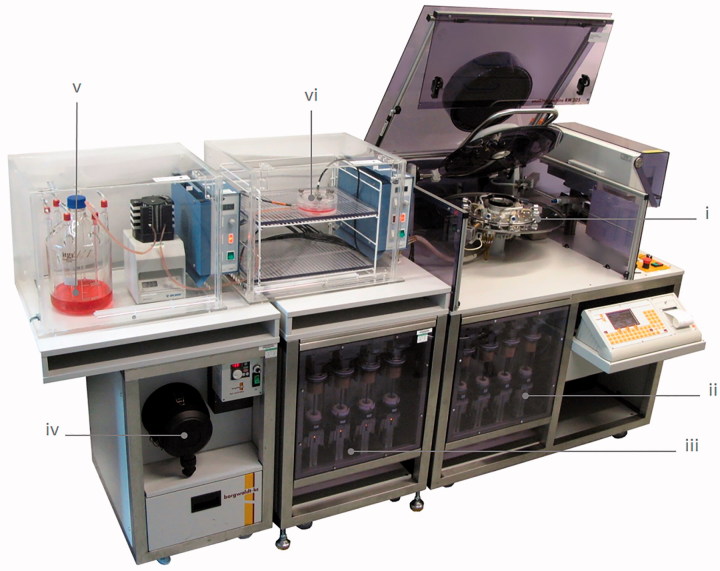
Figure 1.
Figure 1.
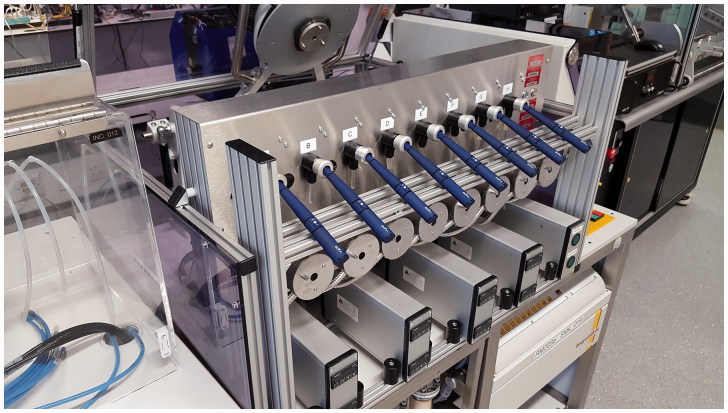
Borgwaldt RM20S smoking machine. (i) Cigarette smoke generator. (ii) Original four-syringe system. (iii) Four-syringe extension. (iv) Air-flow controller. (v) Cell culture media maintained at 37 °C. (vi) British American Tobacco’s exposure chamber housed at 37 °C, attached to the smoke diluter and culture media (modified from Adamson et al., 2011).
Figure 2.
Figure 2.
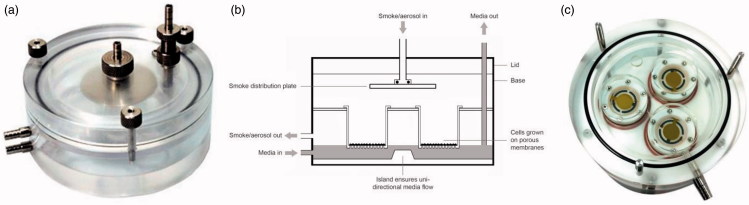
British American Tobacco’s standard exposure chamber used for in vitro exposures to aerosol at the air–liquid interface (a; Adamson et al., and b; Thorne & Adamson, 2013). Modifications to accommodate the three quartz crystal microbalance units (lid removed) (c; Adamson et al., 2013).
Figure 3.
Figure 3.
Vype ePen e-cigarettes are attached to the adapted Borgwaldt RM20S by bypassing the cigarette smoke generator.
Figure 4.
Figure 4.
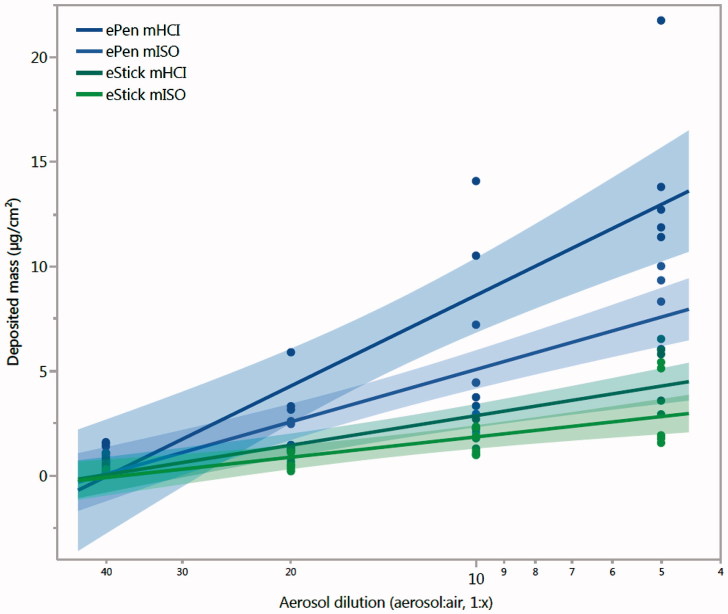
Deposited mass concentration of Vype eStick and Vype ePen e-cigarette aerosol generated over 15 minutes under two different regimens and various dilutions between 1:40 and 1:5 aerosol:air vol:vol, as quantified by quartz crystal microbalances within the in vitro exposure chamber. Data are represented as means and 95% confidence intervals of the fit, represented by the shaded region. Experiments were represented in the graphs by the individual points (n = 4 – 6 exposures per dilution). Abbreviations – HCI: Health Canada intense; ISO: International Organization for Standardization.
Figure 5.
Figure 5.
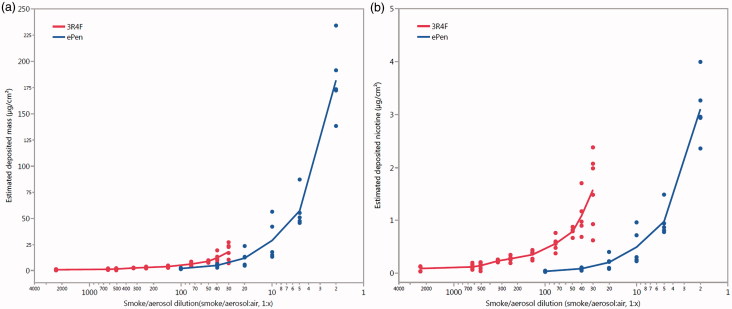
Estimated mass (a) and nicotine (b) deposition of Vype ePen e-cigarette aerosol and 3R4F reference cigarette smoke generated over 60 minutes under modified and standard HCI regimens and various dilutions between 1:100 – 1:2 aerosol:air, vol:vol and 1:2500 – 1:30 smoke:air, vol:vol, respectively, as quantified by quartz crystal microbalances within the in vitro exposure chamber. Experiments are represented by the individual points (n = 4–6). Abbreviation – HCI: Health Canada Intense.
Figure 6.
Figure 6.
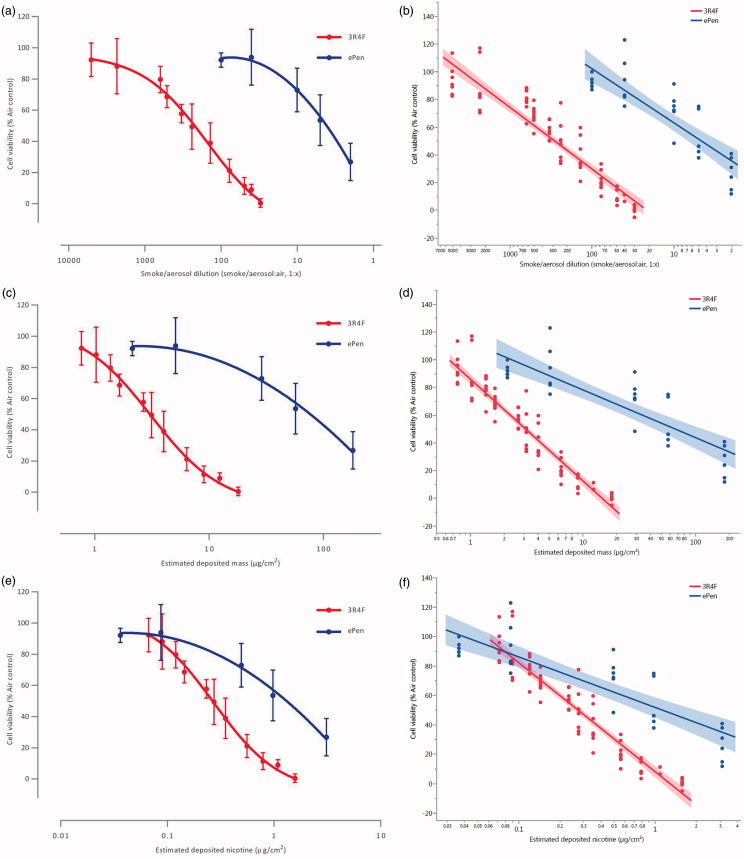
Changes in NCI-H292 cell viability (% of the air control) after exposure to various dilutions (Smoke/aerosol:air, vol:vol) of Vype ePen e-cigarette aerosol (n = 6 exposures per dilution) and 3R4F cigarette smoke (n = 8 exposures per dilution). Data are expressed according to (a) aerosol dilution (ePen EC50 =1:5, 3R4F EC50 =1:153 smoke/aerosol:air, vol:vol), (c) estimated deposited mass (ePen EC50 =52.1, 3R4F EC50 =3.1 μg/cm2) and (e) estimated deposited nicotine (ePen EC50 =0.89, 3R4F EC50 =0.27 μg/cm2). Data are represented as means (circles) and standard deviations (bars). Regression fit of the linear regions of Vype ePen e-cigarette (n = 6) and 3R4F cigarette aerosols (n = 8) NCI-H292 cell viability curves expressed according to (b) aerosol dilution, (d) estimated deposited mass and (f) estimated deposited nicotine. Data are represented as means and 95% confidence intervals of the fit, represented by the shaded region. Experiments are represented by the individual points.

References

    1. Adamson J, Azzopardi D, Errington G, et al. Assessment of an in vitro whole cigarette smoke exposure system: the Borgwaldt RM20S 8-syringe smoking machine. Chem Cent J. 2011;5:50–60. - PMC - PubMed
    1. Adamson J, Hughes S, Azzopardi D, et al. Real-time assessment of cigarette smoke particle deposition in vitro. Chem Cent J. 2012;6:98. - PMC - PubMed
    1. Adamson J, Thorne D, Errington G, et al. An inter-machine comparison of tobacco smoke particle deposition in vitro from six independent smoke exposure systems. Toxicol In Vitro. 2014;28:1320–8. - PubMed
    1. Adamson J, Thorne D, McAughey J, et al. Quantification of cigarette smoke particle deposition in vitro using a triplicate quartz crystal microbalance exposure chamber. Biomed Res Int. 2013;2013:685074. - PMC - PubMed
    1. Armitage AK, Dixon M, Frost BE, et al. The effect of inhalation volume and breath-hold duration on the retention of nicotine and solanesol in the human respiratory tract and on subsequent plasma nicotine concentrations during cigarette smoking. Beitr Tabakforsch Int. 2004;4:240–9. - PubMed

LinkOut - more resources