


Moderating effects of immunosuppressive medications and risk factors for post-operative joint infection following total joint arthroplasty in patients with rheumatoid arthritis or osteoarthritis
- PMID: 27692433
- PMCID: PMC5325817
- DOI: 10.1016/j.semarthrit.2016.08.011
Moderating effects of immunosuppressive medications and risk factors for post-operative joint infection following total joint arthroplasty in patients with rheumatoid arthritis or osteoarthritis
Abstract
Objective: Inconclusive findings about infection risks, importantly the use of immunosuppressive medications in patients who have undergone large-joint total joint arthroplasty, challenge efforts to provide evidence-based perioperative total joint arthroplasty recommendations to improve surgical outcomes. Thus, the aim of this study was to describe risk factors for developing a post-operative infection in patients undergoing TJA of a large joint (total hip arthroplasty, total knee arthroplasty, or total shoulder arthroplasty) by identifying clinical and demographic factors, including the use of high-risk medications (i.e., prednisone and immunosuppressive medications) and diagnoses [i.e., rheumatoid arthritis (RA), osteoarthritis (OA), gout, obesity, and diabetes mellitus] that are linked to infection status, controlling for length of follow-up.
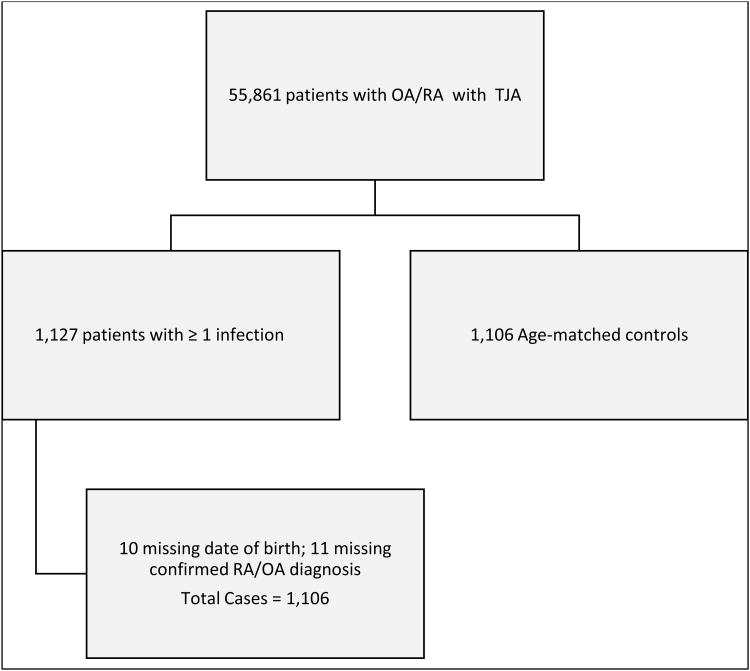
Methods: A retrospective, case-control study (N = 2212) using de-identified patient health claims information from a commercially insured, U.S. dataset representing 15 million patients annually (from January 1, 2007 to December 31, 2009) was conducted. Descriptive statistics, t-test, chi-square test, Fisher's exact test, and multivariate logistic regression were used.
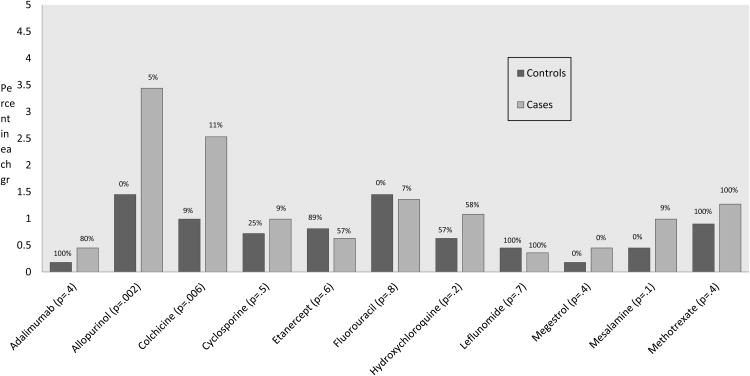
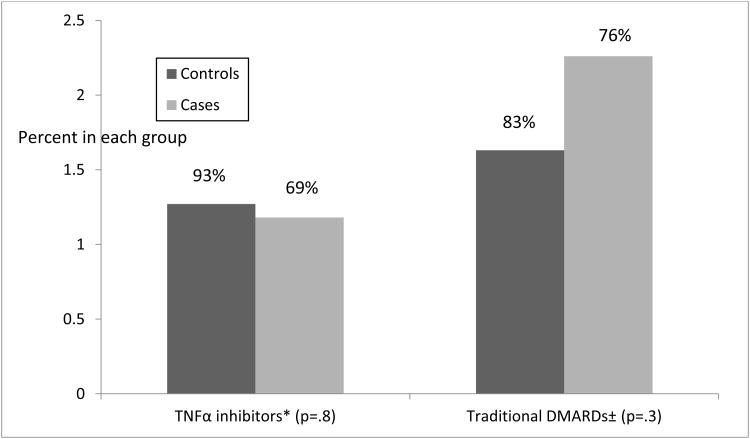
Results: Male gender (OR = 1.42, p < 0.001), diagnosis of RA (OR = 1.47, p = 0.031), diabetes mellitus (OR = 1.38, p = 0.001), obesity (OR = 1.66, p < 0.001) or gout (OR = 1.95, p = 0.001), and a prescription for prednisone (OR = 1.59, p < 0.001) predicted a post-operative infection following total joint arthroplasty. Persons with post-operative joint infections were significantly more likely to be prescribed allopurinol (p = 0.002) and colchicine (p = 0.006); no significant difference was found for the use of specific disease-modifying anti-rheumatic drugs and TNF-α inhibitors.
Conclusion: High-risk, post-operative joint infection groups were identified allowing for precautionary clinical measures to be taken.
Keywords: Case–control study; Immunosuppressive medications; Infections; Perioperative management; Risk factors; Total joint arthroplasty.
Copyright © 2017 Elsevier Inc. All rights reserved.
Figures
References
-
- Center for Disease Control, Inpatient surgery. [accessed 4.8.2015]; http://www.cdc.gov/nchs/fastats/inpatient-surgery.htm.
-
- Trofa D, Rajaee SS, Smith EL. Nationwide trends in total shoulder arthroplasty and hemiarthroplasty for osteoarthritis. Am J of Orthop. 2014;43:166–172. - PubMed
-
- U.S. Department of Health and Human Services. Health, United States, 2014. [accessed 4.8.2015]; http://www.cdc.gov/nchs/fastats/inpatient-surgery.htm. - PubMed
Publication types
MeSH terms
Substances
Supplementary concepts
Grants and funding
LinkOut - more resources
Full Text Sources
Other Literature Sources
Medical
