


Spread through Air Spaces (STAS) Is an Independent Predictor of Recurrence and Lung Cancer-Specific Death in Squamous Cell Carcinoma
- PMID: 27693541
- PMCID: PMC5639476
- DOI: 10.1016/j.jtho.2016.09.129
Spread through Air Spaces (STAS) Is an Independent Predictor of Recurrence and Lung Cancer-Specific Death in Squamous Cell Carcinoma
Abstract
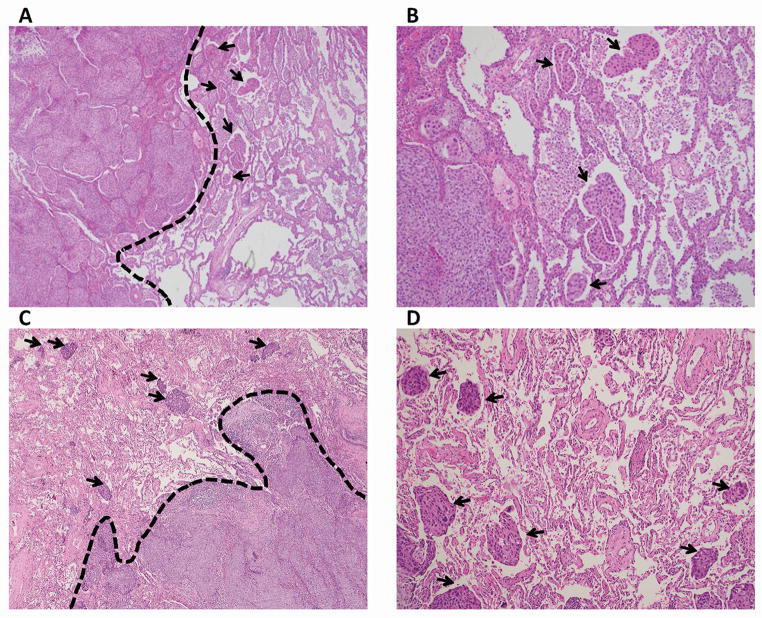
Introduction: Spread through air spaces (STAS) is a recently recognized pattern of invasion in lung adenocarcinoma; however, it has not yet been characterized in squamous cell carcinoma (SCC).
Methods: We reviewed 445 resected stage I to III lung SCCs and investigated the clinical significance of STAS. Cumulative incidence of recurrence and lung cancer-specific death were evaluated by competing risks analyses and overall survival by Cox models.
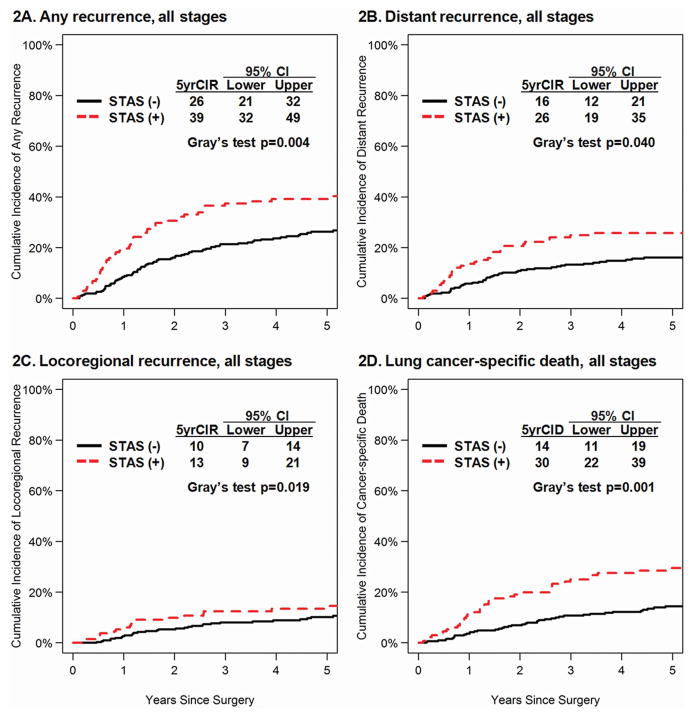
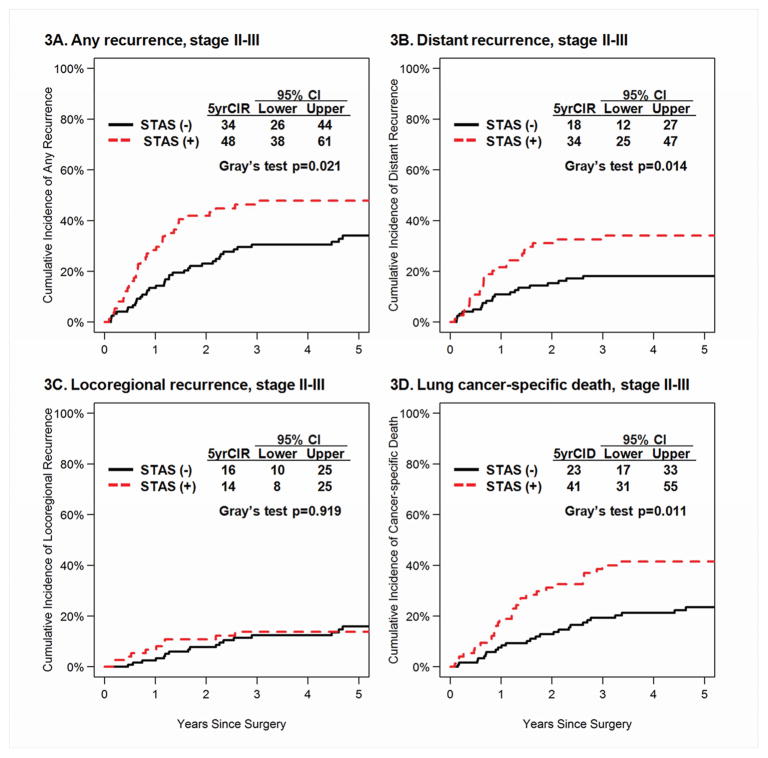
Results: Of the total 445 patients, 336 (76%) were older than 65 years. Among the 273 patients who died, 91 (33%) died of lung cancer whereas the remaining ones died of competing events or unknown cause. STAS was observed in 132 patients (30%) and the frequency increased with stage. The cumulative incidences of any, distant, and locoregional recurrence as well as lung cancer-specific death were significantly higher in patients with STAS compared with in those without STAS, whereas there was no statistically significant difference in overall survival. In multivariable models for any recurrence and lung cancer-specific death, STAS was an independent predictor for both outcomes (p = 0.034 and 0.016, respectively).
Conclusion: STAS was present in one-third of resected lung SCCs. In competing risks analysis in a cohort in which three-fourths of the patients were elderly, STAS was associated with lung cancer-specific outcomes. Our findings suggest that STAS is one of the most prognostically significant histologic findings in lung SCC.
Keywords: Competing risks analysis; Lung; Spread through air spaces; Squamous cell carcinoma.
Copyright © 2016 International Association for the Study of Lung Cancer. Published by Elsevier Inc. All rights reserved.
Conflict of interest statement
The authors declare no conflict of interest.
Figures
Comment in
-
Breaking New Ground: The Evolving Concept of Spread through Air Spaces (STAS).J Thorac Oncol. 2017 Feb;12(2):176-178. doi: 10.1016/j.jtho.2016.10.020. J Thorac Oncol. 2017. PMID: 28115109 No abstract available.
References
-
- Taira T, Ishii G, Nagai K, Yoh K, Takahashi Y, Matsumura Y, Kojima M, Ohmatsu H, Goto K, Niho S, Takashima H, Inoue H, Ohe Y, Ochiai A. Characterization of the immunophenotype of the tumor budding and its prognostic implications in squamous cell carcinoma of the lung. Lung Cancer. 2012;76:423–30. - PubMed
-
- Kadota K, Nitadori J, Woo KM, Sima CS, Finley DJ, Rusch VW, Adusumilli PS, Travis WD. Comprehensive pathological analyses in lung squamous cell carcinoma: single cell invasion, nuclear diameter, and tumor budding are independent prognostic factors for worse outcomes. J Thorac Oncol. 2014;9:1126–39. - PMC - PubMed
-
- Weichert W, Kossakowski C, Harms A, Schirmacher P, Muley T, Dienemann H, Warth A. Proposal of a prognostically relevant grading scheme for pulmonary squamous cell carcinoma. Eur Respir J. 2015 - PubMed
Publication types
MeSH terms
Grants and funding
LinkOut - more resources
Full Text Sources
Other Literature Sources
Medical
Research Materials
