Review
. 2017 Oct:39:106-119.
doi: 10.1016/j.arr.2016.09.002. Epub 2016 Sep 28.

Nutrition and other lifestyle influences on arterial aging

Affiliations
Review

Nutrition and other lifestyle influences on arterial aging

Thomas J LaRocca et al. Ageing Res Rev. 2017 Oct.

Abstract

As our world's population ages, cardiovascular diseases (CVD) will become an increasingly urgent public health problem. A key antecedent to clinical CVD and many other chronic disorders of aging is age-related arterial dysfunction, characterized by increased arterial stiffness and impaired arterial endothelial function. Accumulating evidence demonstrates that diet and nutrition may favorably modulate these arterial functions with aging, but many important questions remain. In this review, we will summarize the available information on dietary patterns and nutritional factors that have been studied for their potential to reduce arterial stiffness and improve endothelial function with age, with an emphasis on: 1) underlying physiological mechanisms, and 2) emerging areas of research on nutrition and arterial aging that may hold promise for preventing age-related CVD.

Keywords: Arterial stiffness; Diet; Endothelial dysfunction; Nutrition.


Figures

Figure 1
Figure 1
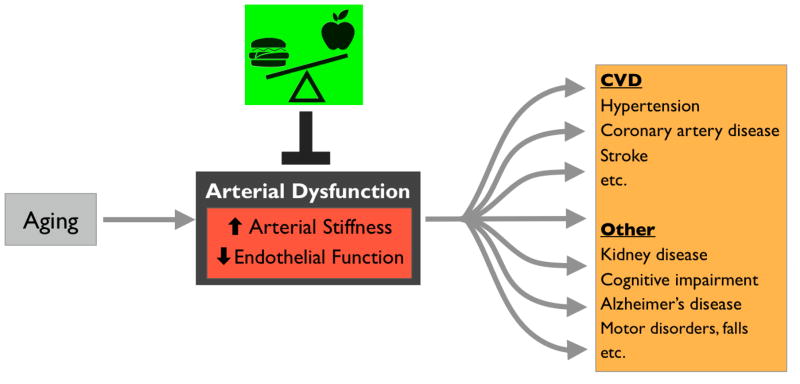
Aging leads to arterial dysfunction (increased stiffness and reduced endothelial function) that predisposes us to cardiovascular diseases (CVD) and other chronic disorders. Diet/nutrition has the potential to modulate/prevent arterial dysfunction with aging.
Figure 2
Figure 2
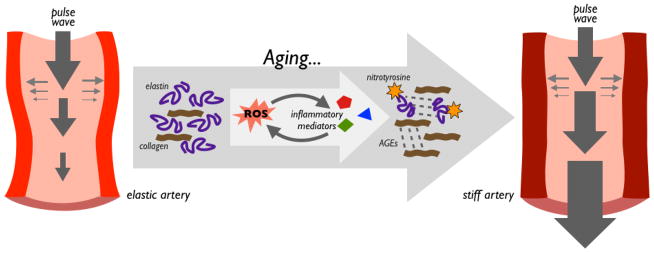
A key function of large elastic arteries is to buffer energy of the pulse wave. As large elastic arteries age, oxidative stress (characterized by excess reactive oxygen species, ROS) and inflammation alter structural protein composition of the arterial wall. Age-related reductions in elastin, increases in collagen, and buildup of oxidatively damaged proteins and advanced glycation end products (AGEs) results in stiffer arterial walls and greater pulse wave velocity/pressure.
Figure 3
Figure 3
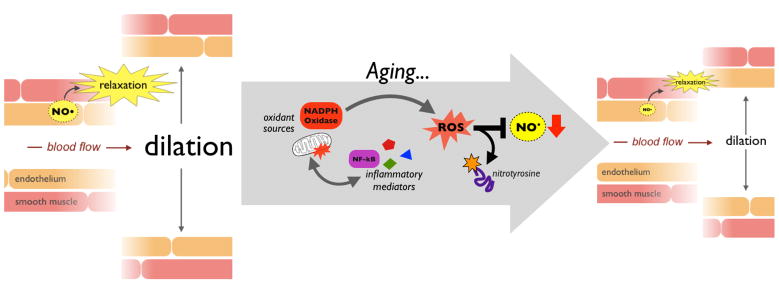
Endothelium-dependent dilation in response to nitric oxide (NO) is an important indicator of overall arterial endothelial function. Aging is associated with increases in oxidative stress (marked by excess reactive oxygen species, ROS) and inflammation driven by nuclear factor kB (NF-kB) and other cytokine mediators. Together, these processes reduce the bioavailability of NO, resulting in reduced endothelium-dependent dilation with age.
Figure 4
Figure 4
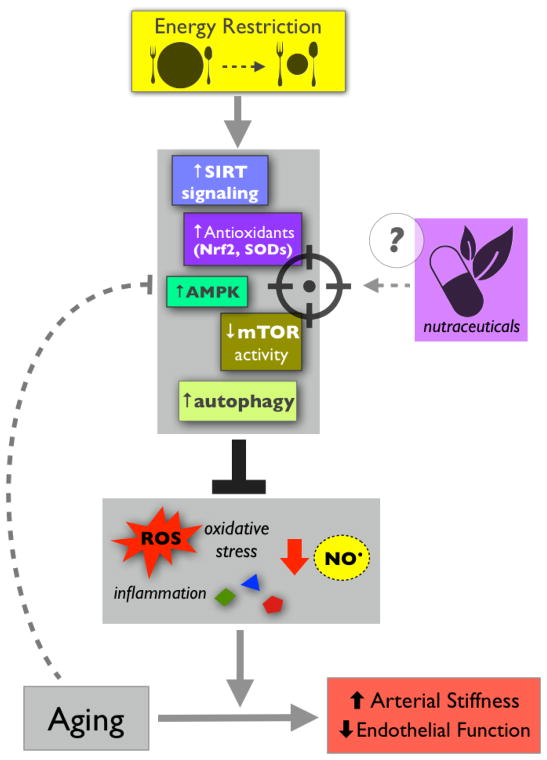
Energy restriction prevents/reverses age-related arterial dysfunction by stimulating key cellular signaling networks that reduce oxidative stress/inflammation and increase nitric oxide bioavailability. These energy-sensitive networks, which tend to become impaired with aging, may be novel targets for alternative nutritional therapies, such as nutraceuticals.
Figure 5
Figure 5
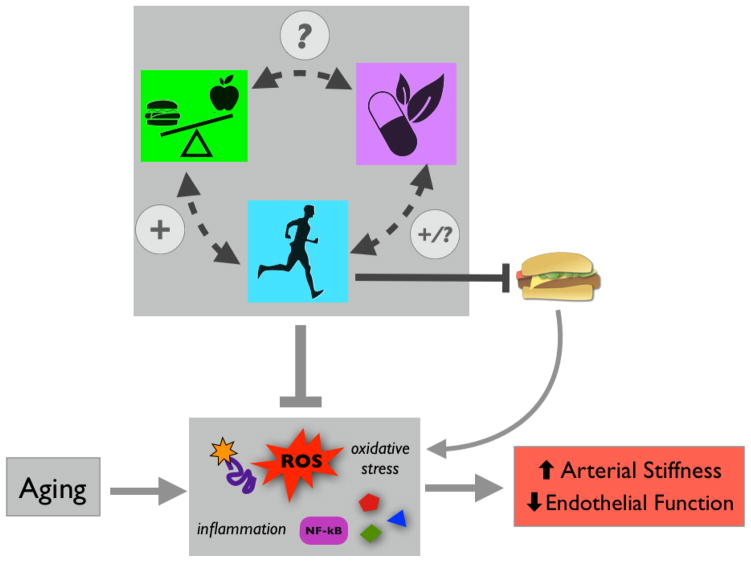
Exercise protects against the effects of poor diet and synergizes with healthy diet, but its interactions with nutraceuticals are less certain. The interactive effects of healthy diet and nutraceuticals on oxidative stress/inflammation-mediated arterial aging have generally not been studied.
Figure 6
Figure 6
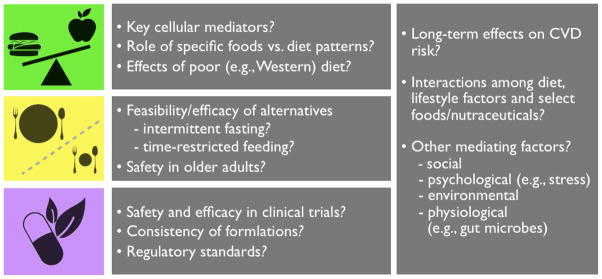
Important remaining questions and areas of research related to healthy diet, energy restriction and nutraceutical treatments for preventing/reversing age-related arterial dysfunction.

References

    1. Aaron KJ, Sanders PW. Role of dietary salt and potassium intake in cardiovascular health and disease: a review of the evidence. Mayo Clin Proc. 2013;88:987–995. - PMC - PubMed
    1. Akazawa N, Choi Y, Miyaki A, Tanabe Y, Sugawara J, Ajisaka R, Maeda S. Curcumin ingestion and exercise training improve vascular endothelial function in postmenopausal women. Nutr Res. 2012;32:795–799. - PubMed
    1. Al-Solaiman Y, Jesri A, Zhao Y, Morrow JD, Egan BM. Low-Sodium DASH reduces oxidative stress and improves vascular function in salt-sensitive humans. J of Hum Hypertens. 2009;23:826–835. - PMC - PubMed
    1. Alfaras I, Di Germanio C, Bernier M, Csiszar A, Ungvari Z, Lakatta EG, de Cabo R. Pharmacological strategies to retard cardiovascular aging. Circ Res. 2016;118:1626–1642. - PMC - PubMed
    1. Ashor AW, Lara J, Siervo M, Celis-Morales C, Oggioni C, Jakovljevic DG, Mathers JC. Exercise modalities and endothelial function: a systematic review and dose-response meta-analysis of randomized controlled trials. Sports Med. 2015a;45:279–296. - PubMed