


A Complex Network Perspective on Clinical Science
- PMID: 27694457
- PMCID: PMC5119747
- DOI: 10.1177/1745691616639283
A Complex Network Perspective on Clinical Science
Abstract
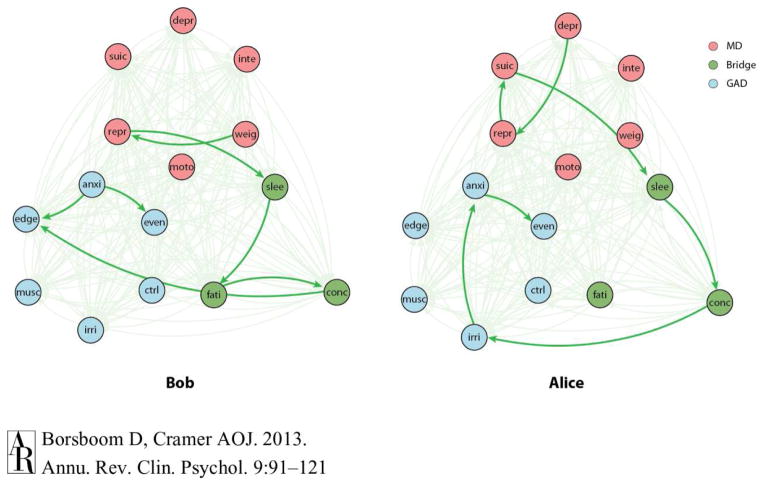
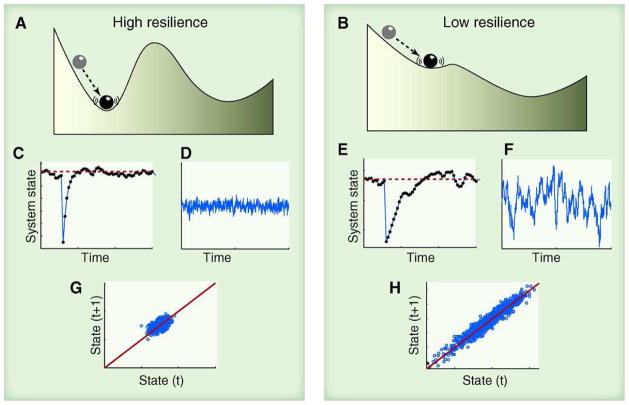
Contemporary classification systems for mental disorders assume that abnormal behaviors are expressions of latent disease entities. An alternative to the latent disease model is the complex network approach. Instead of assuming that symptoms arise from an underlying disease entity, the complex network approach holds that disorders exist as systems of interrelated elements of a network. This approach also provides a framework for the understanding of therapeutic change. Depending on the structure of the network, change can occur abruptly once the network reaches a critical threshold (the tipping point). Homogeneous and highly connected networks often recover more slowly from local perturbations when the network approaches the tipping point, potentially making it possible to predict treatment change, relapse, and recovery. In this article, we discuss the complex network approach as an alternative to the latent disease model and its implications for classification, therapy, relapse, and recovery.
Keywords: complex networks; nosology; psychopathology; psychotherapy.
© The Author(s) 2016.
Figures
References
-
- American Psychiatric Association. Diagnostic and statistical manual of mental disorders. 5. Washington, DC: American Psychiatric Publishing; 2013.
-
- Bollen K, Lennox R. Conventional wisdom on measurement: A structural equation perspective. Psychological Bulletin. 1991;110:305–314. doi: 10.1037/0033-2909.110.2.305. - DOI
Publication types
MeSH terms
Grants and funding
LinkOut - more resources
Full Text Sources
Other Literature Sources
Medical
