. 2016 Sep;11(5):713-729.
doi: 10.1177/1745691616650874.

Conducting Meta-Analyses Based on p Values: Reservations and Recommendations for Applying p-Uniform and p-Curve

Affiliations

Conducting Meta-Analyses Based on p Values: Reservations and Recommendations for Applying p-Uniform and p-Curve

Robbie C M van Aert et al. Perspect Psychol Sci. 2016 Sep.

Abstract

Because of overwhelming evidence of publication bias in psychology, techniques to correct meta-analytic estimates for such bias are greatly needed. The methodology on which the p-uniform and p-curve methods are based has great promise for providing accurate meta-analytic estimates in the presence of publication bias. However, in this article, we show that in some situations, p-curve behaves erratically, whereas p-uniform may yield implausible estimates of negative effect size. Moreover, we show that (and explain why) p-curve and p-uniform result in overestimation of effect size under moderate-to-large heterogeneity and may yield unpredictable bias when researchers employ p-hacking. We offer hands-on recommendations on applying and interpreting results of meta-analyses in general and p-uniform and p-curve in particular. Both methods as well as traditional methods are applied to a meta-analysis on the effect of weight on judgments of importance. We offer guidance for applying p-uniform or p-curve using R and a user-friendly web application for applying p-uniform.

Keywords: heterogeneity; meta-analysis; p-curve; p-hacking; p-uniform.


Conflict of interest statement

The authors declared that they had no conflicts of interest with respect to their authorship or the publication of this article.

Figures
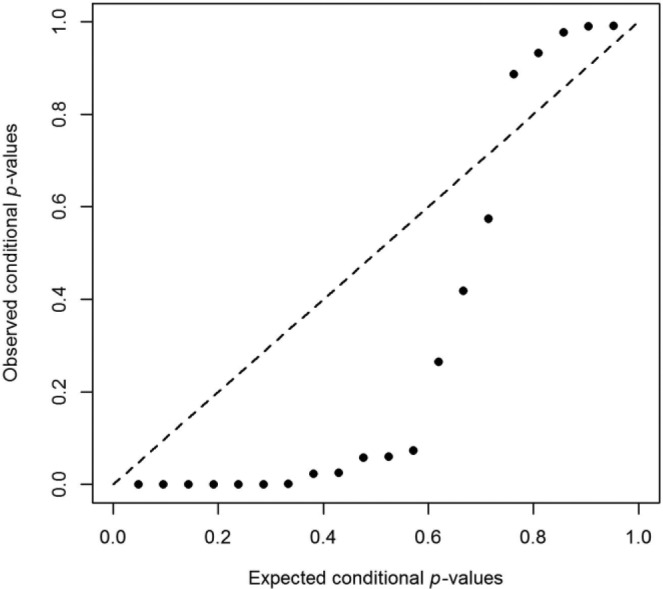
Fig. 1.
Fig. 1.
Probability-probability (P-P) plot for a meta-analysis of 20 studies with large heterogeneity.
Fig. 2.
Fig. 2.
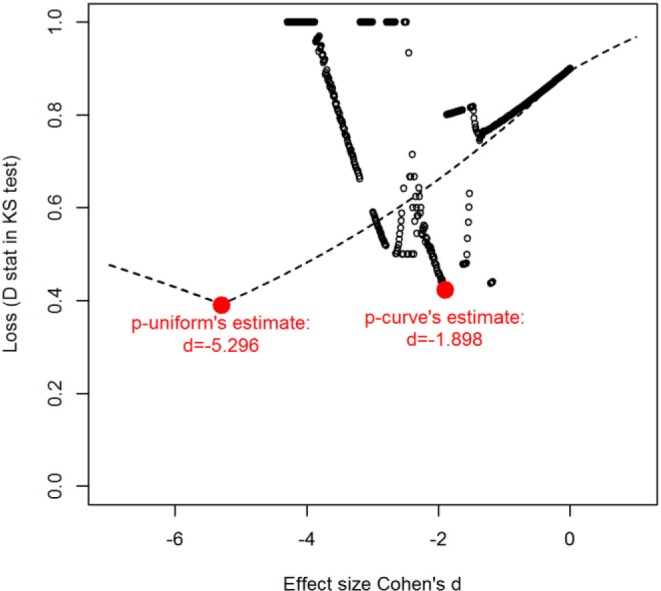
Values for Kolmogorov-Smirnov (KS) test statistics in implementation of p-curve and p-uniform for the example with three observed effect sizes and p values close to .05. D stat = test statistics of KS test.
Fig. 3.
Fig. 3.
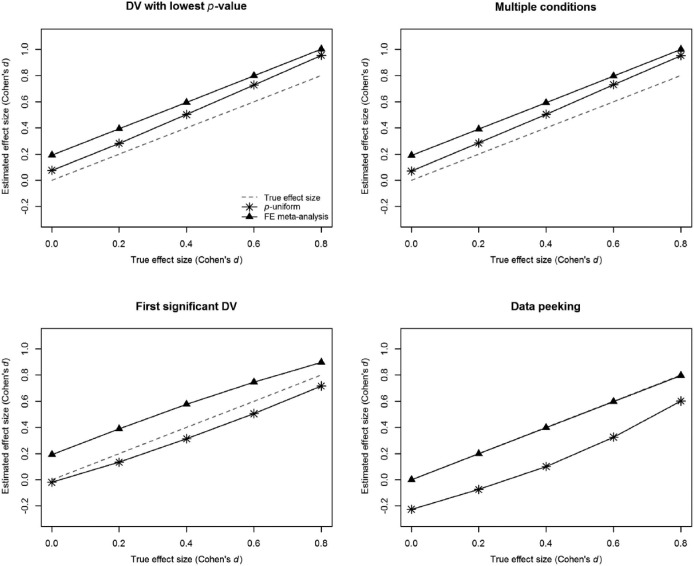
Effect size estimates in p-uniform and fixed-effect meta-analysis in case of four types of p-hacking. FE = fixed-effect; DV = dependent variable.
Fig. A1.
Fig. A1.
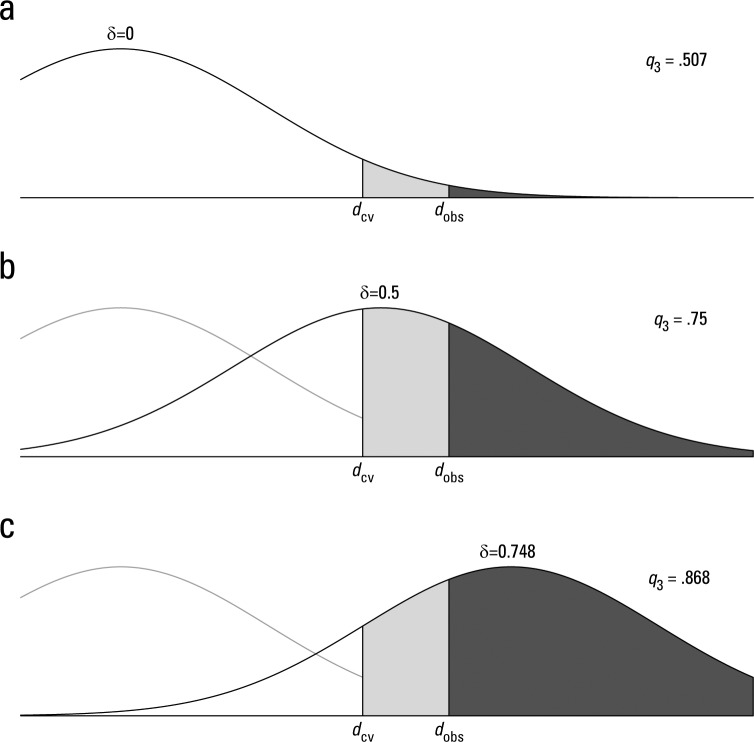
Computation of conditional p values for Effect 3 (q3) for three effect sizes: δ = 0; δ = 0.5 (true effect size); and δ = 0.748 (estimate of fixed-effect meta-analysis). Critical value on Cohen’s d scale is denoted by dcv and observed effect size is denoted by dobs.
Fig. A2.
Fig. A2.
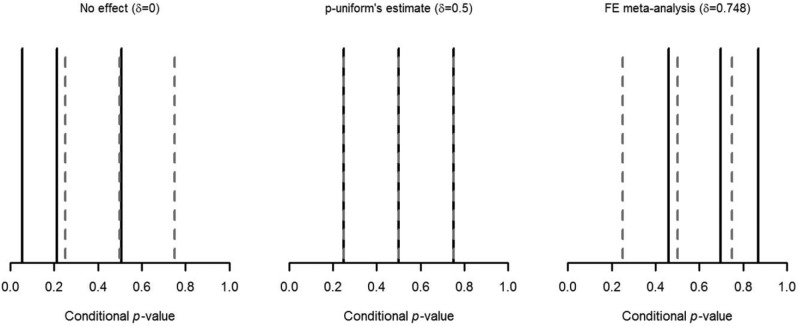
Observed conditional p values (solid black lines) and conditional p values under uniformity (dashed gray lines) for the example with three observed effect sizes. The three panels refer to the conditional p values for the p-uniform hypothesis test of no effect (δ = 0), p-uniform effect size estimate (δ = 0.5), and effect size obtained by fixed-effect (FE) meta-analysis (δ = 0.748).
Fig. A3.
Fig. A3.
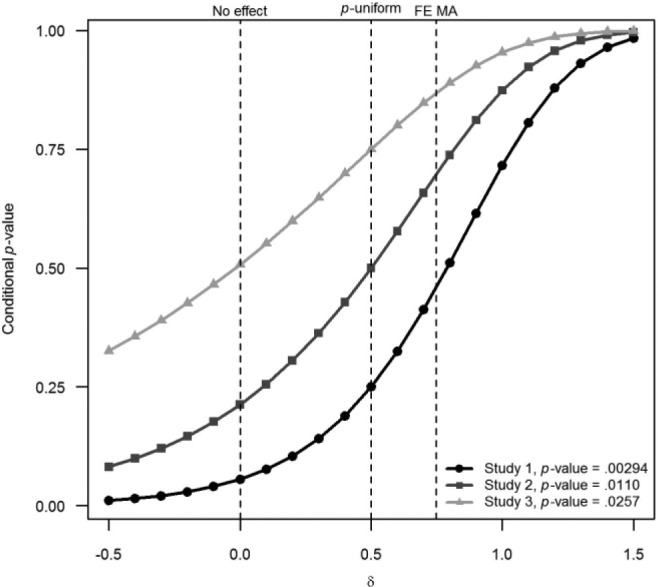
Conditional p values as a function of true effect size (x axis) for each of the three observed effect sizes in the example. Effect sizes zero (δ = 0), true effect size (δ = 0.5), and estimated by fixed-effect meta-analysis (δ = 0.748) are indicated by vertical lines.

References

    1. Ackerman J. M., Nocera C. C., Bargh J. A. (2010, June 27). Incidental haptic sensations influence social judgments and decisions. Science, 328, 1712–1715. doi:10.1126/science.1189993 - DOI - PMC - PubMed
    1. American Psychological Association. (2010). Publication manual (6th ed.). Washington, DC: Author.
    1. Augusteijn H. E. M. (2015). The effect of publication bias on the Q test and assessment of heterogeneity (Unpublished master’s thesis). Tilburg University, Tilburg, the Netherlands.
    1. Bakker M., Van Dijk A., Wicherts J. M. (2012). The rules of the game called psychological science. Perspectives on Psychological Science, 7, 543–554. doi:10.1177/1745691612459060 - DOI - PubMed
    1. Bakker M., Wicherts J. M. (2014a). Outlier removal and the relation with reporting errors and quality of psychological research. PLoS ONE, 9(7), e103360. doi:10.1371/journal.pone.0103360 - DOI - PMC - PubMed

Publication types

LinkOut - more resources