. 2017 Jan 1;64(1):79-82.
doi: 10.1093/cid/ciw663. Epub 2016 Sep 29.

Cervicovaginal Inflammation Facilitates Acquisition of Less Infectious HIV Variants

Affiliations

Cervicovaginal Inflammation Facilitates Acquisition of Less Infectious HIV Variants

Philippe Selhorst et al. Clin Infect Dis. .

Abstract

We evaluated whether genital inflammation affects the selection of the transmitted virus. Among South African women, we found that preinfection genital inflammation facilitates transmission of less infectious human immunodeficiency virus, but highly infectious viruses are able to establish infection regardless of inflammation status. This suggests that viral phenotype can influence transmission risk.

Keywords: HIV acquisition; cytokine; female genital tract; inflammation; viral infectivity.


Figures

Figure 1.
Figure 1.
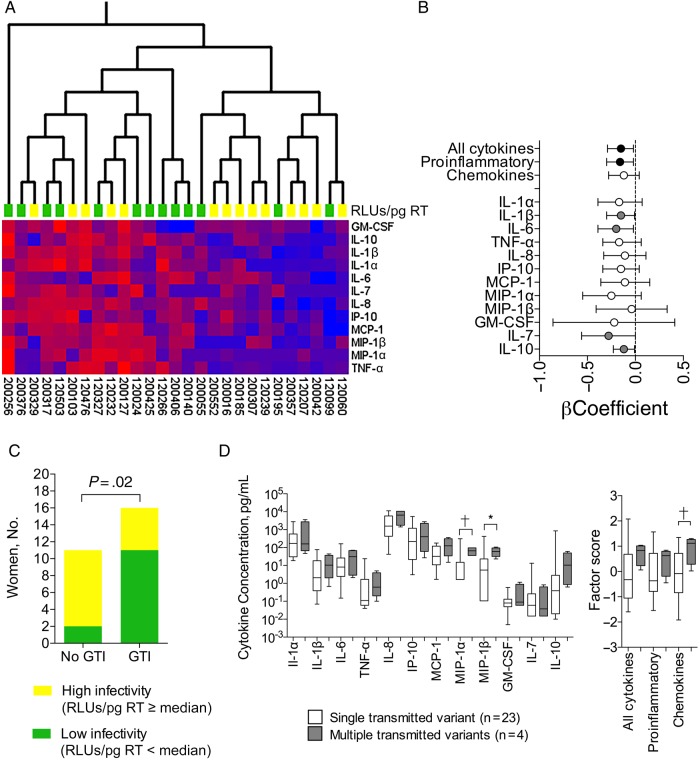
Preinfection genital inflammation was associated with acquisition of less infectious human immunodeficiency virus (HIV). A, Unsupervised hierarchical clustering was used to visualize the variation in cytokine concentrations in individual women and to cluster women according to the similarities of their cytokine expression profiles (using Qlucore Omics Explorer software, version 3.0). Women from whom less infectious viruses were isolated (value below median for relative light units per picogram of reverse-transcriptase [RLUs/pg RT]; n = 13; green blocks) had up-regulated cytokine concentrations in preinfection cervicovaginal lavage (CVL) samples and tended to cluster together. Women from whom highly infectious viruses were isolated (RLUs/pg RT at or above the median) had lower cytokine concentrations and also clustered together (n = 14; yellow blocks). Cytokine concentrations are indicated using a color scale, ranging from blue (low) to red (high). The dendrogram above the heat map illustrates degrees of relatedness between genital cytokine profiles evident among the various women. Patient identity numbers are indicated below the heat map. B, RLUs/pg RT and cytokine concentrations were either log10-transformed or converted to categorical variables (MIP-1α, MIP-1β, GM-CSF, and IL-7), and β coefficients were calculated using linear regression. Factor scores for each functional group of cytokines were generated using confirmatory factor analysis. Circles indicate β coefficients from regression analyses; error bars, 95% confidence intervals. Black circles indicate associations between cytokine factors and RLUs/pg RT that were statistically significant (unadjusted P < .05); gray circles, associations between individual cytokines and infectivity that were statistically significant before adjustment for multiple comparisons. Regression analyses were adjusted for potential confounders, including tenofovir or placebo assignment, virus subtype, tropism, time between infection and virus isolation, age, hormonal contraceptive use, number of sex acts per month, and herpes simplex virus 2 status. C, To estimate baseline levels of inflammation, cytokine factor scores including all 12 cytokines were calculated for 27 HIV-infected women and 54 uninfected controls. Women with cytokine scores at or above the median were considered to have genital inflammation, and those with scores less than the median did not. High- and low-infectivity viruses were defined as those with RLUs/pg RT at or above the median or below the median, respectively. P values were calculated using the Fisher exact test. GTI, genital tract inflammation. D, Relationship between cytokines and multiple variant transmission. Box-and-whisker plots show medians with ranges of cytokine concentrations and factor scores. Mann–Whitney U test was used to compare cytokine concentrations and factor scores between women infected by single (n = 23; white boxes) or multiple (n = 4; gray boxes) HIV variants. *Statistically significant before but not after adjustment for multiple comparisons. †Statistically significant (cytokine factors) or significant after adjustment for multiple comparisons (cytokines). P values for cytokine comparisons were adjusted for multiple comparisons using a false discovery rate step-down procedure. Abbreviations: GM-CSF, granulocyte-macrophage colony-stimulating factor; IL-1α, IL-1β, IL-6, IL-7, IL-8, and IL-10, interleukin 1α, 1β, 6, 7, 8, and 10; IP, interferon γ–inducible protein; MCP, monocyte chemoattractant protein; MIP, macrophage inflammatory protein; TNF, tumor necrosis factor.

References

    1. Abrahams MR, Anderson JA, Giorgi EE et al. . Quantitating the multiplicity of infection with human immunodeficiency virus type 1 subtype C reveals a non-Poisson distribution of transmitted variants. J Virol 2009; 83:3556–67. - PMC - PubMed
    1. Haaland RE, Hawkins PA, Salazar-Gonzalez J et al. . Inflammatory genital infections mitigate a severe genetic bottleneck in heterosexual transmission of subtype A and C HIV-1. PLoS Pathog 2009; 5:e1000274. - PMC - PubMed
    1. Carlson JM, Schaefer M, Monaco DC et al. . HIV transmission: selection bias at the heterosexual HIV-1 transmission bottleneck. Science 2014; 345:1254031. - PMC - PubMed
    1. Deymier MJ, Ende Z, Fenton-May AE et al. . Heterosexual transmission of subtype C HIV-1 selects consensus-like variants without increased replicative capacity or interferon-α resistance. PLoS Pathog 2015; 11:1–22. - PMC - PubMed
    1. Boeras DI, Hraber PT, Hurlston M et al. . Role of donor genital tract HIV-1 diversity in the transmission bottleneck. Proc Natl Acad Sci U S A 2011; 108:E1156–63. - PMC - PubMed