


Effects of Curcuma xanthorrhiza Extracts and Their Constituents on Phase II Drug-metabolizing Enzymes Activity
- PMID: 27695274
- PMCID: PMC5004525
- DOI: 10.4103/0974-8490.188873
Effects of Curcuma xanthorrhiza Extracts and Their Constituents on Phase II Drug-metabolizing Enzymes Activity
Abstract
Background: Curcuma xanthorrhiza is a native Indonesian plant and traditionally utilized for a range of illness including liver damage, hypertension, diabetes, and cancer.
Objective: The study determined the effects of C. xanthorrhiza extracts (ethanol and aqueous) and their constituents (curcumene and xanthorrhizol) on UDP-glucuronosyltransferase (UGT) and glutathione transferase (GST) activities.
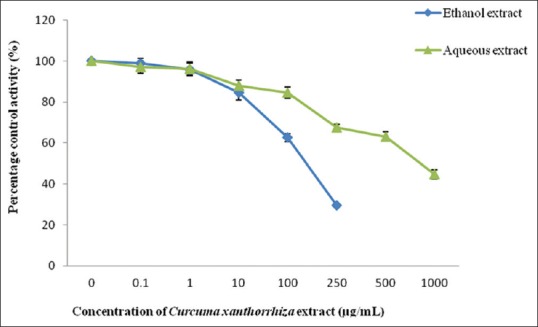
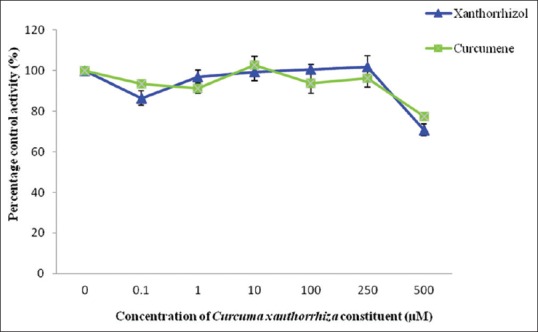
Materials and methods: The inhibition studies were evaluated both in rat liver microsomes and in human recombinant UGT1A1 and UGT2B7 enzymes. p-nitrophenol and beetle luciferin were used as the probe substrates for UGT assay while 1-chloro-2,4-dinitrobenzene as the probe for GST assay. The concentrations of extracts studied ranged from 0.1 to 1000 μg/mL while for constituents ranged from 0.01 to 500 μM.
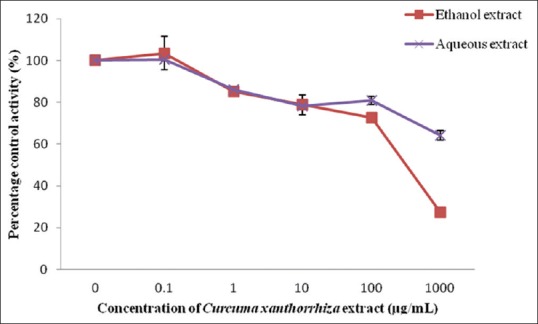
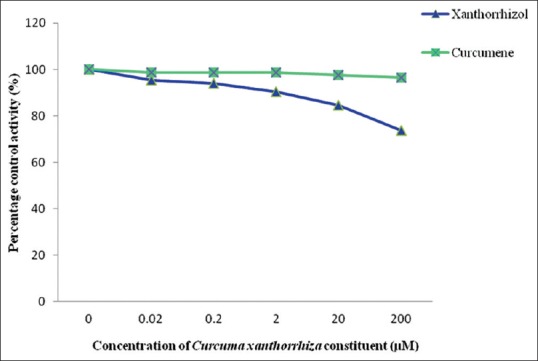
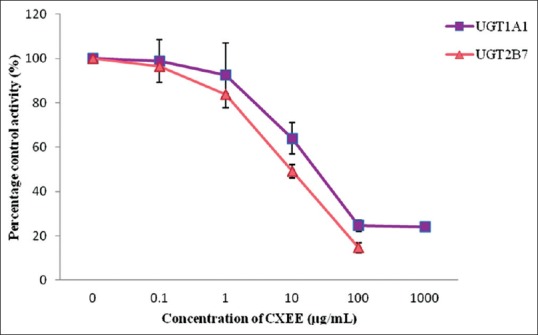
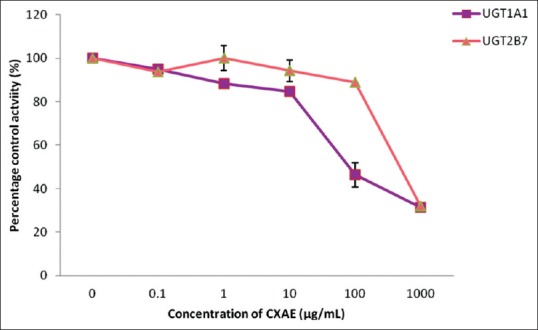
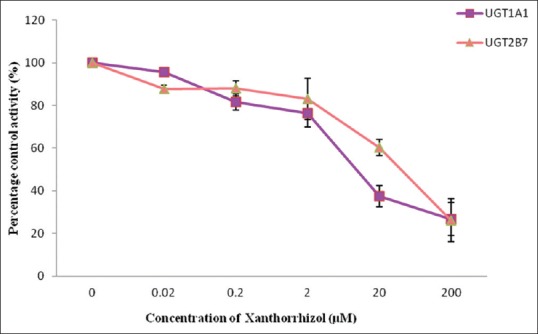
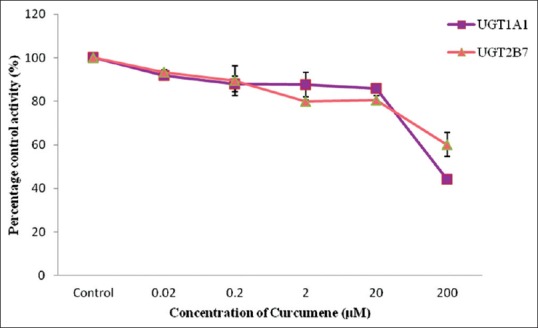
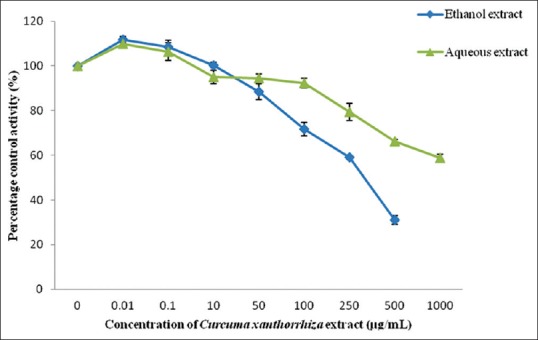
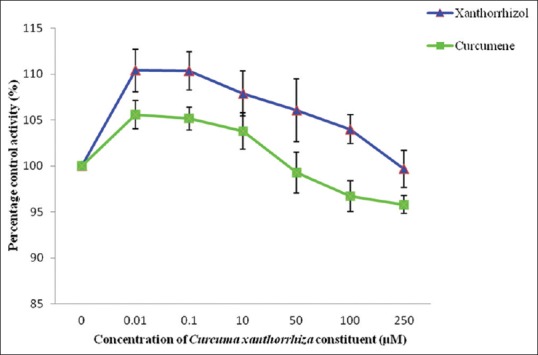
Results: In rat liver microsomes, UGT activity was inhibited by the ethanol extract (IC50 =279.74 ± 16.33 μg/mL). Both UGT1A1 and UGT2B7 were inhibited by the ethanol and aqueous extracts with IC50 values ranging between 9.59-22.76 μg/mL and 110.71-526.65 μg/Ml, respectively. Rat liver GST and human GST Pi-1 were inhibited by ethanol and aqueous extracts, respectively (IC50 =255.00 ± 13.06 μg/mL and 580.80 ± 18.56 μg/mL). Xanthorrhizol was the better inhibitor of UGT1A1 (IC50 11.30 ± 0.27 μM) as compared to UGT2B7 while curcumene did not show any inhibition. For GST, both constituents did not show any inhibition.
Conclusion: These findings suggest that C. xanthorrhiza have the potential to cause herb-drug interaction with drugs that are primarily metabolized by UGT and GST enzymes.
Summary: Findings from this study would suggest which of Curcuma xanthorrhiza extracts and constituents that would have potential interactions with drugs which are highly metabolized by UGT and GST enzymes. Further clinical studies can then be designed if needed to evaluate the in vivo pharmacokinetic relevance of these interactions Abbreviations Used: BSA: Bovine serum albumin, CAM: Complementary and alternative medicine, cDNA: Complementary deoxyribonucleic acid, CDNB: 1-Chloro-2,4-dinitrobenzene, CuSO4.5H2O: Copper(II) sulfate pentahydrate, CXEE: Curcuma xanthorrhiza ethanol extract, CXAE: Curcuma xanthorrhiza aqueous extract, GC-MS: Gas chromatography-mass spectroscopy, GSH: Glutathione, GST: Glutathione S-transferase, KCl: Potassium chloride, min: Minutes, MgCl2: Magnesium chloride, mg/mL: Concentration (weight of test substance in milligrams per volume of test concentration), mM: Milimolar, Na2CO3: Sodium carbonate, NaOH: Sodium hydroxide, nmol: nanomol, NSAIDs: Non-steroidal antiinflammatory drug, p-NP: para-nitrophenol, RLU: Relative light unit, SEM: Standard error of mean, UDPGA: UDP-glucuronic acid, UGT: UDP-glucuronosyltransferase.
Keywords: Curcuma xanthorrhiza; UDP-glucuronosyltransferase; glutathione transferase; xanthorrhizol.
Figures

References
-
- Sears B. Anti-Inflammation Zone – Reversing the Silent Epidemic That's Destroying Our Health. New York, USA: HarperCollins Publishers; 2005. pp. 75–87.
-
- Ruslay S, Abas F, Shaari K, Zainal Z, Maulidiani, Sirat H, et al. Characterization of the components in the active fractions of health gingers (Curcuma xanthorrhiza and Zingiber zerumbet) by HPLC-DAD-ESIMS. Food Chem. 2007;104:1183–91.
-
- Pan Y, Tiong KH, Abd-Rashid BA, Ismail Z, Ismail R, Mak JW, et al. Effect of eurycomanone on cytochrome P450 isoforms CYP1A2, CYP2A6, CYP2C8, CYP2C9, CYP2C19, CYP2E1 and CYP3A4 in vitro. J Nat Med. 2014;68:402–6. - PubMed
-
- Ab-Halim MR, Tan MS, Ismail S, Mahmud R. Standardization and phytochemical studies of Curcuma xanthorrhiza Roxb. Int J Pharm Pharm Sci. 2012;4:606–10.
LinkOut - more resources
Full Text Sources
Other Literature Sources
Research Materials
Miscellaneous