


Comment
doi: 10.1016/j.trecan.2015.10.008.
Epub 2015 Nov 26.
RNA Editing Dynamically Rewrites the Cancer Code
Affiliations
- PMID: 27695712
- PMCID: PMC5042206
- DOI: 10.1016/j.trecan.2015.10.008
Item in Clipboard
Comment
RNA Editing Dynamically Rewrites the Cancer Code
Trends Cancer.
2015 Dec.
Abstract
Global analyses of cancer transcriptomes demonstrate that ADAR (adenosine deaminase, RNA-specific)-mediated RNA editing dynamically contributes to genetic alterations in cancer, and directly correlates with progression and prognosis. RNA editing is abundant and frequently elevated in cancer, and affects functionally and clinically relevant sites in both coding and non-coding regions of the transcriptome. Therefore, ADAR and differentially edited transcripts may be promising biomarkers or targets for therapy.
Figures
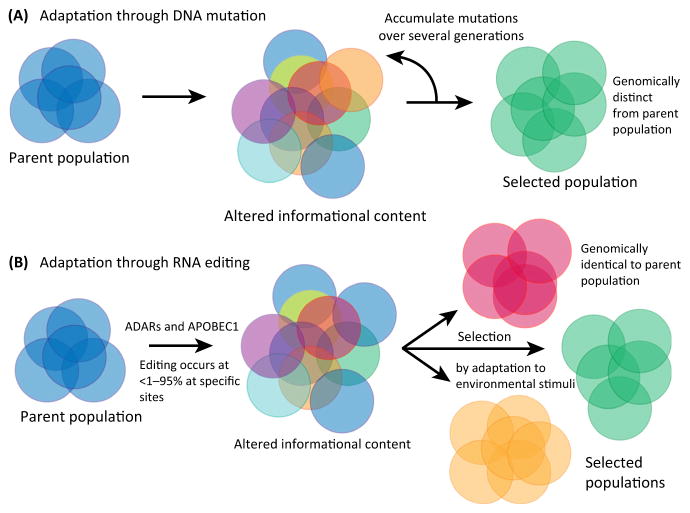
Adding RNA Editing to Current Paradigms of Cancer Progression. (A) Cancer model of DNA mutation, selection, and adaptation. (B) RNA editing contribution to selection and adaptation. Abbreviations: ADAR, adenosine deaminase, RNA-specific; APOBEC1, apolipoprotein B mRNA editing enzyme, catalytic polypeptide-like 1.
Comment on
-
The Genomic Landscape and Clinical Relevance of A-to-I RNA Editing in Human Cancers.Cancer Cell. 2015 Oct 12;28(4):515-528. doi: 10.1016/j.ccell.2015.08.013. Epub 2015 Oct 1. Cancer Cell. 2015. PMID: 26439496 Free PMC article.
-
Principles Governing A-to-I RNA Editing in the Breast Cancer Transcriptome.Cell Rep. 2015 Oct 13;13(2):277-89. doi: 10.1016/j.celrep.2015.09.032. Epub 2015 Oct 1. Cell Rep. 2015. PMID: 26440892 Free PMC article.
-
Elevated RNA Editing Activity Is a Major Contributor to Transcriptomic Diversity in Tumors.Cell Rep. 2015 Oct 13;13(2):267-76. doi: 10.1016/j.celrep.2015.08.080. Epub 2015 Oct 1. Cell Rep. 2015. PMID: 26440895
References
-
- Paz-Yaacov N, et al. Elevated RNA editing activity is a major contributor to transcriptomic diversity in tumors. Cell Rep. 2015;13:267–276. - PubMed
-
- Fitzgerald LW, et al. Messenger RNA editing of the human serotonin 5-HT2C receptor. Neuropsychopharmacol. 1999;21:82S–90S. http://www.ncbi.nlm.nih.gov/pubmed/10432493. - PubMed
Publication types
MeSH terms
Substances
Grants and funding
LinkOut - more resources
Full Text Sources
Other Literature Sources
Research Materials